|
|
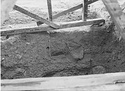
| Pyre in layer 2a in Room 9 SE of Greek House δ. Sand, gravel, ashes, iron nails, carbon, some bones partially cut away by foundation trench of SYPE wall.
Coin
1 July 1971 #459 ... 260-200 B.C ... P 6:6 ... P 6:6 |
Cut down through the west back foundation of the Royal Stoa immediately to the east of the 'Cave' ... Byzantine ... H 6:6 ... H 6:6 |
| Dorothy Burr Thompson ... Grave 27. In some records as Grave I bis. Bones discarded; nothing catalogued.
Notebook says: few burned bones, few burned sherds. Cf. negs. KK 228, KK 237 ... Probably Late Geometric or Early Geometric I ... D 6:6 ... D 6:6 |
Early Roman pit at P/3-6/6,7
Layer 4a in Room 6 of Greek House δ, area P/2,3-6/6,8.
Pit in NW corner of Room 6 bounded by walls of Room to North and West, cut into preexisting layers to east, cutoff by ... 17 May 1971 ... Early Roman Pit at P/3-6/6,7 |
Early Roman pit at P/7-6/4,6
layer Ia in Room 7 of Greek House δ. Black earth fill with much carbon.
Plaster, nails, glass, bones (also bones from deposit P 6:4).
Coin
5 June 1971 #395 ... Early Roman ... P 6:3 ... P 6:3 |
Pyre at N/9-6/1,2, layer 11a.
No formal limits, apparent limits about 0.30-0.40m N-S; 0.50-0.60 E-W (cut into by trench at east) ... Late 575-550 B.C ... Pyre at N/9-6/1,2, layer 11a.
|
| "Koumanoudes' Well.
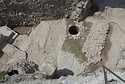
Tile-lined well (diam. 0.85m) at SE corner of courtyard of Roman House E, at top built wall of stones and mortar, bedrock at bottom. Coin
7 August 1971 #495-#500
13 August 1971 #507 ... 28 July-6 August 1971 ... Q/14-6/11 |
| Pyre in layer 8a in SW corner of Room 7 of Greek House δ.
Oval pyre; 0.60 (n-s)x 0.35 (e-w).
The pyre was covered by the surface of layer 8 and extended slightly into layer 9 below it. Small bone fragments, ... 325-300 B.C ... Hesperia Suppl. 47 (2013), no. 1, pp. 98-100, figs. 6, 7, 15-18. |
Turkish bothros/unlined pit at P/1-6/5 (now Ο/20-6/4).
Fill: soft, moist greenish-yellow clay with distinctive/definitive odor. No containers. Grid correction: from P/1-6/5 to Ο/20-6/4 ... 17 April 1970 ... P 6:1 ... P 6:1 |
Layer 7 in South Peristyle of court of Roman House Ε. Irregular cutting in bedrock with sand, gravel, fallen bedrock. Some burning ... 275-250 B.C ... Q 6:5 ... Q 6:5 |
Top slightly broken by 19th century disturbance. Built of soft mortar and stones, lined with stucco. Diameter at bottom (inside) 1.05m; at (maximum) center 1.18m.
Fill soft and green with consistency of ... 16th-17th century A.D ... Q 6:1 ... Q 6:1 |
Amphora dump at P/2,3-6/6,8.
Layer "8b" in Room 6 of Greek House δ.
Trench cut into lower levels next to west wall of Room 6. Fragments of amphorai, tiles.
No coins ... Early Hellenistic ... P/2,3-6/6,8 |
(see H 5-6) Asterisk: H 6:2* ... H 6:2 ... H 6:2 |
(see H 5-6) Asterisk: H 6:3* ... (see H 5-6) ... Asterisk: H 6:3* |
(see H 5-6) Asterisk: H 6:8* ... H 6:8 ... H 6:8 |
Unlined Pit at N/9-6/3,4 partially cut into wall of Mudbrick Pithos (N 6:1). Dimensions 1.20x 2.m.
Soft green-gray with wet sandust consistency. Large number of sea shells, fish and animal bones. No pottery, ... Turkish ... Unlined Pit at N/9-6/3,4 partially cut into wall of Mudbrick Pithos (N 6:1). |
Cistern at 14/Κ. (now H 6:9) Asterisk: G 6:1* ... Cistern at 14/Κ. (now H 6:9) ... Asterisk: G 6:1* |
| Pyre in layer "9d" in SW corner of Room 6 of Greek House δ. Ashes and fragments of small bones ... Ca. 225 B.C ... Pyre in layer "9d" in SW corner of Room 6 of Greek House δ. |
Cancelled Asterisk: C 19:6* ... C 19:6 ... C 19:6 |
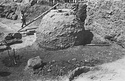
Mudbrick Pithos at N/8-6/3.
Constructed in conical shape of mudbricks, including the floor. Top cut by modern basement wall. Diameter at floor 1.45m Coin
30 May 1930 #113 ... Byzantine ... Mudbrick Pithos at N/8-6/3.
Constructed in conical shape of mudbricks, including the floor. |
Trench at O/7,8-6/1,5. Layer 5 of Trench A cut in Rooms 1 and 2 of Greek House γ. Soft green clay with bones, ash, much pottery. Probably leveling fill ... Archaic ... Trench at O/7,8-6/1,5. Layer 5 of Trench A cut in Rooms 1 and 2 of Greek House γ. |
A very homogeneous dumped filling and no period of use. Apparently a failure as a well.
T 263-T 289 resorted and reduced August 1967. Cf. BI 157 "from behind the curbing of the well by Stoa pier 3." Estimated ... Ca. 470-460 B.C ... H/15,16-6/6,7 |
(now O 9:1) Asterisk: O 8:6* ... O 8:6 ... O 8:6 |
Now C 20:2 Asterisk: B 20:6* ... Asterisk: B 20:6* |
The West Chamber of a double cistern lying between the northeast corner of the Theseion and the Annex to the Stoa of Zeus Eleftherios. ... Both chambers went out of use as water containers simultaneously ... 225-165 B.C ... Group C.
See G 6:2. The following objects are published together with those from G 6:2 but were found in the west chamber of the cistern system: A 230, P 366, P 367, P 403-P 407, P 2387-P 2393, L 459, L 461, L 462, L 464, L 1114, L 1115, T 133, T 134. They are listed under deposit G 6:2 and not duplicated here. |
East Chamber of Cistern System #2. The fill in layers, but probably a destruction fill with layering not significant. Coins:
4 May 1936 #1-#6
5 May 1936 #1-#7
6 May 1936 #2-#6
LRD pottery and gouged ware ... Late 5th-early 6th c. A.D ... D 6:1 ... D 6:1 |
| Classical dump at N/1,6-6/6,8.
Layer 14 in Early Trench E. A tremendously thick layer of dumped fill with ceramic contents ranging down through the second half of the 5th century and into very early years ... Late 5th c. (Early 4th c.) ... N 6:3 ... N 6:3 |
Plaster dump at Q/2,5-6/7,9.
Layer 5 in "Wall Painted Room" of Roman House ε. Layer resting on bedrock and covered partially by good strosis (55.26m.). Fill was red with mudbricks, tiles, much plaster ... Late 1st-early 2nd c. A.D ... Q 6:2 ... Q 6:2 |
Joins occur between this pit and the cistern in section ΛΛ (87/ΛΕ)
(E 5:3). Coins:
16 May 1936 #6 ... Byzantine ... Coins:
16 May 1936 #6 |
The East Chamber of a double cistern lying between the northeast corner of the Theseion and the Annex to the Stoa of Zeus Eleftherios. ... Both chambers went out of use as water containers simultaneously ... Ca. 200 B.C ... The following objects are published together with those from G 6:2 but were found in the west chamber of the cistern system which is deposit F 6:3: A 230, P 366, P 367, P 403-P 407, P 2387-P 2393, L 459, L 461, L 462, L 464, L 1114, L 1115, T 133, T 134.
|
P.H. 1.98m; greatest diameter 1.70; wall thickness 0.20. The walls are of rubble set in clay, and the bottom is flat. Pottery was coarse Byzantine sherds but discarded except for one graffito ... 25 May 1956 ... B 15:6 ... B 15:6 |
| A cave-in not long after the digging of this shaft destroyed its possible usefulness as a well and thereafter it was used as a dump. Two principle periods of such use were noted, and within these several ... Ca. 575-480 B.C ... This was sorted all together, and regrouped by "Kind', lettered under these numbers, as follows (6 tins).
a) Large black glaze amphora; other large pots.
b) Wine jars; black glaze.
c) Cooking ware.
d), e), f) Roof tiles, pithoi, tubs.
|
Cistern System #3: West Chamber at 69/ΛΣΤ, joined by a crooked passage to 69/Λ. Under the southwest corner of the Hellenistic Building to the north of the Temple of Hephaistos. Upper fill of early 1st ... 175-125 B.C ... E 6:2 ... E 6:2 |
Cistern-system west of the Stoa of Zeus. Two chambers connected by a tunnel, each with two fills. Lower fill in south chamber contemporary with upper fill in north chamber, at the end of the 4th c. B.C ... Ca. 375-160 B.C ... Hesperia 6 (1937), pp. 207-208. |
Indicated as "Grave 6" in notebook but recognized as not a grave: "probably a rubbish pit" [deposit notebook summary]. Concentration of pottery, burning, animal bones, snail shells and seashells, probably ... Late 4th-early 3rd c B.C ... Indicated as "Grave 6" in notebook but recognized as not a grave: "probably a rubbish pit" [deposit notebook summary]. |
| Stephen G. Miller ... Irregular circular tomb (Diam. 2.20-2.60) with blocked dromos to northwest. Top of tomb lost in Archaic grading of area, center disturbed by Byzantine pit, overbuilt by northern-eastern walls of Room 3 ... LH III ... Q 6:3 ... Q 6:3 |
| Unfinished well-shaft with debris filling (apparently of the Sullan sack), on the lower NW slopes off the Areopagus. Abandoned due to poor quality of bedrock.
Three closely contemporary fills, considered ... End 2nd c. B.C.-second quarter 1st c. B.C ... Coins:
11 May 1939 #6 |
Well dug through bedrock-settling basin of cistern at 69/ΜΗ. Coins:
21 May 1936 #24-#26
22 May 1936 #14
29 May 1936 #2-#4
2 June 1936 #1-#3
3 June 1936 #2-#4
4 June 1936 #4-#6 Cf. also container ΚΚ 336 ... 3rd c. A.D ... D 6:7 ... D 6:7 |
4th century sandy fill west of Peribolos of the Twelve Gods, with animal bones, metal waste and much pottery. Estimated Grid ... 350-325 B.C ... K 6:2 ... K 6:2 |
West Chamber of Cistern System #2. This chamber filled earlier than the East Chamber. No stratification but at 3.80m. considerable pottery of the late 5th c. B.C., as in 60/ΛΗ cistern, presumably a portion ... First half of 3rd c. A.D ... Coins:
29 April 1936 #18
6 May 1936 #1 |
Found while excavating Stoa Pit E in 1933. See also I 849 (Ε 329) found in the North Well in Stoa Pit E (Deposit H 9:1). Fragment Ε 496 of this inscription, listed with the finds of H 10:6, is likely from ... 8-10 May 1933
17 May 1935
18-26 May 1937 ... H 10:6 ... H 10:6 |
Well or Pit at ΓΓ:65/Ν or ΓΓ:65/ΝΔ (area 64-70/ΝΒ-ΝΖ).
Objects P 14805, P 14939 and P 14940 are noted on page E 19:6 as at top of well at 65/Ν, but are recorded in Deposit E 19:7.
Otherwise, no container, ... 19 April 1936 ... Objects P 14805, P 14939 and P 14940 are noted on page E 19:6 as at top of well at 65/Ν, but are recorded in Deposit E 19:7.
|
Investigations within the Stoa of Zeus, the north part, various levels.
Notebook references: Stoa Trench E Layers IV and V, Stoa Pits A, B and C, and Layers I and II of area between back wall and retaining ... 5th c. B.C ... H 5-6 ... H 5-6 |
Estimated Grid ... Ca. 510-480 B.C ... G/7,8-6/4,5 |
Containers Lot Α 306-Lot Α 340. Estimated Grid ... Ca. 575-535 B.C ... G/7,8-6/4,5 |
Square pit in bedrock southwest of the Hephaisteion. Many marble chips from the construction of the temple of Hephaestus were found here together with a large quantity of pottery and other objects ... Ca. 450 B.C.
Ca. 390-380 B.C ... C 9:6 ... C 9:6 |
| Pyre in House N, room 4 (RSY=Pyre 7), in the industrial area west of the Areopagus.
Pottery, mall pieces of calcined bone, log, wood cinders, and charcoal in diamond-shaped pit in floor sequence. The pyre ... Late 4th-early 3rd c. B.C ... Layer 4 ran over the foundation of the wall between rooms 5 and 6; a layer of decayed mudbrick covered layer 4. |
Rectangular shaft at northwest foot of Areopagus; dumped filling of second half of 4th c. B.C. Pit at 16/Δ-Ε recorded one time as an extension of shaft 17/Δ-Ε (see L 506 and nb.p. 395), but items from ... Ca. 325-275 B.C ... F 16:6 ... F 16:6 |
| Roasting pits associated with the archaic buildings which preceded the Tholos ... Ca. 500-470 B.C ... G 11:6 ... G 11:6 |
Hellenistic filling at NE corner of section. Estimated Grid ... Hellenistic ... G 13:6 ... G 13:6 |
Two narrow trenches at right angles to each other.
Small deposit in bedrock cutting Good black glaze ware ... 430-420 B.C ... G 14:6 ... G 14:6 |
Filling on bedrock.; accumulation extending to about the middle of the 6th c. with earlier material. Some later intrusions to late Roman (?) ... Ca. 600-550 B.C ... G 15:6 ... G 15:6 |
A dumped filling including red figured fragments of the second quarter of the 4th c. B.C. Coins:
25 June 1931 #12 (in strosis above pottery deposit) 15 November 1952, going through the containers Tin 59-Box ... Ca. 375-350 B.C ... H 6:1 ... H 6:1 |
A well behind the Stoa of Zeus. Noted as the finding place of the bronze head of Nike, B 30.
Two Rhodian stamped amphora handles. Fragments of only two bowls ... 260-210 B.C ... H 6:4 ... H 6:4 |
| "From the phot. and description, p. 555, this appears to be a built pithos, rather than a cistern." [deposit nb] Grid 30/ΙΔ also mentioned ... 28 July-3 August 1931 ... H 6:7 ... H 6:7 |
Includes container 202 "quarry waste" ... Ca. 225-160 B.C ... H 6:9.1 ... H 6:9.1 |
Including the passage between the south and north chambers ... Ca. 325-270 B.C ... H 6:9.2 ... H 6:9.2 |
| Rubbish Dump in mouth of abandoned well in Tholos Trench F, Kitchen. Filled with ash, charcoal, broken pottery, roof tiles.
Also from Trench L.
13 March 2014 by Ann Steiner
The deposit has four components ... Ca. 425-400 B.C ... H 12:6 ... H 12:6 |
| Laura Gawlinski ... Well in courtyard of Early Building I, adjacent to wall of Room B. Tile lined; upper course in situ, lower two collapsed probably in antiquity. Letters inscribed on rims (eta, phi, omicron, theta). Medium ... First quarter of the 4th c. B.C ... H 13:6 ... H 13:6 |
Pit at 9/Ε Coins:
7 March 1933 #15-#23 ... Classical to Turkish ... R 13:6 ... R 13:6 |
Flask-shaped cistern (1959) (Cistern under Room 4 in NE corner of Section). Upper filling soft silt with a little pottery. Lower filling hard silt, almost no pottery.
1.35m in diameter at the floor with ... End of the 4th c. B.C ... R 17:6 ... R 17:6 |
Well at 9/ΛΔ, left unfinished. Coins
27 May 1938 #1 (sand at top) M.C. suggests date as second half of 6th c. (March 1956), p. 1052.
No containers ... 550-500 A.D ... S 19:6 ... S 19:6 |
Well L: Early Byzantine ... Early Byzantine ... S 27:6 ... S 27:6 |
S.W. of Archaic Temple : Pocket in bedrock. The pocket was cut through a red clay floor. 71 sherds.
Objects: loom weights; lamp.
Early ware: Gray Minyan; Mycenaean; Protogeometric-Late Geometric; Subgeometric; ... Early 6th c. B.C. and earlier ... T 19:6 ... T 19:6 |
Well 14: Turkish Coins
17 March 1939 #4-#5 Pottery not sorted (March 1940) ... Early Turkish ... T 24:6 ... T 24:6 |
Well 21: Neolithic ... 17-19 April 1939 ... T 26:6 ... T 26:6 |
Turkish well at 71/ΚΘ No coins noted ... Turkish ... M 17:6 ... M 17:6 |
| Grave 3 in notebook. Outside Archaic cemetery, inhumation burial. Deposit list says black glaze pithos (P 8922) containing the bones of a child and four small vases. The pithos lay on its side with the ... Last quarter of 6th century B.C ... M 18:6 ... M 18:6 |
Grave 12 ... Dark Ages - Byzantine ... M 23:6 ... M 23:6 |
Well at 71/ΛΒ (diameter ca. 1.10m) near the east wall of the entrance porch.
Narrows toward bottom, collapsed at top. Six footholds preserved at south, three at north, spaced at ca. 0.50m. Uniform fill ... Late 8th in early 4th c. B.C ... N 11:6 ... N 11:6 |
House C, Room 5, small hoard. Deposit created by A.W. and first appears in his thesis (Biblio. below).
"Another small hoard or purse of Herulian date", A.Walker (1980), p. 127. Coins:
23 June 1947 #7-#13 ... Ca. 267 A.D ... D 18:6 ... D 18:6 |
Cistern System #3: East Chamber at 69/Λ, joined by a crooked passage to 69/ΛΣΤ. Under the southwest corner of the Hellenistic Building to the north of the Temple of Hephaistos ... 175-125 B.C ... E 6:1 ... E 6:1 |
Within the precinct of the Hephaisteion, about 10m. north of the north stylobate of the temple.
Flask-shaped pit (W. (bottom) 3.14 x 2.73m) probably originally intended as a cistern; used for dumping ... Ca. 375-310 B.C.-Byzantine ... E 6:3 ... E 6:3 |
Byzantine, 4th c. A.D ... E 6:3.1 ... E 6:3.1 |
Coins:
27 May 1936 #1-#2 ... 25-27 May 1936 ... E 6:3.2 ... E 6:3.2 |
Ca. 375-310 B.C ... E 6:3.3 ... E 6:3.3 |
Pit near SW corner of Hellenistic Bldg. The object catalogued is one of three TC molds found at the location ... 5th.-4th. c. B.C ... E 6:5 ... E 6:5 |
Grave in south peristyle of Hephaisteion. Grave LVII in notebook.
No mention of bones. Coins:
10 March 1939 #2 Neg. KK 389 ... 9-11 March 1939 ... E 7:6 ... E 7:6 |
Upper fill was early Roman dated by AWP to the 1st c. A transitional fill was later assigned to the upper level.
Nbp. 2913: The history may have been that the well was cleaned out at the time that it was ... 3rd-2nd century B.C and Roman date ... E 14:6 ... E 14:6 |
From cleaning of scarp at K/6,7-1/12,13, from area of large Frankish pit. Coins:
21 July 1994 #1072-#1078 ... Islamic ... K 1:6 ... K 1:6 |
East of Classical Building II backwall, above Mycenaean chamber tomb K 2:5. Rough circular pit of reddish brown fill cut into geometric fill that extends down inside tomb. Some evidence of burning on pottery ... Ca. 460 B.C ... K 2:6 ... K 2:6 |
Diameter of top of well 0.80m.
An early well east of Roman Building, north of Temple of Ares and thus in the region of the Mycenaean cemetery. Sherds almost entirely Mycenaean with nothing later and a ... Mycenaean ... K 6:1 ... K 6:1 |
Pithos at NE corner of Byzantine Building. Coins:
20 May 1938 #1, #3 ... Late 11th-Early 12th c. A.D ... K 6:3 ... K 6:3 |
Found while cleaning wall running east-west over 57. Contained late glazed pottery ... Byzantine ... K 6:4 ... K 6:4 |
| The cistern was lined with stones at the top with an opening 0.80 m in diameter. For the most part, it seemed to cut into bedrock except along its northern edge where some 5th c. B.C fill remains and main ... 2-19 July 2010 ... L 2:6 ... L 2:6 |
Coins:
30 May 1933 #19 ... Turkish ... L 6:1 ... L 6:1 |
| Well O: EG. AS 875-878 ... Middle Geometric ... L 6:2 ... L 6:2 |
| Cistern with dumped filling, second quarter of 4th c. B.C. Also Lot Φ 187bis (selected coarse).
No coins ... Ca. 375-350 B.C ... L 17:6 ... L 17:6 |
| Grave VII in notebook = RSY Grave 21. PD 731-k ... Date uncertain, presumably 7th. or 6th. c. B.C ... B 21:6 ... B 21:6 |
| Dorothy Burr Thompson ... Grave 14 in notebook. Cutting in bedrock. Cremation: bones in pit (E.L. Smithson: Grave XXIV: PG). Bones discarded.
[JP] Nb. says at 16-17/ΞΖ and 16/ΞΖ on cards and on deposit list.(SD) ... Early Geometric I ... C 8:6 ... C 8:6 |
Cut to east of Exedra. Accumulated road packing between the Stoa of Zeus and the early altar to the east, various levels and dates, as late as early as 6th c. B.C. and as late as 5th c. A.D ... 15-17 April 1935 ... I 6:1 ... I 6:1 |
Late pit in bedrock ... Late Byzantine-Turkish? ... I 6:2 ... I 6:2 |
Cistern Shaft at 61/Β and south passage to E.W. drain.
Part of H-I 16-17 system. Coins:
8 April 1932 #14
9 April 1932 #1-#8
11 April 1932 #1-#3
12 April 1932 #1 ... 8-16 April 1932 ... I 16:6 ... I 16:6 |
| Marcie Handler ... The remnants of a disturbed pyre in a layer of dumped Hellenistic fill. The fill was found in the area on top of and east of the eastern wall of the Classical Commercial Building at its north end. Fragmentary ... Ca. 225 B.C ... J 1:6 ... J 1:6 |
Pocket in bedrock 35/Ε. The filling consisting chiefly of coarse ware and roof tiles; some of the material Archaic, but the deposit as late as the mid-5th c. B.C ... Ca. 500-450 B.C ... N 18:6 ... N 18:6 |
Cistern at 60/ΙΕ; bell-shaped cistern with a channel 1.65m high and 4.60m long, leading to a dead end against bedrock. This channel runs north with a slight curve to the east and looks as though it was ... Second half of 3rd c. B.C.-Early 2nd c. B.C ... N 20:6 ... N 20:6 |
| Eugene Vanderpool ... Grave. Bones discarded.
Burial lies over dromos of Mycenaean chamber tomb N 21-22:1. The roots of a tree had upturned the bones, but the head probably lay at the northeast ... Middle Geometric II ... N 21:6 ... N 21:6 |
| Eugene Vanderpool ... Grave (E.L. Smithson: Grave XXXVIII: PG)
Shallow oval cutting in natural bedrock lintel of Mycenaean chamber tomb O 7:5, containing a large two-handled cooking pot. Within, the unburned bones of a foetal ... Developed-Later Protogeometric ... O 7:6 ... O 7:6 |
| Gerald V. Lalonde ... Urn cremation (trench-and-hole), adult female with fetus/neonate. One box with burnt animal bones is stored with the skeleton AA 302 in drawer 97.
Objects also recorded frm Section ΣΤ. PD 1692, PD 1807 ... Early Geometric II, 850 B.C ... H 16:6 ... H 16:6 |
Pocket in bedrock, 50/Λ (= Trench, 50-54/Λ), measuring 4.00x0.60m, 0.60-0.90m deep; possibly cutting for wall foundation Coins:
22 April 1932 #1 ... 330-300 B.C ... H 17:6 ... H 17:6 |
|
|