|
|
Destruction fill in octagonal room of Gymnasium and Rooms to North; also basement room F of late Roman Gymnasium ... Late Roman ... Agora XXXIV, pp. 14-15, 184. |
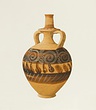
The almost complete red figure hydria set into this cutting suggests the possibility of a 5th c. burial put into a much earlier grave cutting; however, the remainder of the filling appears thoroughly disturbed ... 450-425 B.C- Late Roman disturbance |
Cistern at 21/ΙΗ
Period of use fill dated to ca. 375-350 B.C., Upper fill dated to mostly first half of 6th c. B.C. in Agora XXX ... Ca. 375-350 B.C. |
Gravel above early road some 5m wide. The bedrock was heavily scored by traffic, and the accumulation of gravel, ca. 0.30m, thick produced Middle Helladic Pottery. This early thoroughfare ran in a northwest-southeast ... Middle Helladic |
Cistern on the lower south slope of Kolonos Agoraios; dumped filling, second half of first century after Christ. Coins:
9 June 1937 #3
11 June 1937 #1-#8 ... 50-100 A.D. |
Well at the southeast foot of Kolonos Agoraios.
Use filling of 1st c. A.D.; dumped fillings of 3rd c. and of early Byz. times. Coins:
15 June 1937 #1-#2 (earth)
16 June 1937 #14-#20 (earth)
17 June 1937 ... 1st c. A.D.=POU |
The well had two upper fills and a stratified deposit at the bottom. The well deposit is divided into two parts, 3rd. c. and 2nd. c. (with perhaps late 1st. c.).; dumped filling of 5th century. Coins: ... 1st.-3rd. c. A.D. |
| Report on sorting of pottery, August 1951, by H.S. Robinson [nb p. 3666].
Cistern discovered and dug to 1.60m., vi/10/36; dug to bottom iv/22/37-v/6/37. Diam. At mouth 0.26m.; neck begins to widen out ... 1st. c. B.C. to post-Herulian |
According to the excavator " a pre-herulian filling dumped in to fill the cistern some few years after the Herulian destruction". Coins:
10 June 1936 #2-#6
11 June 1936 #1-#19
12 June 1936 #23-#27 P 11936 ... A.D. 267 to mid 3rd c. |
Two periods of use.
Outside the SW corner of the market square, to the west of the north-south road; lower use of filling, of 1st to early 2nd c. A.D. Coins:
26 May 1937 #1 [to 8.30m.]
9 June 1937 #2-#4 ... 10 -11 June 1935
20 May-20 June 1937 |
| Extract from notebook ΠΘ XIX, pp. 3644-3646. Well at 105/ΝΗ (report on sorting of pottery, July 19, 1951 - H.S. Robinson).
"Not a useful well" HSR.
Well dug to 1.50m., vi/9/36; dug from 1.50m. to bottom ... Early Roman; use fillings of 2nd. c. B.C. and 1st. and 4th. c. A.D.; dumped filling of late 4th. c. (HSR)
Fill I: 2nd. c. B.C.
Fill II-V: to second half of 4th. c. A.D.
Fill VI: mixed to Byzantine. |
Filling in the footing trench of the late Roman Fortification.
Includes Layer 1 and Layer 2 of Library Colonnade opposite Room 2. "Note: both these layers are fill thrown into V.W. footing trench." (nb.p ... End 3rd. c. A.D. |
Well in the bottom of chamber cistern at 106/ΛΓ, stratified. A soft spot in the bedrock at the west side of the well caved in and was packed with typical coarse Roman first century amphoras; the well was ... A.D. 200-150 |
Located in the NE corner of the early peribolos. Probably originally 1.00-1.50m. deeper, the bedrock above having been cut back in late times. Scanty pottery remains; some evidence for a period of use ... Ca. 600-570 B.C. |
Silt fill of early road drain to North of SW Fountain House. Coins:
10 August 1961 #5 ... 325-275 B.C. |
Pit in deep depression in bedrock. Also includes containers from early fill under late Roman floors down to bedrock at 81-83/ΚΗ-ΛΒ. Notebook cites early fill, ca. 6th. c., with some obviously late disturbance ... 7th c. to ca. 575 B.C. |
Located in front of west end of Stepped Retaining Wall, Heliaia. Filled in and covered in last stages of grading of area after construction of Middle Stoa.
Pottery from settling basin nondescript. Single ... 175-150 B.C. |
Cutting in stereo. Early 4th c. fill with some Hellenistic-Early Roman disturbance ... Ca. 400-375 B.C. |
Fillings associated with Southwest and North Buildings (78-99/ΙΣΤ-ΚΘ) and early walls to west of Great Drain.
pottery p. 1189, vol VII ... Subdivisions:
.1=Filling over bedrock.
.2=Fillings behind retaining ... Various levels and dates |
Connected with G 14:3.
There was a layer of Late Roman fill. It rested over a layer of 2nd c. B.C Hellenistic and then another of 4th c. B.C Hellenistic; the passage between the two cisterns contained ... Late Hellenistic |
Well on south slope of Kolonos Agoraios. Use filling of late 1st. to late 2nd. c. A.D.; dumped filling of 4th. c. A.D. Coins:
24 April 1937 #2
27 April 1937 #6-#12
28 April 1937 #2
29 April 1937 #2
8 May ... 1st.-4th c. A.D ... Opait (2022), pp. 199, 200, 201, 207, figs. 11, 14 ... Agora V, p. 124 ... Agora VI, p. 98. |
Pottery Deposit at 57/ΙΔ (also 57/ΙΣΤ and 63-66/Κ-ΚΕ). Contents of pit range from Mycenaean to Turkish; apparently the dump of a modern antiquities dealer ... Modern Context |
Two narrow trenches at right angles to each other.
Small deposit in bedrock cutting Good black glaze ware ... 430-420 B.C. |
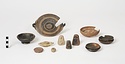
Small compact deposit. Cutting. High proportion of good black glaze; 21 loom weights (19 pyramidal, 2 lentoid); a very large red-figured skyphos somewhat recalls the style of earlier work of the Dinos ... Ca. 430-420 B.C. |
Nbp. 3104: When dug, the fill of the well divided itself into 3 deposits.
Objects catalogued from the "earth" are: L 4838, P 21602, P 21603, P 21604. Dumped filling of Turkish times. Coins:
17 May 1937 ... Late 6th-7th c. A.D. |
Patch of early fill, disturbed. 20/9/1962: Tin 145 is checked and is chiefly late archaic, but some of the coarse ware is late 5th with 4th c. B.C., and a few bits are 4th c. A.D ... Late 6th.-early 5th c. B.C. |
Small deposit in bedrock. Coins:
20 April 1936 #2-#3 ... 4th c. B.C. to early 3rd c. B.C. |
POU = 10.00-11.30m.
"The well is important because it gives us a terminus post quem for Building D." (nbp. 3346)
Shallow well, producing little water or trouble, but a great quantity of coarse late Roman ... Ca. A.D. 300-370 and Ca. A.D. 400 |
Tiled well near the SW corner of the market square between the Southwest Fountain House and the Great Drain, three fills noted: lower fill of earth and stones with a few fragments only of coarse pottery ... 4th-2nd c. B.C.
100-70 B.C. |
Ostrakon Pit (Horos Terrace Trench). Oval pit cut into bedrock. Packed filling of stones, coarse sherds and roof tiles; among these a few fragments of finer vases and 22 ostraka, probably from the ostracaphoria ... Ca. 490-480 B.C. and later |
Upper fill was early Roman dated by AWP to the 1st c. A transitional fill was later assigned to the upper level.
Nbp. 2913: The history may have been that the well was cleaned out at the time that it was ... 3rd-2nd century B.C and Roman date. |
Dumped debris filling east of East Building, badly shattered. There is a small amount of disturbance from the filling immediately above, but the bulk of the pottery is consistent, and very close to that ... Ca. 470-460 B.C. |
| A flask-shaped storage pit or cellar, cut in the rock at the south edge of the levelled top of Kolonos Agoraios. Filled late in first quarter of 6th. c. B.C. (2.95m from east to west by 2.70m from north ... First quarter 6th. c. B.C. |
Sculptor's Workshop at 37-40/Β-ΣΤ Coins
20 April 1933 #1-#20
21 April 1933 #37-#41
24 April 1933 #97-#100
1 May 1933 #5-#8
4 May 1933 #2
12 May 1933 #8-#9
15 May 1933 #8
S 343, S 407-S 413, S 390: Fragments ... Ca. 267 A.D. |
Abandoned digging at 12.85m. due to collapse of side walls. Well H contents probably thrown in to Well I during cleaning in early Roman times; the pottery from the two wells is similar. Cf. E 14:6 ... 350-250 B.C. |
Cistern at the southeast foot of Kolonos Agoraios.
Nbp. 2369: Two chamber cisterns, 88/ΛΔ and 100/ΚΘ, united by a long straight passage running almost due N-S. A draw shaft at 95/ΚΘ is set just off the ... Use filling of late 4th-early 3rd c. B.C.
Accumulative fillings of late 3rd-early 2nd and late 1st c. B.C.
Upper dumped filling of 3rd c. A.D. |
Cistern-shaft at the southeast foot of Kolonos Agoraios.
Nbp. 2369: Two chamber cisterns, 88/ΛΔ and 100/ΚΘ, united by a long straight passage running almost due N-S. A draw shaft at 95/ΚΘ is set just ... Upper fill, Late Roman with some Hellenistic.
Middle fill, Sullan debris to last quarter of 1st c. B.C.
Lower fill, 4th-3rd c. B.C.=POU and abandonment |
Gravel above cobbled street surface ... Second half 2nd c. B.C. |
Large pit in the bedrock over Wells H and I. Fill of the pit thrown in after filling of Well H, containing almost entirely coarse ware. First 4m of Well I, filling the same. Below that Well I fill similar ... Late Roman- 1st c. A.D. (mainly early ?) |
Coins:
15 March 1934 #6 ... 6th-7th c. A.D. |
Rectangular pit over bedrock in north part of E. Building. Broken jars and household basins with a few black glazed and black-figured fragments (uninventoried). The figured pieces indicate the lower limit ... Late 6th-ca. 480 B.C. |
Coins:
9 April 1937 #3-#4
10 April 1937 #3-#4
12 April 1937 #2
13 April 1937 #1-#3 ... Ca. 300-140 |
Well at 53/ΙΗ, east of the east Stoa Plateia. Diameter 1.40-1.50m. Shaft worked with chisel, tapers toward bottom. Plentiful water. Uniform fill with field-stones, perhaps including period of use ... 775-725 B.C. |
Upper part collapsed (diameter 1.25m). Uniform fill with water jars. Sorted June 1956. 4 tins thrown out. Joins from all boxes, but pithos fragments and water jars mostly from boxes 6-16 ... 750-700 B.C. |
Near the SW corner of the market square beneath the north part of the Heliaia (?).
No clear distinction in the filling, either of date or of character, could be observed but the presence of a number of ... Ca. 625-570 B.C. |
Rectangular Pit under House L, Room 2. Rubbish pit belonging to second phase of house ... 4th. c. B.C. |
Great Drain sand fill under Roman bath including small area at north end under tiles that was excavated separately.
See also A-B 19-20:1 for additional Great Drain sand fill at ca. 70-113/* Subdivisions: ... 30 July-11 August 1947 |
Chamber cistern at 95/Κ and Cistern shaft at 95/ΚΕ plus the passage between. System heavily disturbed throughout in Turkish times except for a small amount of red fill on floor of shaft. Coins:
4 May 1936 ... Hellenistic |
Mycenaean Deposit (Gully) in front of NE Stoa (corrected from P 7:1).
It consisted of a series of irregular pits, some gradually linked up with one another to form what seemed a natural gully. The largest ... Mycenaean IIIA-B |
Found in 13/06/1935.
Dumped filling in an unfinished well originally dug only to a depth of 5.50m. Probably a post-Persian cleanup, perhaps in one of the public buildings near the SW corner of the square ... Ca. 520-490 B.C. |
| Rodney S. Young ... Grave 7 in notebook (E.L. Smithson: Grave XXI: PG). Bones discarded. Disturbed and damaged cremation (originally trench-and-hole), the east end cut away, probably contained the burial urn.
JP
It consisted ... Late Protogeometric |
Fillings in and to the north of Building A/Poros Building/Greek Building ("Strategeion"), the accumulation mostly a late archaic dump, but not deposited till near the middle of the century. Most of the ... First half of 5th c. to ca. 460-450 B.C. |
| Grave XXVI in notebook = RSY Grave 12 ... Ca. 525-500 B.C. or sightly later |
| Artifacts, burnt bone, ash, cinders and charcoal in pit in bedrock. The pyre lay directly under mosaic floor A. the deposit is not badly disturbed, however, and it is possible that it was laid immediately ... Early second quarter of 4th c. B.C. |
| Pocket, identified as sacrificial pyre by SIR. Possibly disturbed. Outside south wall of building. Concentration of pottery in a small pocket below a "Hellenistic" fill. There is no mention of bone or ... First quarter 4th c. B.C. |
| Disturbed Pyre at 59/ΚΗ (ΚΖ), in the area of the Poros Building west of the Areopagus.
Against east wall of room 5 west. concentration of artifacts, ash, carbon and a few bones in stratum, no pit discerned ... 3rd c. B.C. |
Water deposit in Polygonal Drain (43-44/Γ-Ζ and martyra)immediately south of the south foundations of the Middle Stoa. Early branch of the original course of Great Drain. P 2248 added to this deposit by ... Ca. 420-390 B.C. |
Exploration in the peristyle of the Heliaea (1960); evidence for rebuilding in the third quarter of the 4th c. B.C. with some disturbance as late as 1st-2nd c. A.D. Date of reconstruction ca. 325 B.C ... Ca. 350- 325 B.C. |
Rectangular shaft cut in rock with NE-SW orientation. Upper part of grave cut into fill over bedrock; this fill later swept away. Paving of small stones. Few human teeth and ribs.
(Dimensions: L. 1.62m, ... 725-200 B.C. |
Mycenaean well and grave.
Single burial, that of a middle-aged man, had been made in the mouth of an unproductive well near the southeast corner of the South Square ... Myc. IIIB-C:1 |
First trial east Stoa colonnade, N. of S. wall III, layer 12.
Note quantities of cattle bones, the knuckles sawn off and many worked bits. Evidently a bone implement factory near by. [nbp. 2139] Coins: ... Late 3rd c.-earliest 4th c. A.D. |
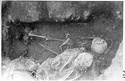
| Rodney S. Young ... Grave 13 in notebook.
Two skeletons of small children lay in a pithos which had been put on its side; its mouth was stopped by a stone slab.
Most offerings were inside the pithos, but two kantharoi and ... Late Geometric |
| Geometric Burial. Burial B in notebook.
Overlay E 14:13. Skeleton lay on smoothed bedrock, head southward, arms folded on chest, hands below chin. Legs, cut off by later disturbance, probably bent, with ... Late Geometric ... Hesperia 14 (1945), p. 306, no. 85 ... Agora VIII, p. 126. |
| Geometric burial. Burial A in notebook.
Shaft in bedrock dug to 0.30m, oriented NE to SW. Upper part was disturbed by Grave XXIV. Skeleton of youth. L. as it lay 1.34m. Pots laid across grave at feet of ... 750-725 B.C. |
Middle Stoa Building Fill (with filling to S) (See also Κ: H-I-J 14-15 and Λ: K-M 13-14)
This deposit is not definitive and must be considered with the above deposits before details are entered into database; ... To ca. 180 B.C. |
Hellenistic fill South of Middle Stoa near NW corner of Heliaea. This fill contained material later in date than that which made up the middle Stoa Building Fill.
Only the coins (and a few amphora handles ... To ca. 140 B.C. |
Well at U/10-14/4, in Byzantine Room I.
Well is ca. 1.20m in diameter, dug into bedrock. Excavated to depth of roughly -8.00m; sides started collapsing and thus did not dig to full depth. Some stone-lining, ... June 15-16, 17-31 July 1972 |
| Laura Gawlinski ... Fill excavated south and west of Early Building Ii, Room E latrine, with a high concentration of votive material, such as pyre saucers, miniature loom weights, and ribbon handled plates. Some traces of ... 400-350 B.C. |
(see O 13-14) Asterisk: O 14:2* |
Now G 13:9. Asterisk: G 14:4* |
(now N 13:1) Asterisk: N 14:1* |
Filling over bedrock. Coins:
14 March 1934 #44-#48 ... Early 5th c. B.C. and earlier |
Turkish Pit at 39/Ε Coins:
14 March 1935 #17
15 March 1935 #16 ... Turkish |
Tile-lined well at T/18,19-14/4,5 (Byzantine). Reused in Byzantine times, originally Roman (?). Upper 1.85m. built of mortared rubble, tile-lined below. Diameter ca. 0.70m., depth 6.80m., top at ca. 68.40m ... |
Containers 24-72.
Masses of pottery; including many BHWJ's; lamps XVIII and XXIV
Coins:
12 June 1937 #14-#53
13 June 1937 #1-#7 (from earth of 12 June)
13 June 1937 #8
14 June 1937 #1-#3
15 June 1937 ... First half 1st c. A.D. |
Fillings behind retaining wall and in road.
SW Building, rooms 3, north, south. Coins:
13 March 1934 #1, #2
14 March 1934 #37
15 March 1934 #37-#38
24 March 1934 #31 ... 6th c. B.C. and earlier |
Cistern through which well G 14:4 was dug. Filling in cistern, early Byzantine, but with various objects resembling those from the upper dumped filling in the well, below the cistern floor (5th c. A.D.) ... Early Byzantine |
| Not completely excavated due to instability of chamber walls and water. Sherds of all periods - Greek, Roman and Byzantine - were found in it [nbp. 424].
Re-examined in 2010. Photos and notes on NB pages ... 10th c. A.D. |
From the mouth to 10.50m. a fill of earth with mixed sherds, Roman 4th. c. to geometric. Probably dumped in to fill the well. From 10.50-17.75m. the fill was of broken bedrock, with a few sherds scattered ... 5th. c. |
Late first quarter 1st c. B.C. |
Coins:
16 April 1932 #1 ... First quarter 4th. c.-2nd c. B.C. |
Called a Turkish pit, located under a Byzantine wall and filled with an upper level of Byzantine material under which a level of Roman material. Coins:
5 April 1932 #1-#3
6 April 1932 #1-#5
7 April 1932 ... 6-11 April 1932 |
Well at 19/ΙΑ (corrected from O 13:2) Incised bowl
Graffito bowl
Water jug x2
Small amphora
Amphora x2
Canteen x2 Tins 132-138 (not found in notebook) ... 12th c. A.D. |
Grave in cella of Hephaisteion. Grave XXI in notebook. Disintegrated bones. Coins:
22 February 1939 #2-#3 ... 22 February 1939 |
Both in cistern and in passage 88/ΛΔ-95/ΚΘ-100/ΚΘ.
Use filling of late 4th-early 3rd c. B.C.; accumulative fillings of 3rd c. and of late 1st c. B.C.; dumped filling of 4th.c. A.D ... Upper dumped filling of 3rd c. A.D., but with earlier material |
Cumulative fillings of late 3rd-early 2nd and late 1st c. B.C. |
Late 4th-early 3rd c. B.C. |
Coins:
24 May 1937 #1
27 May 1937 #1
31 May 1937 #1
2 June 1937 #1 ... Byzantine |
Coins:
9 June 1937 #1
10 June 1937 #1-#11
11 June 1937 #1-#30
12 June 1937 #1-#13 (from earth of 11 June) ... 2nd c. A.D. |
Late Roman (3rd c. A.D) with some Hellenistic |
Sullan debris to last quarter of 1st c. B.C. |
4th-3rd c. B.C.=POU and abandonment |
Coins:
19 May 1936 #1-#2 ... 1st c. A.D. |
Late 4th to early 3rd c. B.C. |
Top to 13.15m. called Byzantine by excavator; 13.15m.-18.10m., 6th c. 18.00-19.00 period of disuse, brick and tile fragments ... 5th-6th and 9th-10th c. A.D. |
Coins perhaps Hadrian 117-138 A.C.
No XXVII lamps and no XX catalogued (but excavator notes their presence in fill) ... 1st-early 2nd c. A.D. |
North of east branch of Great Drain. Coins:
21 June 1973 #1 ... 4th c. A.D. |
Turkish Well at 76/Ζ ... Turkish |
Early Helladic Well near the very middle of the South Square ... Early Helladic |
Trench at 11/ΚΕ cut into the stereo (length 1.40m, width 0.50m). Coins:
5 April 1932 #5 (illegible).
Red figure pottery; coarse ware ... Mid-5th c. B.C. |
|
|