|
|
Pit (Well?) under Building A, Room 2. Coins:
9 May 1949 #1-#2
11 May 1949 #4
12 May 1949 #3 (not a coin, bronze fragment in lotted metal tins ΠΠ 295). Estimated Grid
Remains of coloring matter found with ... Hellenistic-Early Roman ... C 17:5 ... C 17:5 |
Rectangular pit (in Trench IX); dumped filling of late 5th. c. B.C. with some disturbance as late as Early Roman. P 18559 and P 18510 from above this pit ... 5th c. B.C ... C 17:8 ... C 17:8 |
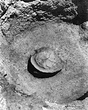
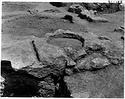
This is associated with Building A. It had a circular marble well-head with a rectangular well slab beneath. The construction throughout was of well tiles. It produced little to a depth of -8.60m. Between ... 4th c. A.D ... C 17:4 ... C 17:4 |
A tiled well with POU from 9.30-10.80m. and dumped fill above 9.30m. The dumped fill differs from lower fill only in the less frequent appearance of fragments of micaceous water jars and the occurrence ... 3rd c. A.D. with destruction at 267 A.D ... C 17:3 ... C 17:3 |
No objects catalogued ... Late 4th c. B.C ... C 17:6 ... C 17:6 |
| North of House G (RSY=Pyre 13).
Concentration of artifacts, small pieces of bone, and burnt material in stratum, no pit discerned. The pyre is cut by the trench of a wall of a Roman house to north. It ... 290-250 B.C ... C 17:2 ... C 17:2 |
Great Drain fills, including "packing over elliptical tiles" and "gravel fills". The central drain area covered by the sections below; other sections are with other deposits. Coins:
9 May 1947 #2-#5
16 ... 1st c. A.D ... C 17:1 ... C 17:1 |
Pocket of pottery to south of grave at 36/ΛΔ; uncertain context. Terracotta figurines resembling those from the Coroplast's Dump (S 19:3) No containers (cf. O 18:2).
T 2468, T 2476, ST 412 from Hellenistic ... 350-320 B.C ... C 17:7 ... C 17:7 |
Pit in House R, West Room. Grouped with and published with C 19:5. Asterisk: C 19:17* ... C 19:17 ... C 19:17 |
| Rodney S. Young ... Grave 8 in notebook. Bones discarded. Fragments of an iron pin found on the chest and a fragment of a Protogeometric krater base found beside the body were not inventoried.
JP
Unlined roughly rectangular ... LH III/EPG (date uncertain) ... C 9:17 ... C 9:17 |
Filling associated with construction of Poros Building. A small amount of fragmentary pottery found in the clay filling of the original floor; perhaps deposited as late as ca. 425-400 B.C. Cf. 18:4 and ... Ca. 475-450 B.C. or later ... C-D 17-18 ... C-D 17-18 |
Coins:
17 May 1937 #1 ... Second half 4th. c. |
Listed in nb. as 16-17/ΞΖ. Pit with furnace debris ... 5th c. B.C. - Hellenistic ... 5th c. B.C. - Hellenistic ... ΚΚ:17/ΞΣΤ |
Cistern with mixed dumped filling uniform throughout cistern and two short blind channels. Coins:
16 May 1939 #6-#7
17 May 1939 #1 ... 6th-1st c. B.C. |
| Dorothy Burr Thompson ... Grave 14 in notebook. Cutting in bedrock. Cremation: bones in pit (E.L. Smithson: Grave XXIV: PG). Bones discarded.
[JP] Nb. says at 16-17/ΞΖ and 16/ΞΖ on cards and on deposit list.(SD) ... Early Geometric I |
POU 3.50-10.30m. dumped filling of 5th or 6th century. Coins:
10 May 1949 #1
16 May 1949 #1
17 May 1949 #1-#2
19 May 1949 #1-#2
20 May 1949 #1-#12
21 May 1949 #1-#4 from dump
23 May 1949 #1-#3 from dump ... 3rd-5th c. A.D. |
| In area West of the Areopagus. Fills with many figurines and molds, possibly from a terracotta factory.
Twelve stamped amphora handles; no long-petal bowls; Type 54 A lamp Coins:
31 May 1939 #11
1 June ... Mostly 200-150 B.C. |
House R, fill under drain tiles and fillings associated with house K in industrial area, including what was C 19:15, plus C 19:16 and
C 19:17.
a) House built as dwelling in second half of 5th.c.
b) Used ... Ca. 5th and 4th c. B.C ... House R, fill under drain tiles and fillings associated with house K in industrial area, including what was C 19:15, plus C 19:16 and
C 19:17.
a) House built as dwelling in second half of 5th.c.
b) Used as marble-workers' shop from beginning of 4th. c. to near middle of century. Rebuilt as an industrial establishment about middle of 4th. c.
c) Area built over in Hellenistic times.
... Originally numbered C 19:15. |
| Located in House H, Room 13 on the lower northwest slope of the Areopagus ... Late 2nd c. B.C. |
Well in the bottom of chamber cistern at 106/ΛΓ, stratified. A soft spot in the bedrock at the west side of the well caved in and was packed with typical coarse Roman first century amphoras; the well was ... A.D. 200-150 |
| James H. Oliver ... (E.L. Smithson: Grave IX: PG). Two children's skeletons one on top of the other. Cf. PD 329 for PD 430 for second skeleton, same deposit.
PG grave about 25m. SW of Cistern A at 46/ΜΔ.
[In some records, ... Developed Protogeometric |
Hellenistic-Early Roman fill over bedrock, along west side of Kolonos Agoraios. Consistent dumped filling; occasionally there is a late Roman fragment intruded from the filling above, but this seems not ... 26-29 February 1936
2-12 March 1936 |
Well in branch of Aqueduct (ca. 13/ΚΔ) 3rd c. A.D. - 5th c. A.D ... 3rd c. A.D. |
Pit in floor of cellar of House 634/19. Contents mixed to late Roman. Pottery 4th c. B.C. to 4th c. A.D. discarded ... 25 April 1958 |
Use filling of early to late 2nd c. A.D., and dumped filling of late 2nd c. Coins:
16 April 1948 #1-#6
17 April 1948 #5
28 April 1948 #1 ... POU 2nd c. A.D ... Use filling of early to late 2nd c. A.D., and dumped filling of late 2nd c ... Coins:
16 April 1948 #1-#6
17 April 1948 #5
28 April 1948 #1 |
Deposit in bedrock cuttings, probably from a household. (Panathenaic Way Cut III, E1 and E2).
E1: Mixed 7th-5th c. B.C.
E2: Late Geometric-Early 6th c. B.C. Coins:
19 May 1959 #5-#7 ... 5th c. B.C and earlier |
| Date of filling early third c. B.C.
Little pottery. Seven stamped amphora handles. Latest coin dates in first third of 3rd c. One small fragment of moldmade bowl of undetermined type. Coins:
12 August ... 310-220 B.C. |
In Southeast House, Room E. The inventoried material consisted entirely of loomweights, all of the 4th c. B.C ... 5th-4th c. B.C. |
From kiln in house of 7th c. B.C. (=Building A), to southeast of Tholos. Tholos Trench U, furnace ... 675-625 B.C. |
| Cistern with dumped filling, second quarter of 4th c. B.C. Also Lot Φ 187bis (selected coarse).
No coins ... Ca. 375-350 B.C. |
Well A
Mostly uniform dumped fill. use level probably late. The well head (A 2753) had evidently been broken up and thrown in as soon as the well went out of use. Dumped filling, second quarter of 7th ... 7th century B.C. |
Cistern shaft at 63/ΚΓ. Part of H-I 16-17 system. Contents of 3rd c. disturbed.
Part of extensive cistern system, of which one chamber, three drawshafts, and two blind tunnels were excavated (H 16:2, ... 3rd c., disturbed ... Part of H-I 16-17 system. Contents of 3rd c. disturbed.
Part of extensive cistern system, of which one chamber, three drawshafts, and two blind tunnels were excavated (H 16:2, I 16:6, I 17:4) |
Shallow pit in bedrock. NB fragment found in gravel to south of pit (ΟΟ 399=P18633) ... Second quarter 5th c. B.C. |
Well at 123/ΝΑ.
At the bottom a few water jars; above , a dumped filling with a small amount of pottery; at the top supplementary fill with scattered sherds.
POU, ca. 500 B.C.
Dumped filling, of ca. 500 ... 6th c. B.C. |
Early Roman, late 1st c. A.D. with some later fragments. Coins:
31 May 1938 #1-#12
1 June 1938 #1-#5
2 June 1938 #1-#2 ... Late 1st c. B.C. |
Pit I at 45/ΙΘ (= Well) (noted also 4th c. pocket in side of this pit).
This is part of the Terracotta Deposit (H 17:4) and the objects listed here are also listed in H 17:4. Containers/lots for this ... Geometric-Protoattic ... Pit I at 45/ΙΘ (= Well) (noted also 4th c. pocket in side of this pit).
This is part of the Terracotta Deposit (H 17:4) and the objects listed here are also listed in H 17:4 ... Lot ΣΤ 172 is the container for the 4th c. B.C. pocket in this pit and for P 26025. |
Rectangular shaft neighboring the well D 17:12. Dug only to a depth of 4.40m. and provided with two galleries or channels extending from it. Apparently never intended as a well. Refilled with the dug bedrock ... 4th c. B.C ... Rectangular shaft neighboring the well D 17:12. Dug only to a depth of 4.40m. and provided with two galleries or channels extending from it. ... Refilled with the dug bedrock in which was a small quantity of Geometric to 5th c. B.C. pottery. A supplementary upper fill included a lamp of type in use in the third quarter of 4th c. B.C. |
Digging terminated at 14.50m. due to falling bedrock. Scanty pottery remains at 10.00m. In the mouth and upper part of the shaft was a heavy dumped filling of much shattered fragments, for the most part ... Last quarter of 5th c. B.C. |
| Pit, partly cleared; dumped filling of first half of 3rd. c. B.C., but with considerable material of the 4th. c. Hellenistic.
Its rotten schist walls collapsed some time near then and it was filled up ... 4th-3rd c. B.C. |
| Pyre in Room 2, area west of street (RSY=Pyre 12).
In courtyard. Artifacts, bone, ash, carbon, and cinders in pit in floor sequence. The rectangular pit was cut into a white strosis with marble chips (ΠΠ ... 315-300 B.C. |
Outside the market square, near the southeast corner, on the south edge of the east-west road, where it passes to the south of the Mint.
There is no doubt that the pottery from the well is "stratified" ... Early 1st to 6th c. and of 8th c. A.D. |
| Phaidon Street Cistern: North Chamber
Sullan destruction debris. One of two chambers connected by tunnel.
Two latest coins date to 87/86. Gray ware lamp of first quarter of 1st c. A.D. indicates disturbance ... 2nd c. B.C ... 2nd c. B.C ... O/2,3-17/16,17 |
A deep pit in bedrock over mouth of well. Context archaic, 6th c.
B.C., but with some traces of later disturbance. Found a circle for a well at the bottom, much water, no sherds.
Lay 2.20m south of Well ... 6th c. B.C ... Context archaic, 6th c.
B.C., but with some traces of later disturbance. ... Lay 2.20m south of Well B (L 17:1). It presumably had been a well, of which the sides collapsed |
Cutting in bedrock (Panathenaic Way Cut II, Cutting C1); loose gravelly filling over bedrock including a number of terracotta figurines. Lot ΠΑ 61? P 26458 is probably a slip. One fragment noted as from ... 4th c. B.C. |
Unfinished well, south of the annex to the Poros Building, west of the Areopagus. The shaft was apparently never used as a well. The lower dumped filling contained a quantity of clean red clay, as if from ... Ca. 350-325 B.C. |
| Herulian Debris in a house on the lower slopes of the Hill of the Nymphs: House P = South House; Room 2 = Dining Room; Room 3 = Kitchen; Room 18; Room 23; Room 24. Coins:
9 August 1947 #1-#37, #47-#49 ... Mid 3rd c. A.D. |
| Phaidon Street Cistern: South Chamber.
Connected by tunnel to O 17:5.
Knidian stamped amphora handle; fragments of five long-petal bowls, one made in worn mold. Type 35 A lamp. Coins
9 August 1957 #1-#3 ... Late 2nd c. B.C. |
Well G, just south of Room D. It was finally filled in the 6th c. A.D. with some attractive sculpture. Its contents suggest that the building was not used for metal work, but was purely domestic containing ... 3rd-6th c. A.D. |
Displaced curbing stone had fallen into top of shaft; fill with and around it is presumably second half of 2nd c. A.D. Below tumbled filling at top, shaft was empty to 10.80m. Tiles were missing to ca ... Late 1st-early 2nd c. |
North of court F, around well head only. Deposit created by A.W. and first appears in his thesis (Biblio. below).
Cf. nbpp. 2204 and 2234 and lot 350 for court F and p. 2127 for north of court. Coins: ... 1st-2nd c. A.D. |
| Homer A. Thompson ... Child's grave, Geometric.
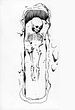
The bones of a child about one month old had been placed into P. 25787, which was lying on its side. The upper side of the pot was cut away in later times. The mouth was closed ... Late 8th c. B.C. |
Stratified well; very late Roman verging on Byzantine. Coins
19 April 1939 #1-#8
22 April 1939 #1-#2
25 April 1939 #1
15 May 1939 #1 Subdivisions:
.1=0.00-15.25m.
.2=15.25-21.00m.
.3=21.00-22.00m ... 3rd-5th c. A.D.
9th c A.D. |
Just east of Building II near its south end. The tiles were in place.
Upper filling (to 3.00m.) of Hellenistic-Byzantine dump all discarded.
POU fill a gradual accumulation of typical Justinianian ware ... 6th c. A.D. POU-7th c. A.D. |
Flask-shaped cistern (1959) (Cistern under Room 4 in NE corner of Section). Upper filling soft silt with a little pottery. Lower filling hard silt, almost no pottery.
1.35m in diameter at the floor with ... End of the 4th c. B.C. |
House F, room 4 below floor at -2.00m., fill 4. Deposit created by A.W. and first appears in his thesis (Biblio. below). Coins;
19 May 1949 #1-#16 Cf. coins from 17 June 1949 #1-#4 listed with lot OO 490 ... First quarter 2nd c A.D. |
| Although separated by a sterile rocky fill the two use fillings are apparently one continuous accumulation (GRE).
Packing around well includes SS 14261, P 25943-P 25953. These are not given a subdivision ... 350-300 B.C. to ca. 225 B.C. |
Manhole-square pit providing access to aqueduct; the dumped filling includes many fragments of coarse pottery, including 5 stamped amphora handles ... Late 2nd-1st c. B.C. |
| Pyre 1 in Central House, Room XI, strosis 3. Sacrificial pyre with characteristic small vases amid carbonized twigs and bone.
Near north side of courtyard. This pit was cut slightly into strosis 3 (lot ... 1st quarter 4th c. B.C. |
Furnace Dump from N. Hypocaust in Bath to East of Poros Building. Coins:
26 March 1948 #4-#8
27 March 1948 #1-#3
29 March 1948 #2-#7
1 April 1948 #2-#3
3 April 1948 #14-#15
7 April 1948 #16-#27
8 April ... Second half 3rd c.-first half 4th c. A.D. |
| A well on the lower slope of the Hill of the Nymphs, (diam. 1.20m -water level -7m), to 7.90m. The scanty use filling at the bottom contained water jars and pitchers as well as the inventoried objects; ... Second quarter of 6th. c. B.C ... The dumped filling, mixed with the broken bedrock above a depth of 2.40m., appears to be of the same date as the use filling, and yielded most of the inventoried objects - black figured and black glazed, as well as coarse ware, lamps, figurines, and loom weights; to be especially noted are a child's commode (P 18010, Hesp. 17 (1948), pp. 154-155), and an inscribed well head (P 18276, Hesp. 18 (1949), p. 125, no. 7). Use filling, second quarter of the 6th. c. to about 560 B.C. Dumped filling also of the second quarter of the 6th. c. |
| Circular pit and irregular cutting north of it. Diam. of pit ca. 0.80m; Dimension of irregular cutting ca. 1.00x1.20m. The pit was dug into bedrock and filled with red earth which was packed with undisturbed ... Second half of 7th c. B.C. |
| Disturbed Pyre at 59/ΚΗ (ΚΖ), in the area of the Poros Building west of the Areopagus.
Against east wall of room 5 west. concentration of artifacts, ash, carbon and a few bones in stratum, no pit discerned ... 3rd c. B.C. |
Channel J (in ΗΗ)
Cutting that probably originally held a drain. Packed with amphoras and other coarse pottery. It tapped the poros aqueduct wall just East of our explanatory trench at the East end of ... 1st c. B.C. - early 1st. A.D. |
| Pocket with burning at 60/ΚΗ. "Is this perhaps a disturbed pyre burial." [Nbp. 2928].
Identified as pyre by SIR.
Near north end of corridor, beside its west wall. Concentration of artifacts, tiny scraps ... 4th c. B.C. |
Pithos in NW corner (room) of Poros Building. Marble chips ... Mid-4th c.? |
Well at west side of Theseion Plataea, partly cleared to a depth of ca. 5.30m. Dumped filling, apparently the debris from a sculptor's workshop, as indicated by both the quantity of marble chips in the ... Second quarter 4th. c. B.C. |
| Use filling of middle of 1st to late 6th c. (Roman Group M); dumped filling of 9th and 10th c. Down to a depth of about 21.00m. the fill of the well contained very few objects, the latest of them being ... 1st-6th c. A.D. |
Well cut through cistern at 51/ΙΑ (merged with R 17:1); well and cistern filled at one time ... 5th c. A.D. |
| Pyre /Burial (?) disturbed, in the area of the Poros Building west of the Areopagus. In northeast corner of room 4 west.
Concentration of artifacts, tiny slivers of bone, and burning in a layer of fill ... Early 4th c. B.C. |
Deposit of jewelry in hypocaust area (92/ΙΗ) of Bath to East of Poros Building. Coins:
8 April 1948 #12-#47 ... 2nd-3rd c A.D. |
Pocket in bedrock at 62/ΚΑ ... Early 5th c. B.C. |
Containers 1-11 ... 9th c. A.D. |
Small pocket between the tumbled wall of large conglomerate blocks and Drain 2 ... 4th c. B.C. |
A filling lying over a cobbled floor in a house-complex on the lower north slopes of the Areopagus.
Area in front of E-W retaining wall, just above cobble pavement, disturbed by coins and pottery as late ... 375-275 B.C. |
| Pyre 2 in Central House, Room X, under strosis 9. Signs of burning, carbonized food, animal bone.
In room south of courtyard. concentration of artifacts, bone, and charred material in floor makeup, no ... 290-275 B.C. |
Containers 23-35. Coins:
6 April 1937 #1, #6 ... 5th. c. A.D. |
Containers 14-16 ... 6th c. A.D. |
Containers 5-13 ... 6th c. A.D. |
Containers 43-47. Coins:
22 April 1939 #1-#2
25 April 1939 #1
15 May 1939 #1 ... 3rd c. A.D. |
Scanty filling over bedrock ... Latest 6th c. B.C. |
| Sacrificial pyre in Poros Building, NW Room (RSY= Pyre 1).
Against east wall of room 5 west. artifacts, bone, carbon and ash in pit in floor sequence. the pyre lay below a floor covered with marble dust, ... Middle of 4th c. B.C. |
Cistern and drawshaft connected by tunnel; used in modern times as cesspool. No stratigraphy noted, but pottery from first five boxes excavated is later than that from boxes 6-18.
11 stamped amphora handles ... Hellenistic and Late Hellenistic |
Located in Room IV, strosis 3, of SW House. Archaic, later disturbed, filling in and over undug well. See also L-M 17-18:1 where objects SS 14318 and T 3576 are actually from the filling over the undug ... 6th-5th c. B.C. |
Pit H ... Second half of 4th c. B.C. |
Containers 63-67. Coins:
6 April 1937 #4-#5 ... Late 3rd c. A.D. |
Containers 44-62. Coins:
5 April 1937 #3 (disintegrated)
6 April 1937 #2-3, #7
8 April 1937 #1
9 April 1937 #1-#2 ... Early 4th c. A.D. |
Containers 36-40 ... Late 4th c. A.D. |
Containers 1-4 ... Late 6th c. A.D. |
Containers 106-107. Coins:
16 April 1937 #1-#7 (Dump) ... Mid-1st c. A.D. |
Containers 87-99. Coins:
7 April 1937 #30-#31
8 April 1937 #41-#82
9 April 1937 #3-#4 (#4=Dump)
13 April 1937 #1
14 April 1937 #1-#10 ... Late 2nd c. A.D. |
Containers 83-86. Coins:
7 April 1937 #13-#29
8 April 1937 #2-#40
12 April 1937 #2 ... Early 3rd c. A.D. |
| A well in the industrial area of the Areopagus, about 7.00m. west of the West Bath, to a depth of 14.60m. This well was the direct successor to A 17:1, replacing it when it collapsed. The use filling at ... Second quarter 6th. c ... This well was the direct successor to A 17:1, replacing it when it collapsed. The use filling at the very bottom contained the black figured amphora P 18348 (Hesp. 17 (1948), p. 184, pl. 65, 1) and a well head (P 18853, Hesp. 18 (1949), p. 125, no. 8). ... Use filling, second quarter of sixth c. B.C., the last half. |
Containers 17-22. Coins:
5 April 1937 #1-#2 (disintegrated) ... 2nd half 5th c. A.D. |
| An area about 10m2. on the lower northwest slopes of the Areopagus, southeast of the archaic fountain house. A dumped fill to the end of the 3rd quarter of the 7th c. B.C., containing many votives, overlying ... 7th c. - 625 B.C ... A dumped fill to the end of the 3rd quarter of the 7th c. B.C., containing many votives, overlying the fallen clay walls of the houses of Geometric times ... This large deposit encompasses H 16:6, H 17:2, H 17:3, H 17:7 and the objects are listed both here and in their separate deposits. |
Containers 63, 66-82. Coins:
7 April 1937 #1-#12, #32
10 April 1937 #1-#3
12 April 1937 #1 ... Mid-3rd c.-267 A.D. |
Includes a transitional layer 15.25-16.50m. Containers 12-42. Coins:
19 April 1939 #1-#8 (#2-#8 from dump) ... 4th-5th c. A.D. POU |
Modern fill to 21.00m. at which depth a human skeleton weighed down with iron. ER fill from 21.00-28.00m. (bottom). A POU fill with a possible break around 25.00m ... 1st to mid-2nd c. A.D. |
Well L.
Use filling and well-head; abandonment filling chiefly of mud and stones, with a scattering of pottery ... ca. 575-550 B.C.-To early 5th c. B.C. |
|
|