|
|
Coins:
22 February 1936 #4-#13
26 February 1935 #1-#2
27 February 1936 #1-#4
28 February 1936 #3-#5 |
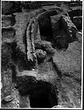
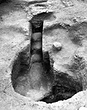
Cistern System #1a: Shaft (Manhole) at 10/ΞΗ (10-11/ΞΖ-ΞΗ). Filling consistently late Hellenistic in hole and in passage; probably 1st c.
B.C. Coins:
26 May 1936 #1 ... 110-75 B.C ... Filling consistently late Hellenistic in hole and in passage; probably 1st c.
B.C ... Coins:
26 May 1936 #1 |
Coins:
26 May 1936 #2-#3
Fragments of "A" ware and of micaceous water jars; no basket-handled water jars; and a lead seal with the name and portrait of Hadrian ... Late 2nd.-early 3rd. c. A.D. |
A well on Kolonos Agoraios. The upper dumped filling, a heavy deposit of pottery, was separated from the lower filling of similar character by several meters of plain mud. No use filling. Coins:
8 April ... Ca. 375-325 B.C. with disturbance of 250-225 B.C. |
Cistern System #1b: Shaft/manhole and gallery at 18-19/ΞΑ-ΞΓ.
Objects divided between the two features, shaft and gallery, according to deposit notebook list, not according to remarks on cards. 22 February ... Late 1st c. B.C.-early 1st c. A.D. |
Well cut through cistern at 6/ΝΕ (C 9:7).
The stele I 3244 in position in the cistern over the mouth of the well is listed with the cistern deposit C 9:7. Coins:
26 February 1936 #2-#4
27 February 1936 ... A.D. 1st ... Well cut through cistern at 6/ΝΕ (C 9:7).
The stele I 3244 in position in the cistern over the mouth of the well is listed with the cistern deposit C 9:7 ... Coins:
26 February 1936 #2-#4
27 February 1936 #2-#10
28 February 1936 #3-#6
29 February 1936 #2
2 March 1936 #2-#3
3 March 1936 #1-#6
4 March 1936 #2-#4
5 March 1936 #1-#2 |
Great Drain fills, including "packing over elliptical tiles" and "gravel fills". The central drain area covered by the sections below; other sections are with other deposits. Coins:
9 May 1947 #2-#5
16 ... 1st c. A.D. |
Well at 63/ΙΒ (in House H, Room 15). Upper fill mixed Hellenistic to 2nd c. or later. Probably thrown in in Early Roman times when House H was built. Contained many figurines; probably part of Koukla factory ... 12 August 1947 ... Upper fill mixed Hellenistic to 2nd c. or later. Probably thrown in in Early Roman times when House H was built. ... Lower fill with much 4th c. and as late as upper fill into 2nd c. ... Coins:
26 September 1947 #2 |
Hellenistic-Early Roman fill over bedrock, along west side of Kolonos Agoraios. Consistent dumped filling; occasionally there is a late Roman fragment intruded from the filling above, but this seems not ... 26-29 February 1936
2-12 March 1936 |
Well 19: Latest Mycenaean. Near Klepsydra. Diameter mouth 1.25-1.35m., narrowing about a third of the way down and becoming rectangular, 0.90-1.0 to a side. Muddy at m; water collecting rapidly at 8.m ... Late Mycenaean |
Back fill in an unfinished well, originally dug only to a depth of 3.80m. Apparently dug in the 3rd. c. B.C. and refilled at once; the filling contained a scattering of 5th. and 4th. c. fragments as well ... To early 3rd century. |
Klepsydra: Filling in overflow channel = Channel A, North of Paved Bldg. (was T 26-27:1) Three layers, all containing a mixture of early material (LHIIIC and Protogeometric) with late Hellenistic and early ... Mid 1st. c. A.D. with later intrusions ... Klepsydra: Filling in overflow channel = Channel A, North of Paved Bldg. (was T 26-27:1) ... Some intrusions of 3rd c. A.D. in upper layer. |
Washed-in filling at the base of the Acropolis cliffs, some 7m. east of the Klepsydra; the fill was characterized by teh fragments of a series of red-figured oinochoai of special shape, of the late 5th ... Late 3rd c. B.C. |
| Mike Laughy ... This pyre was found within an otherwise mostly sterile fill directly under a white floor surface in the southern section of Area IV. It was located ca. 0.50m. east of a similar deposit, Pyre J 2:25. The ... 4th c. B.C. |
A small concentration of pottery in lowest 1.80m., possibly a use fill. Three fills above, with little pottery, ranging from Hellenistic to late Roman in date. Coins:
26 February 1934 #4-#6
27 February ... 325-200 B.C. |
Catch Basin in Building P, Room 7. Coins:
26 April 1948 #20-26 ... 3rd. c. A.D. to pre-Herulian |
Two periods of use.
Outside the SW corner of the market square, to the west of the north-south road; lower use of filling, of 1st to early 2nd c. A.D. Coins:
26 May 1937 #1 [to 8.30m.]
9 June 1937 #2-#4 ... 10 -11 June 1935
20 May-20 June 1937 ... Outside the SW corner of the market square, to the west of the north-south road; lower use of filling, of 1st to early 2nd c. A.D ... Coins:
26 May 1937 #1 [to 8.30m.]
9 June 1937 #2-#4 [to 16.00m]
11 June 1937 #31 [to 17.60m]
12 June 1937 #54-#55 [to 18.10]
14 June 1937 #4-#5
15 June 1937 #1
17 June 1937 #12 (earth)
18 June 1937 #1-#3 (earth)
19 June 1937 #1-#3 (earth) |
See I 870, a piece of which was found in disturbed red fill in Β' southeast of Tholos.
Although apparently from the same context as P 5339 (tins 24-26, undisturbed fill), P 5336-P 5338 are recorded from ... 27 February-8 April 1935 |
Michael Laughy ... Debris pit, located in Room 2 of ΒΘ East. Pit measures ca. 2.30 by 1.70m., and nearly a meter deep. The pottery from the pit dates ca. 10th-12th c. A.D. The fill of the pit consisted of soft, black charcoal ... 10th-12th c. A.D. |
Fill in abandoned cistern, lower terrace adjacent yo the Eleusinion on the north.
Uncatalogued material: 189 sherds, 4 objects. Many kernoi fragments.
Objects : loom weights; lamp.
Early ware : Gray Minyan; ... Mid. 4th c. B.C. |
Coins:
26 April 1937 #1-#7
27 April 1937 #2-#5
28 April 1937 #1 ... 1st. c. B.C.-1st. c. A.D. |
Cistern in valley west of the Areopagus. Dumped filling of late 1st. to early 2nd. c. and of 5th to 6th century. Coins:
7 June 1939 #12
8 June 1939 #18-#19
9 June 1936 #26 ... 1st.-2nd. c. A.D ... Dumped filling of late 1st. to early 2nd. c. and of 5th to 6th century ... Coins:
7 June 1939 #12
8 June 1939 #18-#19
9 June 1936 #26 |
Nbp. 661: Dug in 1st c. Cleaned out almost to bottom shortly after the middle of the 3rd c. and used for a few years. During Herulian invasion of 267, Laughing Faun broken up and thrown in. Thereafter ... 1st-5th c. A.D., 2nd c. A.D.=POU |
Wells at 24/ΙΓ at 26/ΙΑ near the SW corner of the market square, about 10m west of the Southwest Fountain House (the party wall between them broken through in antiquity).
Use filling middle to third quarter ... Ca. 550-525 B.C ... Wells at 24/ΙΓ at 26/ΙΑ near the SW corner of the market square, about 10m west of the Southwest Fountain House (the party wall between them broken through in antiquity).
Use filling middle to third quarter of 6th c. B.C., upper filling, 6th c. |
Filling over bedrock. Coins:
26 May 1938 #7-#10
27 May 1938 #1
28 May 1938 #1 ... 1st-early 2nd c. A.D. |
Containers 53 (transitional)-69. Coins:
20 May 1938 #6
21 May 1938 #1
26 May 1938 #1-#2 ... Early Roman 1st c. A.D. |
It may perhaps be assumed that in the 5th c. the Romans cleaned the well to 25.30m., thus removing 2nd c. and subsequent fill, and then began to reuse the shaft. Coins
20 May 1938 #6
21 May 1938 #1
25 ... POU 1st c. and 5th-6th c. A.D ... It may perhaps be assumed that in the 5th c. the Romans cleaned the well to 25.30m., thus removing 2nd c. and subsequent fill, and then began to reuse the shaft ... Coins
20 May 1938 #6
21 May 1938 #1
25 May 1938 #1-#2
26 May 1938 #1-#2 |
Filling on bedrock.; accumulation extending to about the middle of the 6th c. with earlier material. Some later intrusions to late Roman (?) ... Ca. 600-550 B.C. |
Coins:
19 May 1937 #1-#10
24 May 1937 #1
25 May 1937 #6
26 May 1937 #1-#2 ... Late 1st.-late 2nd. c. A.D. |
Well with overflow into cistern system. Probably Hellenistic in origin. POU late 1st. c. to early 3rd. c. Dumped filling of 4th. (and 5th.?) c.
Abandoned at 22.50m. because of water. Coins:
21 May 1937 ... Late 1st. c.-4th. c. A.D. (and 5th c. A.D.?) ... POU late 1st. c. to early 3rd. c. ... (and 5th.?) c.
Abandoned at 22.50m. because of water ... Coins:
21 May 1937 #5-#31
22 May 1937 #2-#4
4 June 1936 #12
22 June 1936 #1-#3
From dump:
28 May 1937 #1, #12-#24, #26-#28
1 June 1937 #1
12 June 1937 #1-#7 |
Coins:
21 May 1937 #5-#31
22 May 1937 #2-#4
from dump:
28 May 1937 #1, #12-#24, #26-#28
1 June 1937 #1
12 June 1937 #1-#7 ... Late 1st. c.-earliest 3rd. c. A.D. |
Hoard of coins dated 6th c. A.D. down to end of Slavic invasion. Presumably a deposit hidden from the invaders, likely buried 582/3
A.D. Nbpp. 496, 1375. A fragmentary bronze situla was also found nearby ... 26 May 1971 ... Hoard of coins dated 6th c. A.D. down to end of Slavic invasion. ... Coins:
26 May 1971 #467-#807 |
Well C - Passage, belongs with II - Brick Shaft. All dumped fills. No objects catalogued from Well C of section ΟΑ. One object (I 5422) catalogued from modern fill in shaft, one from dump (I 5545). Coins: ... 2nd c. A.D.- Byzantine ... Well C - Passage, belongs with II - Brick Shaft. ... No objects catalogued from Well C of section ΟΑ. ... Subdivisions:
.1=Fill A.
.2=Fill B.
.3=Fill C.
.4=Fill D.
Estimated Grid |
| Sacrificial Pyre = Pit in floor (identified as pyre by SIR); with the characteristic small plates and saucers. "Saucer Grave" at 12/ΚΑ.
Dimensions: 2m (length)x 0.70 (width).
North of north wall of building ... First half 4th c. B.C. |
Exploration of packing below paving blocks of Panathenaic Way.
Uncatalogued material: 66 sherds, 2 objects (50A) and 43 sherds (50B). Coins:
26 April 1960 #1-#2
3 May 1960 #1-#4, #6-#9 Deposit created ... 1st c. A.D. |
| Mycenaean grave.
Small pit grave (0.50m by 1.35m by 0.75m deep) containing the skeleton of an infant girl. Although a simple grave with a single interment, the pit was packed with gifts. These consisted ... No later than mid-15th c ... Hesperia 21 (1952), pp. 107-108, pl. 26 c. |
Trial cut at 26/ΙΣΤ-ΙΖ, Layer I; Circular Building, 22m south of Eleusinion. P 30171, P 30172, L 5818 added on 7 May 1973 ... 4th c. B.C ... 4th c. B.C ... ΙΙ:26/ΙΣΤ-ΙΖ ... ΙΙ:26-27/ΙΣΤ |
North of Eleusinion: Loose fill in pit outside Roman Building. 14 inventoried items, 22 objects, 325 sherds.
Objects : terracottas; handmade object; large figurine; lamps.
Early ware : Gray Minyan; Mycenaean; ... 6th c. B.C. and earlier. |
| Rodney S. Young ... Grave 5 in notebook.
The grave had been somewhat disturbed by the digging of Well B. The hydria lay on its side; in it was found the skeleton of a small child lying on its side with the knees drawn up ... Late 8th-early 7th c. B.C. |
North of Eleusinion: Fill in Room 3 of Roman Building. 614 sherds (6 miniature shapes, 20 intrusive sherds).
Objects : terracottas; loom weights; spindle whorls; disks; handmade tray; lamps.
Early ware ... First half of 6th c. B.C.-Mixed Fill to ca. 480 B.C. |
Cistern System in East Portico.
Drawshaft with two blind tunnels, in court of House of the Greek Moisaic; partially excavated by Dorpfeld. No legible coins or amphora handles. Coins:
26 June 1964 # ΔΕ3 ... 2nd c. B.C. |
Well on south slope of Kolonos Agoraios. Use filling of late 1st. to late 2nd. c. A.D.; dumped filling of 4th. c. A.D. Coins:
24 April 1937 #2
27 April 1937 #6-#12
28 April 1937 #2
29 April 1937 #2
8 May ... 1st.-4th c. A.D ... Use filling of late 1st. to late 2nd. c. A.D.; dumped filling of 4th. c. ... Coins:
24 April 1937 #2
27 April 1937 #6-#12
28 April 1937 #2
29 April 1937 #2
8 May 1937 #1-#2
19 May 1937 #1-#10
24 May 1937 #1
25 May 1937 #6
26 May 1937 #1-#2 |
| Eugene Vanderpool ... Infant grave near Phaidon street cistern. No offerings.
Roughly rectangular, almost elliptical cutting in bedrock, measuring 0.70m long, 0.35m wide, and 0.40m deep, oriented south-southwest to north-northeast ... Late Helladic III C/Early Protogeometric (date uncertain) |
It was impossible to return to the digging of this well either in 1939 or 1940 [due to collapse of stereo] (nbp. 1432).
HAT compares pottery to that of Square Building fill. Coins
26 May 1939 #1 ... Second half of 4th c. B.C. |
Furnace Dump from N. Hypocaust in Bath to East of Poros Building. Coins:
26 March 1948 #4-#8
27 March 1948 #1-#3
29 March 1948 #2-#7
1 April 1948 #2-#3
3 April 1948 #14-#15
7 April 1948 #16-#27
8 April ... Second half 3rd c.-first half 4th c. A.D. |
Digging abandoned at 17.10m.
Nbp. 2863: The fill in the mouth to -6.50 was a dump of mixed hellenistic and late roman sherds. From -6.50 to -11.00m. small stones with a few late roman sherds 4th-5th c ... 4th-5th c. A.D ... From -6.50 to -11.00m. small stones with a few late roman sherds 4th-5th c. From -11m. the well deposit started and was very heavy and continuous to abandonment depth, 4th-5th c. A.D. pots and 4th c. coins. A third century phase was beginning to appear at time of abandonment ... Coins:
17 May 1935 #1-#6
20 May 1937 #1
22 May 1937 #1
27 May 1937 #2
28 May 1937 #1-#26
29 May 1937 #1-#6
3 June 1937 #1-#6 (earth of 1-2 June)
4 June 1937 #1-#3 (earth) |
Well dug through bedrock-settling basin of cistern at 69/ΜΗ. Coins:
21 May 1936 #24-#26
22 May 1936 #14
29 May 1936 #2-#4
2 June 1936 #1-#3
3 June 1936 #2-#4
4 June 1936 #4-#6 Cf. also container ΚΚ 336 ... 3rd c. A.D. |
L 1079 and L 1080 are identified as from a pit at 29/ΝΓ. L 1082 and P 2130 are from a pit at 26-29/ΜΘ-ΝΑ. Probably the same pit as indicated on a note in deposit cardex. The finds are recorded together ... 5th c ... 5th c ... Η':26-32/ΜΗ-ΝΓ ... Η':26-29/ΜΘ-ΝΑ |
| Cistern in the valley between the Areopagus and the Hill of the Nymphs. Simple, flask-shaped chamber withdraw-shaft; no tunnels. Mouth cut away in Byzantine times. Lower filling, 3rd c. B.C. Coins:
25 ... 25-30 April 1947 ... Lower filling, 3rd c. B.C ... Coins:
25 April 1947 #1
26 April 1947 #1-#5
28 April 1947 #1-#3
29 April 1947 #1
29 April 1947 #2-#4
30 April 1947 #1-#2
6 May 1947 #6-#7 Dump
Several Rhodian amphora handles. ... Subdivisions:
.1=Fill 1, Early Roman.
.2=Fill 2
.3=Fill 3, 2nd. c. B.C. |
Cistern connected by tunnel to another chamber filled in Byzantine period. Small Hellenistic deposit on floor. somewhat contaminated by Byzantine fill above
No stamped amphora handles later than 3rd c.; ... 250-190 B.C ... Small Hellenistic deposit on floor. somewhat contaminated by Byzantine fill above
No stamped amphora handles later than 3rd c.; latest lamp type 45C; fragments of many bowls (ca. 40), similar to those in M 21:1 and P 21:4 ... Coins:
16 February 1937 #7-#9
22 February 1937 #23-#26 |
Fill in shaft; upper fill in lower chamber; fill in vaulted chamber. Coins:
29 April 1937 #1-#8
5 May 1937 #1-#27
26 May 1937 #1-#12
27 May 1937 #1-#10
28 May 1937 #1-#6
24 March 1938 #3-#7
12 June 1939 ... Late 4th c. A.D. |
Fillings to either side of the Great Drain, in the southern part of the area west of the Areopagus; various levels, late 6th. and early 5th c. B.C. to Sullan destruction. Coins:
26 July 1946 #1-#2
30 July ... Late 6th. c. B.C.-1st. c. A.D ... Fillings to either side of the Great Drain, in the southern part of the area west of the Areopagus; various levels, late 6th. and early 5th c. B.C. to Sullan destruction ... Coins:
26 July 1946 #1-#2
30 July 1946 #1-#3
31 July 1946 #1
1 August 1946 #1= IL 1189
7 August 1946 #1
9 August 1946 #1
10 August 1946 #1-#3 |
Coins:
26 April 1932 #1
27 April 1932 #1-#2
Only the pottery from last 1.00m of fill retained. Finds recorded in both Δ and Δ'. See Δ nbp. 114 for division of Δ into two parts, northern (Δ) and southern ... 4th c. A.D. |
Homer A. Thompson ... Well at the northwest foot of the Areopagus. Use filling of the Roman period. After the abandonment of the well and the collapse of the well-curb, the upper 2m of the shaft were filled with a dump apparently ... 1st-3rd c. A.D., 5th century |
Wells at 24/ΙΓ at 26/ΙΑ near the SW corner of the market square, about 10m west of the Southwest Fountain House (the party wall between them broken through in antiquity). ... Ca. 500 B.C ... Wells at 24/ΙΓ at 26/ΙΑ near the SW corner of the market square, about 10m west of the Southwest Fountain House (the party wall between them broken through in antiquity). Top filling disturbed, dumped fill ca. 500 B.C., use filling of late 6th c. B.C.; both filled at the same time. |
| Herulian Debris in a house on the lower slopes of the Hill of the Nymphs: House P = South House; Room 2 = Dining Room; Room 3 = Kitchen; Room 18; Room 23; Room 24. Coins:
9 August 1947 #1-#37, #47-#49 ... Mid 3rd c. A.D. |
Sand fill N of Base A.
... Because of the uncertainty of ground level contemporary with Base A and of the possibility of missing a continuous strosis or disturbance in this soft sandy fill, I have kept ... Last quarter 2nd-first quareter 3rd c. A.D ... Sand fill N of Base A.
... Because of the uncertainty of ground level contemporary with Base A and of the possibility of missing a continuous strosis or disturbance in this soft sandy fill, I have kept the pottery from the separate patches dug separately; hoping that when the pottery of 2nd and 3rd c. A.D is published a more precise date for the lower fill will be possible [p. 3062].
... 3 April 1952 #5-#6
5 April 1952 #25-#26
12 April 1952 #4-#6
14 April 1952 #13-#14
15 April 1952 #8-#10
25 April 1952 #7-#8
26 April 1952 #8-#11
28 April 1952 #1-#2 |
Well cut through the floor of a cistern. Apparently a dumped fill in an unused well. Coins:
16 March 1934 #15 (illegible)
17 March 1934 #2
19 March 1934 #1-#4
20 March 1934 #1-#3
22 March 1934 #1
23 March ... 1st-early 2nd c. A.D. |
| Debris filling in a bronze casting pit and workshop, characterized by mold fragments but including also a few plain vases and fragments of wine jars. Third quarter of 4th. c. BC.
The pit was cut into the ... Ca. 350-325 B.C. |
A filling lying over a cobbled floor in a house-complex on the lower north slopes of the Areopagus.
Area in front of E-W retaining wall, just above cobble pavement, disturbed by coins and pottery as late ... 375-275 B.C ... Area in front of E-W retaining wall, just above cobble pavement, disturbed by coins and pottery as late as the 3rd c. B.C ... Coins:
21 May 1932 #2
25 May 1932 #6-#7
26 May 1932 #1-#3 |
"Red Fill" (extending to bedrock or near, over most of area). Mainly first century after Christ with later disturbance. Coins:
17 April 1936 #10-#13
18 April 1936 #1
20 April 1936 #13-#17
21 April 1936 ... 1st-2nd c. A.D. |
Part of the cistern system 44/ΙΓ - 46/ΙΑ - 42/Θ. The filling of the 46/ΙΑ cistern shaft, with the exception of a little Roman at the top, was the same as the bottom fill of 44/ΙΓ - late Hellenistic, running ... Late 2nd-early 1st c. B.C ... The filling of the 46/ΙΑ cistern shaft, with the exception of a little Roman at the top, was the same as the bottom fill of 44/ΙΓ - late Hellenistic, running down to the end of the 1st c. B.C. and perhaps into the 1st c. ... Coins:
25 February 1936 #2-#3
26 February 1936 #1
27 February 1936 #1
28 February 1936 #1-#2
29 February 1936 #1
5 March 1936 #3 |
| Cistern at 77/Μ on lower north slopes of the Areopagus. Bottom diameter of 2m connected by tunnel to cistern M-N 18:1.
Only stamped amphora handle dates slightly after 240. Latest coin dates about 200 ... 3rd c. B.C.-196/190 B.C. |
Filling in the footing trench of the late Roman Fortification.
Includes Layer 1 and Layer 2 of Library Colonnade opposite Room 2. "Note: both these layers are fill thrown into V.W. footing trench." (nb.p ... End 3rd. c. A.D. |
Road SE of altar, below 51.56m.
In 1981, p. 1883: "A single pass, ca. 0.03m. thick and we hit another surface, at 51.56m. which we take as Layer XV. Fairly loose gravelly fill under surface, sandy, greenish ... 1st c. B.C. |
| Large tile-lined well in SW Bath, Room A4. The top had been sealed with ca. 1.30m of concrete, and the floor to carry the hypocaust columns of the room in Phase C had been carried over it.
The well was ... Late 2nd-early 1st c. B.C ... The top had been sealed with ca. 1.30m of concrete, and the floor to carry the hypocaust columns of the room in Phase C had been carried over it.
... Coins:
26 May 1969 #1
27 May 1969 #1-#8 |
Accumulated fillings in a system of underground drains at west end of section ΔΔ with northward continuation into and across Section Υ.
The filling in the "underground passages" in section ΔΔ appears to ... 3rd c. B.C.
2nd c A.D ... The filling in the "underground passages" in section ΔΔ appears to be not later than 3rd c. B.C.; but drain channels, pits and cuttings, etc. in Υ are partly Early Roman, some mixed to Late Roman or later.
... Section Υ: pit at 31-32/ΜΘ-Ν, 31-32/ΜΣΤ-ΜΖ, 36-38/ΞΔ, 33/ΝΒ, 31-32/ΜΓ-ΜΣΤ, 31/ΜΑ-ΜΓ
two fragments of semi-glazed bowls with everted rim (late 2nd c.?) intrusive in west branch. More extensive disturbance in east branch indicated by fragments of dipper, 2nd c. plate, at least five moldmade bowls, a Roman lamp. |
Fillings associated with early houses on the lower north slopes of the Areopagus; various levels and dates.
Both houses were built in the 6th century B.C. and destroyed by the Persians; both also have ... 6rd c. B.C.-3rd c. A.D. |
| Laura Gawlinski ... Circular pit uncovered in Early Building II, south of Room E latrine, adjacent to the preserved latrine floor surface. Continues beneath the latrine surface and the western scarp (unexcavated). Fill relatively ... Late 5th c. B.C ... This pit seemed to be cut into surrounding harder fills that were also of the 4th c. B.C., including scattered votive deposit G 13:14 above.
... Continued 26 June- 15 July 2008. |
Destruction debris in Late Roman Buildings on Lower N slope of Areopagus (see summaries under M-Q 17-21).
Over 130 coins came from this filling, of which some 51 survived in a condition to permit accurate ... 6th c. A.D. |
| Report on sorting of pottery, August 1951, by H.S. Robinson [nb p. 3666].
Cistern discovered and dug to 1.60m., vi/10/36; dug to bottom iv/22/37-v/6/37. Diam. At mouth 0.26m.; neck begins to widen out ... 1st. c. B.C. to post-Herulian |
| Komos Cistern at 66/Κ, on the north slope of the Areopagus. Homogeneous fill.
Thirty-four stamped amphora handles. Eight Histiaian tetrobols, dating 170-160 at the earliest, found near top, possibly an ... Last quarter of 3rd c. B.C.-Early 2nd century B.C. |
Cistern at 9/Β (10/Β on plan), at the NW foot of the Areopagus, some 200m to the west of the Coroplast's Dump. It had evidently belonged to one of the small houses in that thickly populated residential ... Second half 4th c. B.C. |
Accumulated debris on the west side of the market square.
Related layers added 1999/2000 (JWH), e.g. "Gravelly layer above burning", "Clearing Classical floor", "Lowest level above bedrock", "Below burning", ... First half of 5th c. A.D. |
Great Drain South (ca. 70-113, from SW edge of section as far north as the Roman Bath) Hellenistic Sand Fill. Silted-up filling of the southern branch of the Great Drain, abandoned due to some damage at ... 4th. c.-86 B.C. |
| Marcie Handler ... The contents of this Hellenistic cistern shaft were excavated in a series of layers: the preserved top of the shaft, six layers in the shaft and the fill within the tunnel. At the bottom of the shaft on ... POU: Mid-3rd c. BC
Dumped fill: after 225 BC |
| An extensive cistern system on the lower north slope of the Areopagus, south chamber with blind tunnel extending further south (south tunnel); north chamber; drawshaft further north, extends to north tunnel ... Ca. 320-240 B.C ... The cisterns and chains of cisterns must have been filled up at various times between the end of the 4th B.C. and the 1st c. A.D.
Cistern System, 45/Β and 45/ΙΑ (Hell. ... Coins: ΣΤ
13 April 1932 #1-#3
14 April 1932 #3-#5
16 April 1932 #9, #15
20 April 1932 #2-#3
21 April 1932 #5-#13
23 May 1932 #1
Coins: ΣΤ'
25 May 1932 #1-#4
26 May 1932 #4
30 May 1932 #1-#2
31 May 1932 #1
1 June 1931 #1-#2 |
Middle Stoa Building Fill (with filling to S) (See also Κ: H-I-J 14-15 and Λ: K-M 13-14)
This deposit is not definitive and must be considered with the above deposits before details are entered into database; ... To ca. 180 B.C ... Otherwise bowls similar to those in other deposits of early 2nd. c. Fragments of six molds ... Coins: Θ
1 March 1933 #14
2 March 1933 #3
6 March 1933 #3, #8
9 March 1933 #1-#3, #20
10 March 1933 #6-#7, #10, #15, #18, #20-#21, #26-#27, #31-#32, #35, #37
11 March 1933 #5, #7
14 March 1933 #34
16 March 1933 #1
17 March 1933 #4-#5, #26-#27
31 March 1933 #2-#3, #5-#8
12 May 1933 #11, #15-#16
13 May 1933 #1
15 May 1933 #2-#3, #6-#7
16 May 1933 #10
20 May 1933 #6
22 May 1933 #7
24 May 1933 #8-#11
27 May 1933 #9-#10
1 June 1933 #2-#3
Coins: Λ
24 April 1935 #1
3 May 1935 #2
4 May 1935 #1
6 May 1935 #1, #3
8 May 1935 #2
Coins: ΜΣ and K
19 February 1953 #1
24 February 1953 #1-#6
28 February 1953 #2-#9
2 March 1953 #4 (?)
3 March 1953 #2
4 March 1953 #2-#11
5 March 1953 #1-#3, #6-#23, #25-#26 #28
6 March 1953 #2-#3
7 March 1953 #3-#8
9 March 1953 #1
13 March 1953 #3, #9-#14, #16-#17
14 March 1953 #1-#26
16 March 1953 #7-#9, #13-#17
17 March 1953 #1-#19
18 March 1953 #1-#3
19 March 1953 #1-#6, #12-#13, #18-#19
24 March 1953 #3
27 March 1953 #1-#9
28 March 1953 #1-#11
29 April 1953 #7-#14
22 May 1953 #1 (?)
|
|
|