|
|
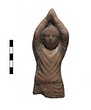
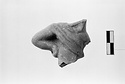
| First interpretation: female figure.
Complete, but figure represented only to mid-thigh. Lower edge finished smooth; considerably chipped.
Hands joined over head. Clad in sleeved chiton girt low; garment ... 13 June 1932 ... Male Dancer Figurine |
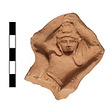
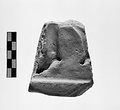
| A piece of the mold for the drapery of a large figure.
Flat back preserved; otherwise broken all around. Early Roman fill. Leica ... 15 February 1936 ... Mold Fragment for Dancer Figurine |
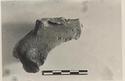
| Upper part preserved.
Figure in sleeved, full-skirted dress (preserved to just below waist), and tiara, facing. His hands are clasped above his head, and he is bending to his right (in the positive).
Pinkish-buff ... 29 July 1950 ... Mold Fragment for Phrygian Dancer Figurine |
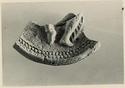
| Mold for tall altar crowned by scroll with slight traces of lower part of draped figure standing to side and partially in front of altar. Both figure and altar stand on high rectangular base.
Parts of ... 2 August 1973 ... Mold Fragment for Dancer by an Altar |
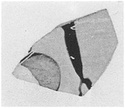
| Wall fragment. Dancer and satyrs and kantharos above. Part of leaf calyx below.
Pinkish-buff clay, brownish-black glaze. Well, upper fill. 7885, 7903 Leica ... 23 July-2 August 1947 ... Wall fragment. Dancer and satyrs and kantharos above. |
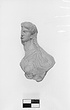
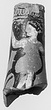
| Shoulder, chest and left arm of woman.
Left arm with drapery over it extended outward to the side.
ADDENDA: Dancer figurine. Very dull impression. Cistern. Leica, XXXIV-37 ... April 1938 ... ADDENDA: Dancer figurine. Very dull impression. |
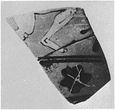
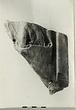
| From a kylix(?) of the comast group; black glaze inside. Outside, the rump, painted red, of a dancer; a belt, incised, above, and an arm and hand hanging down behind. Under red strosis, Hellenistic fill ... 21 April 1934 ... Outside, the rump, painted red, of a dancer; a belt, incised, above, and an arm and hand hanging down behind. |
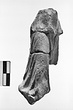
| Torso of a female draped figure, flying or running.
Perhaps Nike or a dancer.
The lower part of the figure with the base added later (T 2649).
ADDENDA Cf. Olyntos XIV (1952), p. 224. Komos cistern. Leica, ... 1947 ... Perhaps Nike or a dancer.
The lower part of the figure with the base added later (T 2649).
|
| Two joining and one non-joining fragment from wall.
a) Dancing nude woman; below, rosette.
b) Feet of male dancer; below, head of panther.
Orange clay. Black figure and white directly on clay, outlined ... July 1959 ... a) Dancing nude woman; below, rosette.
b) Feet of male dancer; below, head of panther.
|
| Broken all around. Part of surface gone.
Frontal human leg covered by vertical drapery folds. Drapery folds also on either side of leg.
Inside fairly smooth.
Buff fabric with thick orange core.
ADDENDA ... 22 June 1973 ... ADDENDA RVN: Dancer (?). |
| Part of middle of figure, showing overfold; the figure striding or dancing forward.
Broken at top and bottom.
Nike or dancer (?).
Soft buff-red clay.
ADDENDA In 1955, in box 379, two more joining pieces ... 1946 ... Nike or dancer (?).
Soft buff-red clay.
|
| Broken on all sides.
Subject not clear: looks like a bent left arm covered with numerous drapery folds possibly resting on a piece of furniture.
Inside fairly smooth.
Traces of added white paint.
Buff ... 1 August 1973 ... ADDENDA RVN: Female dancer. |
| Broken on three sides.
Subject uncertain. High slightly curved stand above which seem to have the lower part of an animal.
Inside smooth.
Much added white paint and slight traces of black paint preserved ... 1 August 1973 ... ADDENDA RVN: Fragment of dancer. |
Wall fragment.
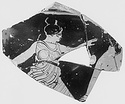
Part of a female figure, dancing right; her short skirt (? kalathiskos dancer) flies out behind her. From the left flies Eros. Dots in field at lower left.
No relief contours. White for ... 7 February 1931 ... kalathiskos dancer) flies out behind her. |
| Small fragment with part of rim and ring foot. Plain rim, bordered inside by double row of raised nodules. In relief inside, feet and legs of a dancer(?). On the bottom, a relief rosette with two moulded ... 16-21 January 1939 ... In relief inside, feet and legs of a dancer(?). On the bottom, a relief rosette with two moulded rings inside the foot.
|
There remains only the body and left arm of the figure.
A female figure, probably a dancer clad in a thin clinging chiton. A thin edge of drapery flies out around her waist. The free end falls loosely ... Early fourth century B.C ... A female figure, probably a dancer clad in a thin clinging chiton. |
| Broken at right, left and top.
Lower part of a mold for a plaque, preserving two bare feet of a figure in motion. The right foot is forward and lower than the left, the toes of both feet much lower than ... 22 July 1975 ... Perhaps a dancer.
Coarse dark buff clay. |
| Broken on three sides. One side, front, back preserved.
Fragment of half upper torso and head of draped frontal female figure.
Long hair falling over preserved shoulder.
Smooth back.
Pinkish-yellow fabric ... 1 August 1973 ... ADDENDA RVN: Mold associated with T 4064. A dancer or a goddess (?). |
| Broken at neck; one of bottom hinges missing.
Segmented doll of which torso preserved.
Horizontal hole through shoulder for attachment of arms. Three projections at bottom of torso (one now missing), pierced ... 29 June 1973 ... Articulated dancer. |
| Three non-joining fragments of a mold for a "maenad" relief.
Fragment a), bottom of flowing drapery and foot on tip toe. A rim 0.028m. wide runs the width and almost the length of the fragment, forming ... 16 April 1956 ... Fragment b), drapery hanging from shoulder of a second dancer; preserved to right of figure.
|
| Mended from six pieces; part of the out-turned lip preserved. Depicts two dancers between seated sphinxes. White for the beard and fillet of one dancer; red for the fillet of the other and on the sphinx's ... 2 March 1934 ... White for the beard and fillet of one dancer; red for the fillet of the other and on the sphinx's wing and head. |
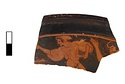
| Mended from three pieces; broken all around. Draped female figure (maenad) dancing to the right; before her, part of a bearded male figure (satyr). The dancer wears a thin chiton drawn rather tightly over ... 22 June 1931 ... Draped female figure (maenad) dancing to the right; before her, part of a bearded male figure (satyr). The dancer wears a thin chiton drawn rather tightly over her body; her hair is in a high knot. |
Wall fragment. Glaze thin in places. Max. dim. 0.113. Choes and Anthesteria, p. 88, cat. no. 217, fig. 192; Beck, Album, pl. 77:382.
At the left, a woman (forearms and hands, legs with chiton and himation) ... Ca. 450-440 B.C ... Then comes a dancer (part of arm, skirt, legs) also to right. ... The composition on 904 may have looked something like the one by the Phiale Painter in Copenhagen, inv. 1942 (ARV2 1020, 88; Paralip. 441, 88; Addenda 315; Oakley, Phiale Painter, p. 80, cat. no. 88, pl. 69); there, however, the dancer is nude.
The Phiale Painter (ARV2 1020, 89; Addenda 315); not certainly by him (ARV2 1678, 89). |
| From the upper part of a cup with offset lip. Nothing of the medallion preserved.
On the outside, a dancer moving right (maenad), looking back. She wears a kerchief around her head and a chiton decorated ... 1936 ... On the outside, a dancer moving right (maenad), looking back. |
| Three joining fragments from the wall; unglazed inside. Ovule border at botton. Above, parts of two figures, a woman with flutes, seated to right, and a dancing girl in front of her. The seated figure ... 24 April 1939 ... The seated figure wears chiton and himation, the dancer a short dress with flaring skirt ornamented with dots. |
I. Two youths. The one at the left stretches his hands down reaching his left raised foot. (One dance right); a taenia, held apparently in his left raised hand, falls over his left thigh. The other stands ... 1931 ... The other stands facing, looking left towards the dancer. His left hand is on his hip; a large roughly circular object (discus?) |
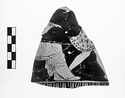
Wall fragment. Rather streaky brownish black glaze on inside. Glaze slightly greenish on outside. Max. dim. 0.077. Matheson, Polygnotos, p. 483, cat. no. PGU 190.
Kalathiskos dancer: most of head, shoulders, ... Ca. 450 B.C ... Kalathiskos dancer: most of head, shoulders, start of arms, the left raised and outstretched. |
| Two non-joining fragments, remarkably similar in clay and technique, but apparently not from the same figure.
a) Torso and right arm of a nude male figure, the right hand on the hip, a cloak worn diagonally ... 13 October 1947 ... reaching to the mid-thigh.
Dancer or actor?
Traces of orange paint on flesh.
|
| Mended from three pieces. Upper part and most of one side missing.
Roughly rectangular mold for front part of figured group; parts preserved represent heavily draped female figure, standing with legs crossed, ... 1 August 1973 ... Woman or goddess (resting dancer?). |
| The lebes missing; the stand broken below. Around top of stand, egg and dot band. Below, two female figures. One, in himation, faces right, and carries a box in her outstretched hand; a broad striped scarf ... 10 March 1952 ... To either side of the dancer the background has not been completely filled in.
|
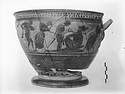
| Depicts seated figure with flute players and dancers. Mended from many pieces. Foot and most of bowl preserved; handles missing save one side of one. On either side a bearded draped figure seated on the ... June 1932 ... Beyond, on either side, a female, and a grotesque male dancer. Slight variations in the two pictures. |
Wall fragment. Glaze slightly pitted and abraded. Max. dim. 0.068.
Woman (lower part of head to left, shoulders, upper part of torso), to right, dancing(?). She wears a brassiere (ταινι'α or ἀπο'δεσμος) ... Probably early 4th century B.C ... From what remains on 446, this figure is very likely a dancer. |
|
|