|
|
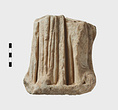
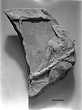
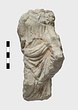
| Broken off above knees. Has shallow rough-picked plinth for setting into a base.
Figure in long heavy chiton or peplos with a mantle hanging down the back.
Perhaps Demeter. Type related to Apollo Patroos ... 22 August 1977 ... Statuette Fragment: Demeter |
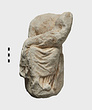
| Demeter seated, holding Kore on her lap. Both heads missing, upper parts of bodies badly weathered.
Both figures wear chiton and himation; Kore's right arm rests on Demeter's shoulder. Demeter sits on ... 12 October 1949 ... Demeter seated, holding Kore on her lap. ... Both figures wear chiton and himation; Kore's right arm rests on Demeter's shoulder. Demeter sits on a plain circular seat.
|
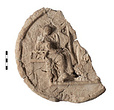
| About half preserved. A few chips missing, including the woman's right shoulder. The back roughly tooled.
Round flat disk with raised band around edge of front.
In relief, a draped female figure, Demeter, ... 15 May 1940 ... In relief, a draped female figure, Demeter, seated right on a throne with turned legs and a winged beast as support for the arm. |
| Intact.
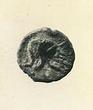
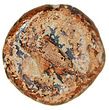
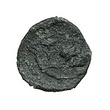
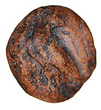
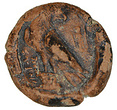
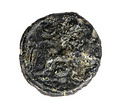
Obverse: Athena and olive tree. Countermark.
Reverse: draped, standing Demeter (?), facing left. With coins for the day nos. 78-97. Leica ... 29 May 1936 ... Reverse: draped, standing Demeter (?), facing left. |
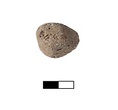
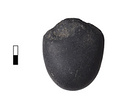
| Single piece of pumice.
Worn smooth on several faces, and tapering to a point at one end. Catalogued 28 June 2000. "Demeter Cistern" ... 20 February-8 March 1932 ... "Demeter Cistern". |
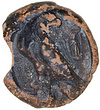
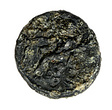
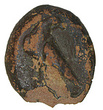
| Obverse: two winged snakes, right.
Probably the serpent drawn car of Triptolemos or Demeter.
Reverse: illegible. Originally entered as coin no. 4. Layer III. Leica ... 30 April 1936 ... Probably the serpent drawn car of Triptolemos or Demeter.
Reverse: illegible. |
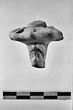
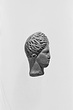
| Broken at neck; battered.
Face completely missing, head preserves a thick stippled wreath on top.
Pink-buff clay. Catalogued April 1972. "Demeter" cistern 9/B. Leica ... March 1932 ... "Demeter" cistern 9/B. |
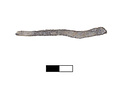
| Single piece of lead, broken off at both ends.
Square-sectioned strip of lead, tapering to one end, slightly flattened at the other. Added 21 June, 2000 "Demeter Cistern" ... 20 February-8 March 1932 ... "Demeter Cistern" |
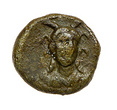
| Obverse: a female bust facing front, wearing a helmet (?).
Reverse: plain.
ADDENDA: Demeter or Kore bust wretahed with corn (Gkikaki July 2020). Cleaning floor of Great Drain. 1410 Leica ... 27 April 1948 ... ADDENDA: Demeter or Kore bust wretahed with corn (Gkikaki July 2020). |
| Single piece of stone.
Very smooth; rounded at one end for holding and broken away by repeated striking at other end.
Sculptor's tool (?).
Basalt (?). Catalogued 23 June 2000. "Demeter Cistern" ... 20 February-8 March 1932 ... "Demeter Cistern". |
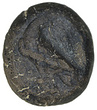
| Obverse: an eagle left.
In field right a standing draped figure with two torches (Artemis or Demeter ?); in field left, an inscription.
Reverse: plain.
Black to reddish glaze, worn.
Well, in passage near ... 16 April 1934 ... In field right a standing draped figure with two torches (Artemis or Demeter ?); in field left, an inscription.
|
| Obverse: Athena, left, with shield on left arm, olive tree to her right.
Reverse: draped standing figure, Demeter (?). At left a wheel. With coins for the day nos. 3-18. in zip lock bag in conservation ... 21 May 1936 ... Reverse: draped standing figure, Demeter (?). At left a wheel. |
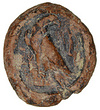
| Obverse: an eagle left, head turned back, standing.
In field, right, woman holding two torches, Demeter or Artemis. In field left, an inscription.
Reverse: plain.
Thin black wash.
Red fill under late ... 27 February 1935 ... In field, right, woman holding two torches, Demeter or Artemis. |
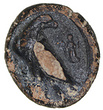
| Obverse: an eagle standing left, but with head turned back.
In field right, standing female figure with two torches (Demeter or Artemis ?). In field left an inscription.
Reverse: plain.
Blackened by fire ... 16 April 1935 ... In field right, standing female figure with two torches (Demeter or Artemis ?). |
| Partly broken away behind.
Obverse: an eagle left, head turned right. In field right a standing draped figure with two torches (Artemis or Demeter ?); in field left, an inscription.
Reverse: plain.
Glazed ... 17 April 1934 ... In field right a standing draped figure with two torches (Artemis or Demeter ?); in field left, an inscription.
|
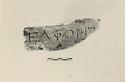
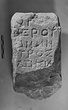
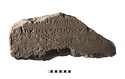
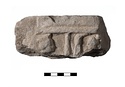
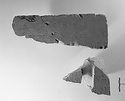
| Inscribed fragment.
Inscribed face only preserved.
Dedication to Demeter and Kore.
One line of the inscription preserved.
Pentelic marble.
ADDENDA Joins I 5299. Found in a context of Turkish times west ... 17 March 1939 ... Dedication to Demeter and Kore.
One line of the inscription preserved.
|
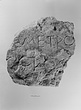
| Inscribed fragment.
Broken at right, a little at left, and possibly above and below.
Boundary Stone of Demeter.
A rough slab of Hymettian marble. Found beneath the floor of the Stoa of Attalos, in front ... 29 May 1950 ... Boundary Stone of Demeter.
A rough slab of Hymettian marble. |
| One end broken away. Irregular clay pellet.
Obverse: an eagle standing left.
In field right, standing draped female figure with two torches (Demeter or Artemis ?). In field left an inscription.
Reverse: ... 30 May 1936 ... In field right, standing draped female figure with two torches (Demeter or Artemis ?). |
| Small inscribed boundary stone.
Broken at the bottom, and chipped at the top.
Sanctuary of Demeter Azesia.
Most of five lines of the inscription preserved.
Hymettian marble. Found in a modern wall, over ... 4th. century B.C ... Sanctuary of Demeter Azesia.
Most of five lines of the inscription preserved.
|
| Obverse: eagle standing left, head thrown back.
In field to right, a draped female figure erect, Demeter or Artemis (?), a tall torch (?) in either hand. In field to left, a branch and an inscription ... 18 June 1937 ... In field to right, a draped female figure erect, Demeter or Artemis (?) |
| A small fragment missing. Otherwise intact.
Obverse: an eagle (?) left, with head turned back over its shoulder.
In field right, standing draped female figure with two torches (Demeter or Artemis ?) ... April 1934 ... In field right, standing draped female figure with two torches (Demeter or Artemis ?). |
| Mold for a woman broken off across the chest.
Fine pink clay, baked fairly hard.
ADDENDA: Mold for a group of two girls or Demeter and Kore. Pit. Probably from the filling of the cistern at 17-18/ΛΑ ... 4 May 1938 ... ADDENDA: Mold for a group of two girls or Demeter and Kore. |
| Obverse: an eagle standing left, but with head turned back.
In field right, standing female figure with two torches (Demeter or Artemis ?). In field left an inscription.
Reverse: flat, plain.
Poor black ... 10 May 1935 ... In field right, standing female figure with two torches (Demeter or Artemis ?). |
| Inscribed fragment of statue base.
Top and left side are preserved; otherwise broken.
Dedication to Demeter and Kore.
Five lines of the inscription preserved.
Bluish pentelic marble.
ADDENDA Joins with ... 15 January 1937 ... Dedication to Demeter and Kore.
Five lines of the inscription preserved.
|
| Inscribed fragment of statue base.
Inscribed face and left side preserved.
Surface much worn, especially at left.
Base for the statue of a priestess of Demeter.
Three lines of the inscription preserved ... 5 May 1939 ... Base for the statue of a priestess of Demeter.
Three lines of the inscription preserved.
|
| Obverse: an eagle standing left, with head turned back to right.
In the field to right, a standing draped female figure (Demeter or Artemis ?) with a tall torch upright in either hand. In the field to ... 29 April 1937 ... In the field to right, a standing draped female figure (Demeter or Artemis ?) |
| Obverse: an eagle standing left, head turned back to right.
In the field to right, a standing draped female figure (Demeter or Artemis ?) with a long torch in either hand. In the field to left an inscription ... 22 May 1937 ... In the field to right, a standing draped female figure (Demeter or Artemis ?) |
| A: seated figure left, with branch in left arm, right outstretched.
Snake or tree (?) in front. Crescent in field upper left. All in border of dots.
Possibly Demeter left, in serpent car.
B: bumpy, no ... 16 May 1947 ... Possibly Demeter left, in serpent car.
|
| A: seated figure left, with branch in left arm, right outstretched.
Snake or tree (?) in front. Crescent in field upper left. All in border of dots.
Possibly Demeter left, in serpent car.
B: bumpy, no ... 16 May 1947 ... Possibly Demeter left, in serpent car.
|
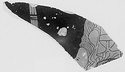
Shoulder fragment with start of return. Dull, grainy black glaze on inside. Max. dim. 0.106.
Woman (part of right arm and torso), probably Demeter or Persephone, standing frontally, wearing a peplos over ... Ca. 460-450 B.C ... Woman (part of right arm and torso), probably Demeter or Persephone, standing frontally, wearing a peplos over a chiton. |
| Inscribed fragment of stele.
Broken off diagonally from the left and across the bottom. Part of the pedimental top preserved.
Decree in honor of Satyra, daughter of Krateas of Melete, thesmophoros of Demeter ... 2nd. century B.C ... Decree in honor of Satyra, daughter of Krateas of Melete, thesmophoros of Demeter and Kore.
Fourteen lines of the inscription preserved.
|
| Head under large hat.
Tip of hat seems to be broken away.
Head covered with veil which crosses mouth right to left; features dim. The hat rests on top of the head; the broad brim is folded back in sections ... 1 March 1932 ... "Demeter " cistern.
350-300 B.C. |
| Inscribed fragments.
Dedication to Demeter and Kore.
Fragment ΙΙ 243 a), inscribed face preserved.
Two lines of the inscription preserved.
Fragment ΙΙ 243 b), right side preserved.
One line of the inscription ... 7 March 1938 ... Dedication to Demeter and Kore.
Fragment ΙΙ 243 a), inscribed face preserved.
|
| Upper wall and shoulder fragment from a large partly closed vase: stamnos or column krater? Part of a woman, in chiton with peplos over it, holding a torch in the right hand. Partial relief contour.
... 5 April 1933 ... ADDENDA Amphora?
Demeter and Kore?
ADDENDA (Sept. 2020), according to Agora XXX, Amphora or Pelike fragment. |
| The upper part of a small relief, broken away below. Part of the left edge preserved, close to right edge also.
The heads of two women are facing. The one at the left wears a polos and holds a staff in ... 24 March 1936 ... The one at the right has her hair tied on top, and holds a torch: Demeter and Persephone
Hymettian marble. |
| Obverse: an eagle standing left, with head turned back to right.
In the field to right, a standing draped female figure (Demeter or Artemis ?) with a long torch in either hand. In the field to left an ... 13 May 1937 ... In the field to right, a standing draped female figure (Demeter or Artemis ?) |
| Mold for female figure with right arm raised right leg bent; left side, head and area below knees missing. Exterior of mold roughly smoothed.
Broken on sides. One side, back and front preserved.
Fabric: ... 28 June 1973 ... Mourning Hydroforos or woman (Demeter?) carrying a child on shoulder (?). |
| Inscribed base.
Left side hacked off and reworked, and face much chipped.
A rectangular cutting, rough picked, inside top, its dimensions ca. 0.27X 0.222 X 0.065m. deep.
Front and right faces smoothly ... 2 June 1938 ... Dedication (?) to Demeter and Kore.
Four lines of the inscription preserved.
|
| Top and rough-picked back of relief slab preserved.
At right is the torso of a woman, Demeter, dressed in a chiton, facing; in her right hand she grasps the lower end of a torch, which she carries diagonally ... 13 May 1938 ... At right is the torso of a woman, Demeter, dressed in a chiton, facing; in her right hand she grasps the lower end of a torch, which she carries diagonally across her body. |
| Inscribed fragment.
Head missing, and part of right leg; minor fractures.
The eagle is standing, his left foot advanced. Feathers carved in shallow but naturalistic style. In bottom surface of plinth, ... (ΙΙ 430) 9 May 1938
(ΘΘ 296) 21 May 1938 ... Dedication to Demeter and Kore; "The two Goddess".
|
| Rough-picked back, right side, bottom except for broken tenon and part of top, with cutting above third figure from right, preserved.
Four figures, from left to right: seated draped figure right, with ... 2 May 1952 ... Same subject, identified as Demeter, Kore and possibly Iakchos carrying infant Ploutos. |
| a) From the shoulder of a large volute krater of heavy fabric. Tongue pattern around base of neck. The upper part of a garlanded male head, left; in front, the flame of a torch added in red. Letters in ... 14 April 1939 ... Head and shoulders of Demeter, left. In front of her, a phiale and the staff of a flowering scepter, one or both held by Triptolemos facing the goddess.
|
| Statuette of which head, feet, right arm below elbow, and left hand, are missing.
The draped female figure is standing with weight on left leg, the right leg bent at the knees. Her right arm hangs by her ... 10 May 1935 ... Possibly the statuette represents Demeter. Workmanship is mediocre.
|
| Preserved with neck. End of nose and chin worn, and part of plait (?) broken away, back of head.
Hair parted in the middle, high curly mass leaving the brow triangular. Regular features in oval face. Ears ... 7 March 1932 ... Cistern at 3.23m. below stone. "Demeter" cistern.
Late 4th c. |
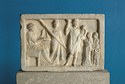
| Complete. Rectangular plaque with plain border, tenon for setting below and rough-finished back.
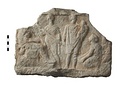
Seven figures in low relief, left to right: draped woman (Demeter) with staff (?) in left hand and patera ... 11 June 1947 ... Seven figures in low relief, left to right: draped woman (Demeter) with staff (?) |
| Inscribed fragments.
Dedication to Demeter and Kore by the wife of a Daidouchos from Halai.
Fragment ΙΙ 181 a), inscribed face, right side and top preserved.
Apparently from a base.
Three lines of the ... a) (ΙΙ 181) 12 February 1938
(II 436) 13 May 1938
b) (ΙΙ 286a) 19 May 1938
c) (ΙΙ 286b) 21 May 1938 ... Dedication to Demeter and Kore by the wife of a Daidouchos from Halai.
|
| Complete except for chips; mended from many pieces.
Medallion: rosette with two rows of ribbed leaves, surrounded by a scraped groove; from this spring a row of small ribbed leaves and two rows of large ... 4 May 1971 ... Following the chariot: three indistinct figures (one is Demeter); a female armed with round shield, spear and helmet (Athena); a draped female with drawn bow and arrow (Artemis).
|
Wall fragment with start of rim. Narrow reserved line on inside. Glaze misfired a little on outside. Max. dim. 0.097. P. E. Corbett, Hesperia 18, 1949, pl. 80:4; Schwarz, Triptolemos, p. 51, cat. no. V ... Late 5th century B.C ... The manner in which the olive leaves on the rim meet indicates this is the center of this side; thus, Triptolemos was probably flanked by Demeter and Persephone.
|
Two non-joining fragments of slightly outturned rim and wall. Max. dim. a) 0.081, b) 0.047.
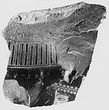
Triptolemos. Fragment a (illustrated) shows on the left either Demeter or Persephone (legs missing from the ... Probably mid-4th century B.C ... Fragment a (illustrated) shows on the left either Demeter or Persephone (legs missing from the knees down) to right, holding two torches. |
Wall fragment from rather low on the vase. Max. dim. 0.093.
Triptolemos (segment of wheel and wing of throne) to right. Relief contour. Rim of wheel incised (compass-drawn). Dilute glaze: decoration at ... Second quarter of the 5th century B.C ... Dugas ("La mission de Triptolème d'apres l'imagerie athénienne," Melanges Rome 62, 1950, pp. 9--31 [reprinted in Recueil Charles Dugas, Paris 1960, pp. 123--139]) recognized three categories of this theme in Greek art: (1) Demeter giving instructions to Triptolemos, often with Kore present; (2) Triptolemos about to set off on his mission and a libation being poured; (3) Triptolemos and the Eleusinian divinities following his return to Eleusis. |
| Inscribed statue base with dedication.
Besides the large piece of the long face, many small fragments were found built into the wall of the modern drain, including one bit with the letters "M H". One fragment ... Second quarter of 4th. century B.C ... The facing block for the base of a statue (or group) dedicated to Demeter and Kore; and bearing the signature of Praxiteles.
|
Four non-joining fragments, a -- c of shoulder, d of neck. Glaze misfired slightly on tongue pattern on fragment a. From a very large krater. Max. dim. a) 0.127, b) 0.15, c) 0.089, d) 0.093. G. Schwarz, ... Ca. 460 B.C ... Fragment b shows most of the head, neck, and shoulders of Demeter, dressed in a chiton and standing to left. ... She did not observe the inscription naming Zeus and thus calls him Triptolemos; nor did she notice the flames of Demeter's torch painted below her name; the goddess on fragment b is not identified and the scepter, branch, and phiale are not linked with Triptolemos but merely mentioned. For Demeter with the torch against her shoulder, see the figure of her in the Triptolemos scene on the calyx-krater in Lyons by the Altamura Painter, E 120 (ARV2 591, 24; Prange, Niobidenmaler, p. 164, cat. no. |
Wall fragment. Max. dim. 0.12. Schwarz, Triptolemos, p. 37, cat. no. V 49, pl. 8:14; Hayashi, Triptolemosbildes, p. 136, cat. no. 37, pl. 5:1 (wrongly called a calyx-krater); Langridge, "Eucharides Painter," ... Ca. 490-480 B.C ... Of the three episodes in this myth recognized by Dugas, 289 probably depicted the second, the departure for the mission where Triptolemos sits on the throne flanked by Demeter and Kore, one of whom pours a libation into his phiale. |
| Inscribed fragments of votive or funerary reliefs.
Cave of Pan relief.
Fragment Ω 1525, broken all around. Part of top and bottom surfaces preserved. Bottom border of a stele with part of the tenon preserved ... 330-320 B.C. (?) ... Both arms broken off (Demeter); draped male figure facing left, behind a rock altar. |
Krater.
Most of rim, part of body, and one handle restored. Foot chipped, hole in floor (probably intentional); some appliqué figures partly missing.
Molded foot; broad, flat resting surface. Low, hollow ... Context of 150-110 ... She wears high-girt chiton with mantle over her head and across her lower body (Demeter?).
Side B: (6) Left part of appliqué missing. |
|
|