|
|
Well at edge of east slope of Kolonos Agoraios. Essentially uniform fill of second half of 8th c. B.C. but some earlier material. Thrown out from destroyed graves ... Early Geometric to third quarter of 8th c. B.C. |
| Dorothy Burr Thompson ... Grave 4 in notebook. (E.L. Smithson: Grave XLIV). No remains (not really a grave, note on p. 331).
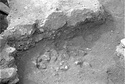
Roughly rectangular patch of unworked fieldstones, measuring about 1.20x0.80m neatly laid on bedrock, ... 19-21 March 1932 ... The similarity of this feature to funerary deposit/ Q 8:12 in the cemetery along the south bank of the Eridanos, and in close proximity to Mycenaean and Early Iron Age graves, suggests that both deposits are funerary in nature. |
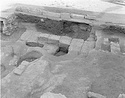
Mycenaean Grave below Stoa stylobate opposite pier 21, about 0.75m below the bottom of the Stoa conglomerate foundations. Although only the south side and the west end could be certainly fixed, the dimensions ... Myc. III A-early IIIB |
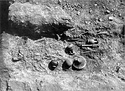
| Evelyn Lord Smithson ... Grave 3: (Grave XXVII: EG). Urn cremation (trench-and-hole), adult male. Carbonized figs and grapes included in inventoried objects (no number). [JP]
"Craftsman-Warrior" tomb: combination of weapons and ... Early Geometric I |
Eugene Vanderpool ... Disturbed burial: Pocket in bedrock (Grave 11: PG). In some records as Grave XI. No remains. No cutting or traces of burning nearby
The coin listed here was found "cleaning bedrock", presumably at the ... Developed to Late Protogeometric ... The vases constitute evidence for early burials on the southeast slopes of the Kolonos Agoraios, although no trace of graves, or of any robbed tomb pits, was preserved nearby. |
| Well South of Soft Yellow Poros Foundation. Dumped filling of a collapsed well, that, due to hazardous conditions, could not be cleared below- 2.50m. The well was partly cut on the east side by a Byzantine ... Protogeometric-Early Geometric II, ca. 850 B.C ... The well was partly cut on the east side by a Byzantine storage pithos, and on the south side it was disturbed by another, tile-lined, well of the Roman period (U 19:4), which had been used for water and then as a cesspool inn the early 20th century.
Filling almost entirely later Protogeometric, with a few sherds of Earliest Protogeometric, all apparently drawn from disturbed graves.
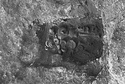
At -1.50m a complete and ordered skeleton (man of 45-50 years old), doubled up so that its thighbones were parallel to and to the backbone, lay on a rough stone slab. |
| Dorothy Burr Thompson ... Child's Grave (E.L. Smithson: Grave XXVIII: G).
Cf. Container Lot ΣΤ 165 (fill over geometric grave).
Neat, rectangular, unlined trench, cut into bedrock to a preserved depth of 0.20m,below the level ... Early Geometric I |
| Eugene Vanderpool ... Rectangular pit, oriented east-west, cut party into filling of Early Protogeometric pit-well (I 18:4), to a preserved depth of about 0.30m. A late Byzantine wall founded below the floor of the grave destroyed ... Middle Geometric I ... Rectangular pit, oriented east-west, cut party into filling of Early Protogeometric pit-well (I 18:4), to a preserved depth of about 0.30m. ... Although half of the tomb was entirely destroyed by later building activity, what survived constitutes one of the richest graves on the slopes of Areopagos and in Early Iron Age Athens. |
|
|