|
|
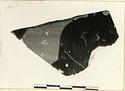
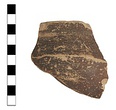
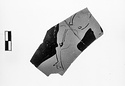
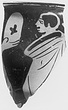
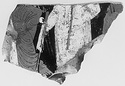
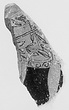
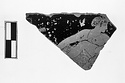
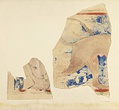
| Broken all around. Unidentified representation from reverse of Panathenaic amphora. Agora excavations. Leica ... 5 February 1962 ... Agora excavations. |
| Small fragment from shoulder.
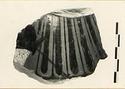
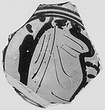
Head of Athena to right; tongues. Landscaping operations in the excavations; exact provenience unknown. Leica ... January 1955 ... Landscaping operations in the excavations; exact provenience unknown. |
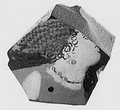
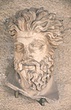
| Wall fragment. Male head, wreathed and bearded, left. Partial relief contour. Surface of Panathenaic Way; Agora excavations. Exact provenience unknown. Leica ... March 1957 ... Surface of Panathenaic Way; Agora excavations. Exact provenience unknown. |
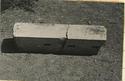
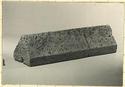
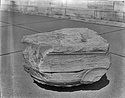
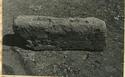
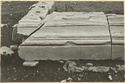
| One corner missing; projecting molding mostly broken off.
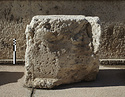
Poros. Finished Lying as left after earlier excavations east of Hypapanti Church. 251 Leica ... April 1959 ... Lying as left after earlier excavations east of Hypapanti Church. |
| Part of rim preserved; short-topped handle.
Circular stamp with monogram. Context unknown; from the excavations. ΑΡΤ (Α,Ρ,Τ monogram in O) Leica ... (1949) ... Context unknown; from the excavations. |
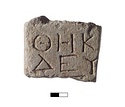
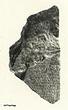
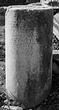
| Inscribed fragment of columnar grave monument.
Broken all around.
Inscribed face only preserved
Two lines of the inscription preserved.
Hymettian marble. Brought in from the excavations; provenience unknown ... 1949 ... Brought in from the excavations; provenience unknown. |
| Fragment of prehistoric vase with part of rim. Buff clay, brown matte paint covering vase inside and out.
Found by Oscar Broneer during final cleaning of excavations, with preceding. Finished ... 1 Oct 1932 ... Found by Oscar Broneer during final cleaning of excavations, with preceding. |
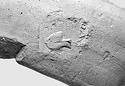
| Lightly struck stamp, rectangular, with a small head(?) right, and two letters preserved near the corner.
Early Thasian. Finished Context unknown; from the excavations. Ἀ[λ]θημ̣( | Θασ̣[ίων | ---]
... (1949) ... Context unknown; from the excavations. |
| Inscribed fragment.
Broken at back and sides; traces of tooth chisel on the bottom.
Parts of eight lines of the inscription preserved.
Hymettian marble. Brought in from outside the excavations. Leica ... May 1933 ... Brought in from outside the excavations. |
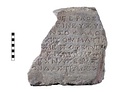
| Inscribed fragment.
Left side perhaps original; otherwise broken all around.
Part of two lines of the inscription preserved, with traces of the lines above and below.
Pentelic marble. Brought in from the ... January 1957 ... Brought in from the excavations, finding place unknown. |
| Intact.
Button-like object but hole not pierced through. A couple of grooves and ridges near edge; also around "hole".
On undersurface, groups of scratches radiating from the center. Catalogued April 1954 ... From Agora excavations, exact provenience unknown. |
| Head and shoulders of woman, right; peplos, earring, necklace, knitted(?) sakkos. No relief contour. Added clay for ornaments; white for flesh; the dress once painted in an added color.
Pinkish-buff ... (1953) ... Agora excavations, provenience unknown. |
| Most of foot and center of floor preserved, with start of walls. Moulded ring foot.
Interior, mantel figure, right. Other figures on sides A and B. No relief contour. Glazed and reserved circles on underside ... March 1957 ... Areopagus dump; Agora excavations. Exact provenience unknown. |
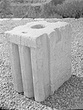
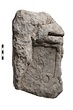
| Broken at top and upper parts of sides. All four sides worked smooth, bottom rough-picked.
From late reconstruction of Peribolos of Eponymous Heroes.
Pentelic marble. Found at I/19-11/2 (Fall 2016). Found ... 31 July 1967 ... Found in early excavations. Inventoried 31 July 1967. |
Part of wall and foot.
Recessed bottom, slightly concave. Fired black and red.
In the 1967 excavations two wall fragments of a mug, P 27793, were found which have narrowly spaced concave ribs and which ... 450-425 B.C ... In the 1967 excavations two wall fragments of a mug, P 27793, were found which have narrowly spaced concave ribs and which preserved the start of the plain rim. |
| Broken at bottom, back and one side. Top preserved. Front surface worked smooth; side left slightly rough.
From late reconstruction of Peribolos of Eponymous Heroes.
Pentelic marble. Found at I/18-11/1 ... 31 July 1967 ... Found in early excavations. Inventoried 31 July 1967. |
| Reused as millstone (or as olive press weight, see Expedition 21), but in excellent preservation.
On top, mason's mark, the letters: Σ Δ. On either side at bottom a dowel cutting and pry cutting.
From ... February 1953 ... Found February 1953, in the excavations of the Greek Archaeological Service at the corner of Nike and Apollo Streets. First transferred to the mosque near the Market of Caesar and Augustus, and later (spring 1953) to the Agora Excavations. |
| Torso of nude male figure with part of the left arm and right leg. Relief lines sketchy. The figure appears to be advancing rapidly to the left.
Attic clay; black glaze inside. Clearing old excavations: ... 13 June 1931 ... Clearing old excavations: N.W. corner of Dörpfeld's 'stoa'. |
| Intact.
A. head of Athena in crested Corinthian helmet, right, dolphin in field, below, at right, star above.
Circle of dots.
B. head of Poseidon, right. Trident in field, right, twined around by dolphin ... 20 April 1937 ... Surface of last year 's excavations in section Σ. |
| Broken at top. Bottom and four sides preserved. Front worked smooth, other sides left slightly rough-picked, bottom rough.
From late reconstruction of Peribolos of Eponymous Heroes.
Pentelic marble. Found ... 31 July 1967 ... Found in early excavations. Inventoried 31 July 1967. |
| Inscribed fragment of base (?) from a monument.
Small rectangular pilaster with moulding around lower part.
Dowel hole in center of bottom.
Lower part only preserved; broken above.
Pentelic marble. Found ... 27 December 1949 ... Found in marble dump, in pre-war excavations in the area of the Stoa of Attalos. |
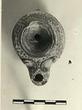
| Handle missing; point of nozzle chipped.
Deep sunk discus set off by raised bands; body decorated with raised dots; scrolls at nozzle.
On base, in relief, within a raised circle: "A".
Type XX of Corinth ... May 1935 ... During excavations for water main in "Odos Anaprastos", west of Theseion Plataea. |
| Rim fragment from multiple kernos, with one saucer and part of handle preserved.
Rather worn black glaze inside and out, save for underside of rim and immediately adjacent wall.
Cf. Agora XII, no. 1364 ... 16 March 1936 ... Dump from Greek excavations in Stoa of Attalos. |
| About one-third of floor and high moulded ring foot preserved.
On floor, head and shoulder of cloaked youth, right.
Poor mottled black to brown glaze. Scratch on bottom probably part of graffito. Tin ... 16 March 1936 ... Dump from Greek excavations in Stoa of Attalos. |
| Single fragment preserves some of sharply out-turned rim and of wall. A draped standing figure facing left; facing him part of drapery of a second figure, the hand holding "discus" decorated with a cross ... 1 December 1954 ... Ramp east of Theseion; mixed fill dumped from excavations. |
| Broken at top; all other sides preserve ancient surface. Two joined fragments.
Front and sides picked fairly smooth, back left rough. Both sides preserve three slots each for fence rails.
From late reconstruction ... 31 July 1967 ... Found in early excavations. Inventoried 31 July 1967. |
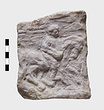
| Small roughly worked slab, the top broken, the sides apparently original, a little finished lower surface apparently preserved at lower right.
Horseman right, crudely blocked out; details uncertain. A ... March 1957 ... From the Areopagos Dump: Agora excavations, exact provenience unknown. |
| Inscribed fragment.
Broken above, below and at left.
Back surface very rough picked; right side worked smooth with tooth chisel. Only relatively small triangular area of inscribed surface reserved.
Non-stoichedon ... 29 November 1970 ... Found in dump of pre-war excavations. Now in section ΝΝ, but dump from all over site. |
| Broken at top and bottom but original surface preserved on four sides. Several joining fragments. All sides worked smooth. One slot for fence rail preserved on each side.
From late reconstruction of Peribolos ... 31 July 1967 ... Found in early excavations. Inventoried 31 July 1967. |
| Two joining fragments preserved complete block. Triangular in section with truncated sides. Dowel at bottom of one end only. Both ends dressed with slight anathyrosis. Dressed smooth with toothed chisel ... 5 June 1968 ... Found in earlier excavations. Inventoried 5 June 1968 |
One end broken off, existing piece bent out of original shape.
Thin, angular band; preserved end a tapering knob with fillet above; end was purposely bent to form a hook for affixing to a vessel.
Cf ... 400-350 B.C ... Robinson, Excavations at Olynthus, X, Metal and Minor Miscellaneous Finds, Baltimore, 1941, pp. 207-221, pl. |
| Part of relief face and rough-picked back only preserved; front surface much battered.
Left side of a standing draped figure with bent left arm resting on object at his left, possibly a lyre, rectangular ... 5 July 1946 ... Found among marbles in court June 1946; almost certainly from Agora Excavations; section and exact provenience unknown. |
| A single fragment preserves part of handle, rim and discus.
On discus, christian symbol. On rim, raised concentric circles.
Dull reddish to blackish glaze-wash.
Type XXXI of Corinth collection.
ADDENDA ... 9 June 1939 ... Possibly parallel from old Marinatos excavations in cave at Amnisos, Crete. |
Neck only.
From a large neck-amphora. Collar rim concave on exterior; stubs of strap handles. Firm red glaze on top and outside of rim, and on outside of handles. Unglazed inside.
Similar exterior profile ... Context of late 5th c. B.C., heavily disturbed in Roman times ... Similar exterior profile but with the inner measuring ledge as on 1460, a fragment P 27408 S 16:1, context of last quarter of 5th century (1965 excavations). |
| Broken at top and along one side. Full width preserved at back. Front has shallow groove tapering toward bottom. Sides have slot for fence rails. Dowel hole in bottom outside edge for doweling to sill ... 31 July 1967 ... Found in early excavations. Inventoried 31 July 1967. |
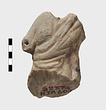
| Head missing, also right forearm and left arm. Broken across lower torso.
Draped female figure wearing chiton and himation. Right forearm was separately attached, as shown by pinhole at the elbow; head ... 30 January 1971 ... Found in dump of pre-war excavations now in Section ΟΟ, but dump from all over site. |
| Woman kneeling on her right knee and bending forward. Head, arms, knees and toes of right leg missing. She wears a chiton. On her right shoulder rests the hand of another draped person who formed the right ... February 1955 ... Excavations dump. |
| The right upper arm of a statue in the Archaic manner, a kore, buttoned into a crinkly garment, himation. Lower front part preserved of socket, perhaps for a separately added forearm. The inside of the ... Last quarter of 6th c. B.C ... Found outside the excavations in a cafeneion on Eponymon Street. |
| Probably crowning member, i.e. mouth and flaring lip of a grave lekythos. Broken edges at bottom, but hole for attachment indicates that this piece was made separately and is almost complete as preserved; ... 5 July 1946 ... Probably from Agora excavations; brought into house some time between 1941 and 1946. |
| Complete except for nozzle and parts of right side and bottom.
Plain rim, plain horse-shoe-shaped discus with channel on neck. Volutes on either side of nozzle. Pierced and grooved handle; no signature ... 12 April 1937 ... Clearing in Greek Excavations west of the Stoa of Attalos, in pocket of ash beneath strosis of second century A.D., with coin no. 28 for the day. |
| Broken at top; original surface preserved on all other faces. Back rough-picked. Front and sides left slightly rough with smooth band along edges. Sides preserve bottom of first slot for fence rail on ... 31 July 1967 ... Found in early excavations. Inventoried 31 July 1967. |
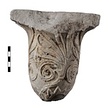
| Full height and main mass of corner capital preserved, much damaged all around. Of the volutes only about half of one and a small bit of another preserved.
Pentelic marble.
Same series as A 1130 (ΙΙ 514) ... 15 June 1951 ... Dionysios Areopagite during Soteriou's excavations. Brought to the excavation house 15 June 1951. |
| From lower edge of wing near body.
Preserves part of front surface, with feathers, and back surface, covered by folds of a flying mantle, of right wing of Nike or similar figure.
At top what seems to be ... 1955 ... Not certainly from Agora excavations. |
| From the floor of a very large plate; two moulded rings beneath; fish plate? Parts of four figures: leg of small standing figure, white, Eros. Knees and legs of draped seated female figure; standing female ... March 1957 ... Areopagus dump; Agora excavations. Exact provenience unknown. |
| Inscribed column drum.
The drum is one of a series which have been used in building the wall. Found stands upright in the tower.
Two dowel cuttings in the top. It was uncovered in the earlier excavations ... 17 January 1936 ... It was uncovered in the earlier excavations here.
Honorary monument.
|
Plump jug on high ring foot. Polychrome decoration, a broad taenia, white edged with red, around the shoulder; at the back, strings tie the headband beneath the handle.
For the examples of this shape ... Context ca. 425-400 B.C ... A fragment from a third contemporary deposit, P 27424 S 16:1 (excavations of 1965) preserves part of another decorated jug with traces of a white taenia. |
| Fragments of mouth missing. Flat offset bottom; tall slender body; raised ring at junction of neck and body; round bell mouth; thickened band handle, from lip.
Brownish clay with black particles. Dull ... 26 May 1938 ... Arthur's excavations 1983) [JWH, July 1983]. |
| Part of center of floor and beginning of stem showing reserved bands and moulding. Left hand and knee of a warrior holding a shield, seen in three-quarter view; decorated on the inside with a wreath and ... 18 July 1931 ... Selected sherds from 1931 excavations. |
| Fragment of poros fence. Broken along one side and recut at top; original surfaces preserved front, back, one side and bottom.
Shallow longitudinal groove tapering toward bottom in both front and back ... 31 July 1967 ... Found in early excavations. Inventoried 31 July 1967. |
| Five fragments preserve part of original surface of egg and dart molding of Altar of Temple of Ares (?)
a) Corner piece preserving a little of the projecting fascia above the egg and dart, the height 0.10m ... June 1950 ... From marble piles, from excavations 1940 and earlier, 5.00m. to 10.00m. |
| Head, right arm, feet and chips of figure and seat missing.
Seated in Mother of Gods attitude, but without attributes. Doric chiton and cloak with heavy fold drawn over knees and falling down left side ... 1949 ... From earlier excavations; then placed in colonnade in front of Shop XVI, (the north end of Stoa of Attalos). |
| Two pieces of rim and wall, loose piece (c) of floor. Heavy rolled rim, low curved wall, wide flat floor. Two sets of four shallow grooves on floor, with shallow cross-burnishing imitating rouletting ... 1934 ... ADDENDA Cf. examples (for and fabric) present in a deposit of ca. 75 B.C. at Gravina di Puglia (U. of Alberta excavations, 1991. Magna Graecia/Apulian series? |
| Fragment from left side of inscribed moulded block.
Back, right and part of under surface broken. Top surface original, but not carefully finished.
The inscription is carved on the front surface (inclined ... 30 June 1931 ... Found outside the excavations at the north, on Hephaistos Street. |
| Handle and large portions of body missing; mouth does not join directly. Shape, fabric and technique as P 13162 (Ψ 553), but glaze light yellowish-brown to red.
ADDENDA South Italian or Sicilian, as P ... 26 May 1938 ... Arthur's excavations 1983) [JWH, July 1983]. |
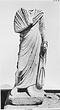
| Lacks head, left arm, right hand, left leg in toto and right leg below knee.
Standing female figure wearing cuirass, cloak and girdle, with a remnant of a sword by her right side.
The surface when not ... 1869 ... Found in 1869 in excavations of the Greek Archaeological Society in the Panagia Pyrgiotissa at south end of Stoa of Attalos. |
Flat-topped rim; walls nearly vertical above, rounded below; spreading ring foot. A broad stripe of glaze crosses the rim at the points of the handle-attachments.
Type common in late archaic contexts; ... Context ca. 520-490 B.C ... A close match to 1825, P 27104, probably from the same shop, was found in the 1963 excavations on the Areopagus along with an example of the common variety, P 27105, having the same flaring foot. |
| Right side broken off. Like A 3732. Upper surface preserves dowel hole without pour channel and cutting for Π-clamp. Right corner of back is cut in roughly 0.15m. from rear surface on left. Anathyrosis ... 24 July 1969 ... It was recovered from the marble pile left by the excavations of the 1860's and set in its present position in the early 1950's. |
| From the wall of a pyxis, part of the rim preserved, the inner vertical flange broken off. Nude female figure reclining left, looking back right. A cloak is thrown over her legs, and she wears an embroidered ... 11 May 1937 ... Vouliagmeni Street, excavations of the telephone company. |
Handles missing.
Foot in two degrees with reserved resting surface; under- side reserved with four circles and dot. Scraped groove just above foot. Decoration inside: five linked palmettes round central ... 390-380 B.C ... The excavations in the Sanctuary of the Nymph, south of the Acropolis, have produced similar early 4th century transitional pieces: Athens, Acropolis Museum 1956 NAK 69, 71, 72, and 75. |
| Well preserved except for corner of lower torus, which is broken away.
Corner block as A 3732 with same features. Upper surface has one lewis hole and a shallow cutting for a dovetail clamp on the return ... 24 July 1969 ... It was recovered from the marble pile left by the excavations of the 1860's and set in its present position in the early 1950's. |
| Fillet and lower toros and face of plinth all broken away. Like A 3732 but from straight course rather than corner. Upper surface preserves lewis hole. Dowel hole without pour channel, and cutting for ... 24 July 1969 ... It was recovered from the marble pile left by the excavations of the 1860's and set in its present position in the early 1950's. |
| Upper left corner is broken off but joining fragment survives. Like A 3732 but from straight course. On upper surface are cutting for Π-clamp on right, lewis hole in center, and dowel (?) hole on left ... 24 July 1969 ... It was recovered from the marble pile left by the excavations of the 1860's and set in its present position in the early 1950's. |
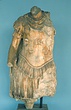
| Complete to neck (head made in separate piece) except for ends of fingers of left hand, ends of object held in this hand, and a small fragment of base.
Draped to ankles in himation with long fold falling ... Possibly 3rd c. A.D ... From earlier excavations; then placed in colonnade in front of Shop XVI, (the north end of Stoa of Attalos). |
| Plinth, lower toros, and square fillet broken for left one-third of the block and block is cracked through behind this. Like A 3732 but from straight course. Upper surface preserves cutting for Π-clamps ... 24 July 1969 ... It was recovered from the marble pile left by the excavations of the 1860's and set in its present position in the early 1950's. |
| Three joining fragments only, the left of which preserves the full molding face. Upper left corner of this piece broken away. Like A 3732 but from straight course. On upper surface are three dowel cuttings ... 24 July 1969 ... It was recovered from the marble pile left by the excavations of the 1860's and set in its present position in the early 1950's. |
| Plinth, lower toros and square fillet broken away on right half of block. Like A 3732 but from straight course. On upper surface are cuttings for Π-clamps at both ends and what appear to be three dowel ... 24 July 1969 ... It was recovered from the marble pile left by the excavations of the 1860's and set in its present position in the early 1950's. |
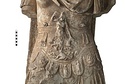
| Lacks head, both arms and both legs.
Female figure wearing cuirass, cloak and girdle.
On front of cuirass in relief, Scylla; on lappets of upper row from left to right, Aiolos, three sirens, Polyphemos; ... 1869 ... Found in 1869 in excavations of the Greek Archaeological Society in the Panagia Pyrgiotissa at south end of Stoa of Attalos. |
Lower part of stand with flaring torus base, flat on underside. Unglazed on inside. Glaze chipped in places, especially on torus. Some abrasion on base. P.H. 0.055; est. diam. of base 0.135.
On side of ... Probably mid-5th century B.C ... It compares rather favorably with such stands, yet, so far, no red-figured dinos may be attested in the Agora excavations. These are the dinos stands known to me: Würzburg 540 by the Achilles Painter (ARV2 992, 69); Ferrara 9379 = T.11 C VP by the Kleophon Painter (ARV2 1144, 11; Paralip. 456, 11; Addenda 334; Matheson, Polygnotos, p. 408, cat. no. |
| Two joining fragments.
a) Lower part of neck with spring of shoulder from a bearded creature with head turned to his right. Good work; surface of marble comparatively fresh. Note spring of background on ... August 1946, 5 July 1949 ... a) From marble pile between Odeion and Giants. b) Reported to have been found in the region of the Frankish Tower at Eleusis, in excavations conducted by D. |
| Two joining fragments of monument base corner block with only small chips missing from original surface. Above a plinth the moldings ascend and step back toward the interior in the order of toros, square ... 24 July 1969 ... It was recovered from the marble pile left by the excavations of the 1860's and set in its present position in the early 1950's. |
| Inscribed fragments of dedicatory inscription of the Stoa of Attalos.
Fragment ΣΑ 317, (a), inscribed face only preserved.
Many additional fragments with parts of letters are preserved.
Fragment ΣΑ 794, ... a) (ΣΑ 317) March 1949
b) (ΣΑ 794) 4 October 1949
c) (ΣΑ 875) November 1949
d) (ΣΑ 876) November 1949
e) (Τ 3112) 31 March 1955 ... Possibly part of post-excavation accumulation and hence from earlier Greek excavations, or perhaps from fallen wall of Byzantine pithos ar edge of trench.
b) (ΣΑ 794), found in debris of late Roman Fortification wall, just north of middle tower (Piers 12-13 E).
c) (ΣΑ 875), found in marble pile from demolition of Middle Tower.
d) (ΣΑ 876), found in marble pile from demolition of Middle Tower.
e) (Τ 3112), found in marble pile.
f) (Υ 454), found in the walls of old excavation houses.
g) (Υ 458), found in the walls of old excavation houses. |
| Seven fragments, making up to four:
a) Two joining fragments preserve full height of block and left end of block, part of bracket and of coffer.
b) Two joining fragments preserve part of fascia below face ... 10 March 1938 ... Seven fragments, making up to four:
a) Two joining fragments preserve full height of block and left end of block, part of bracket and of coffer.
b) Two joining fragments preserve part of fascia below face A, to full height.
c) Two joining fragments preserve part of face B, with full height of fascia, part of soffit and coffer.
d) Preserves full height of fascia below face B, with soffit and part of coffer.
e) A sizable fragment, found 7 April 1959 in file of marbles from 1938-1939 excavations, which joins fragment a) at right and gives part of lioness' belly and part of front leg.
|
Mended with small missing pieces restored in plaster and painted. Lip offset on inside; foot offset on underside. Glaze slightly abraded on handles. H. 0.074; diam. of rim 0.18; W. with handles 0.238; ... Ca. 510-500 B.C ... Camp, The Athenian Agora: Excavations in the Heart of Classical Athens, London 1986, pl. 8, opp. p. 135 (I); LIMC III, 1986, p. 460, no. 428, pl. 349 (B), s.v. |
|
|