|
|
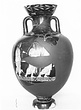
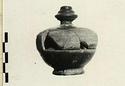
Handle, part of shoulder, a little of wall, all of foot missing. P.H. 0.135; diam. 0.053.
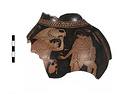
Owl (part of head and body missing). At right, olive sprig. On the shoulder: rays; above, tongue pattern.
Originally, ... Third quarter of the 5th century B.C ... Originally, the owl and sprig were complete. First noted as missing in February 1966.
|
| First interpretation: woman 's figurine.
The head missing.
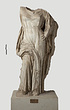
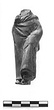
A boy completely muffled in a long himation, the right arm held across the chest under the garment. A round hole in the back.
Traces of white ... 31 May 1935 |
| Back and front surfaces of background preserved, but no original edge.
Parts of two male figures preserved. The first, preserved from chest to ankles, nude save for cloak hanging in folds along his right ... January-February 1949 |
| First interpretation: face of female figurine.
Lower part of the face.
Rounded face; broad flattened nose; small mouth with thick lips; double chin; fat neck.
Mold made; hollow.
Pink clay.
ADDENDA: Same ... 30 June 1931 |
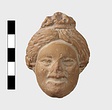
| First interpretation: head of female figurine.
Front part of head.
Large heavy lidded eyes, broad flat nose; thick lips; round fat cheeks; thick neck.
Traces of red paint over white. Mold made. Hollow ... 30 June 1931 |
| First and best preserved section of water pipe from system found in place.
Made of a sheet of lead folded to form a tube. The opening at one end is larger, for insertion of the connecting section of pipe ... 2 May 1952 |
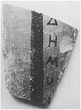
| The pillar beside Athena is in part preserved. At the right, reading downwards: ΔΗΜΟΥ
The archon may be either ΘΟΥ)ΔΗΜΟΥ or ΑΡΙΣΤΟ)ΔΗΜΟΥ. The first was archon in 353/2; the second in 352/1.
Good black ... 29 May 1933 |
| a) Bowl. Mended from many pieces; complete except for chips. Small ring foot, concave underside with small nipple; curving side wall; high vertical flange for lid.
b) Lid. Mended from many pieces; complete ... 17 May 1971 |
| Stoa of Zeus. General Account (September 1931). South Foundations. First Noted. First Cleared. Complete Clearance. East Foundations. Clearing. Explorative Pit North of Railway. Early Pit beneath. Floor ... Α-9 1911, 1912 A 46 A 47 A 49 A 420 A 676 ... First Noted ... First Cleared |
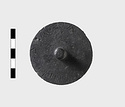
| Intact.
Solid hub.
Inscribed. Obverse : ΨΗΦΟΣ ΔΗΜΟΣΙΑ
Reverse : Ε Ενεπίγραφη δικαστική ψήφος. Terrace, first northern extension. Stoa Gallery 2773 Leica, LXIII-9, LXIII-10, LXIV-34, 80-130, 86-150 ... 27 November 1953 |
| First interpretation: fragment of figure crouching.
Head and feet missing. Broken away behind.
A seated figure,"slave on altar", wearing a short coat and long-legged and long-sleeved tights, plays the ... 27 February 1935 |
Cistern and drawshaft connected by tunnel; used in modern times as cesspool. No stratigraphy noted, but pottery from first five boxes excavated is later than that from boxes 6-18.
11 stamped amphora handles ... Hellenistic and Late Hellenistic ... No stratigraphy noted, but pottery from first five boxes excavated is later than that from boxes 6-18.
11 stamped amphora handles. |
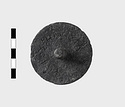
| Intact.
Solid hub.
Inscribed. Obverse : ΨΗΦ[ΟΣ ΔΗΜΟΣΙ]Α
Reverse : two small rectangular stamps, uncertain representations. Ενεπίγραφη δικαστική ψήφος. Terrace, first northern extension. Metals Room 90-27 ... 27 November 1953 |
| Mended from many pieces; profile almost complete. Missing: most of mouth, of back and of foot, handle and much of the front.
Panel: above, palmettes and lotus flower band; below and at the sides a glaze ... 13 March 1955 |
| Small piece missing.
Solid hub.
Obverse : plain
Reverse : Γ Ενεπίγραφη δικαστική ψήφος. Λείπει μικρό τμήμα από την άκρη της. Terrace, first northern extension, layer 5, tumbled mud brick on floor of room ... 27 November 1953 |
| Parts of left foot of a colossal figure.
a) First three toes of foot. Edge of plinth to proper right appears to be original. Very precise work; surface extremely fresh. Traces of red (?) on toenail.
b) ... a) (ΩΔ 229) 15 June 1946
b) (Ι 1640) July 1959 |
| Many fragments preserve most of the lip, both handles, the base and much of the wall. Restored in plaster. Panathenaic shape. Flaring echinus lip; small handles, below lip to shoulder; plain foot flat ... 26 May 1937 |
| Intact.
Solid hub.
Inscribed. Obverse : ΨΗΦΟΣ ΔΗΜΟΣΙΑ
Reverse : Θ Ενεπίγραφη δικαστική ψήφος. Terrace, first northern extension. Metals Room 90-27 Nov. 24, 2003-April 15, 2004 2773 Leica, color slide, ... 27 November 1953 |
| Intact.
Solid hub.
Inscribed. Obverse : ΨΗΦΟΣ ΔΗΜΟΣΙΑ
Reverse : Ε Ενεπίγραφη δικαστική ψήφος. Terrace, first northern extension. Metals Room 90-27 Nov. 24, 2003-April 15, 2004 2773 Leica, color slide, ... 27 November 1953 |
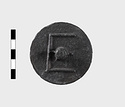
| Intact.
Solid hub.
Obverse : plain
Reverse : E Δικαστική ψήφος, με ανάγλυφη παράσταση γράμματος "Ε". Terrace, first northern extension. Metals Room 90-27 Nov. 24, 2003-April 15, 2004 2773 Leica, color ... 27 November 1953 |
| First interpretation: female head.
The finished lower edge seems to be preserved at the front; chipped at the back.
A woman 's face, with large heavy features and open lips. The heavy roll of hair, parted ... 4 March 1936 |
| Two joining sherds preserve part of floor and much of low ring foot.
Satyr running right, holding a thyrsos in his right hand. The head of the thyrsos is drawn over the maeander border.
Partial relief ... 17 April 1954 ... For the style cf. a cup in CVA Oxford, II, 7; noted there is a stemless cup from the same hand. ... With the Agora fragment came a handful of black glazed and semi-glazed sherds, discarded, looking late archaic: first, or possibly into second quarter of 5th c. |
| Pyre 1 in Central House, Room XI, strosis 3. Sacrificial pyre with characteristic small vases amid carbonized twigs and bone.
Near north side of courtyard. This pit was cut slightly into strosis 3 (lot ... 1st quarter 4th c. B.C ... The pyre is approximately contemporary with the renovation of the house that initiated phase 3 in the first half of the 4th c., so it could be associated with that event. The excavator noted that the pyre :had clearly been burned elsewhere and deposited," but she also described a layer of charcoal 0.05m thick, which seems inconsistent with this conclusion. |
| [Originally identified as pelike]
Many fragments make up part of shoulder of pelike. Upper part of one side preserved; double row of dots in border to either side of panel; linked dots above.
Komos: ... 16 May 1957 |
| Missing: head (which was inserted); right arm (formerly doweled on, as was right foot, traces of the rust of the arm dowel, and the actual dowel itself in the foot are still preserved); fragment from back ... 8 June 1933 |
House R, fill under drain tiles and fillings associated with house K in industrial area, including what was C 19:15, plus C 19:16 and
C 19:17.
a) House built as dwelling in second half of 5th.c.
b) Used ... Ca. 5th and 4th c. B.C ... Most of the material comes however from the second and third phases noted above: either the marble-workers' shop, or the heavy filling of dumped earth and marble chips thrown in over the area when the level was raised for the remodelling of the building at about the middle of the 4th c. ... It is not always possible to distinguish between these two periods; the objects from both, mostly of the late 5th into the first half of the 4th c., have been listed together. |
Cistern with two tunnels, the one entering its neck cut off by an early Roman well, the other, at the bottom not excavated.
Chamber conical in shape, with a depressed draw basin in the center of the floor ... Early Roman-3rd c. B.C ... No stratigraphy noted during excavation, but analysis of pottery suggests three fills, of which the lower two are potter's dumps.
... Latest coin dates in first third of 3rd c. |
http://agathe.gr/overview/the_altar_of_zeus_and_statue_of_hadrian.html The Altar of Zeus The Agora Excavations began with the aim of revealing the monuments and history of the ancient Agora. Of course, every artifact or feature that was exposed held importance, but when something ... On July 23, 1931, the excavator filled five pages of his notebook describing a significant discovery of the first excavation season: "A large structure once covered a large part of [the] area, it was almost certainly an Altar." ... The altar was later identified as the Altar of Zeus Agoraios, an important ancient monument believed to have been erected first on the Pnyx in the 4th century B.C. and later dismantled and re-erected at the turn of the millenium in its present location. ... Lifting the statue to an upright position Cleaning and preparing to photograph the statue The first formal photographic portrait of the statue of Hadrian |
Fifteen non-joining fragments of wall, P 18278 b--c and P 19582 a--d of torus rim with zone of ornament below. Glaze mottled here and there; has a greenish cast in places; abraded in part on rim. Max ... Ca. 480 B.C ... But there are objections to this. First of all, the thickness of the wall between the shield fragment and the two Achilleus fragments differs by one to two millimeters, a difference that does not seem much in print but is important if one considers that the thickness of the wall of a well-potted calyx-krater, like this one, is usually consistent horizontally, although it may vary considerably from top to bottom. ... The woman on P 19582 i cannot hold the spear because, if she did, part of the shaft would appear in front of her, and here there is only black glaze (as already noted by Ashmead, Hesperia 35, 1966, p. 29).
... This interpretation is not without problems. First of all, it would be more compelling if we could include in this composition P 18278 a, the fragment with the shield, but for the reasons given above, this does not seem possible. |
|
|

.jpg.icon.jpg)