|
|
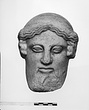
| Complete except for large chip from lower part of beard, and tip of nose.
Front half of the head of a bearded God. The hair is parted in the middle and pulled in long strands to high over the ears, covering ... 23 June 1972 ... Mask of Bearded God |
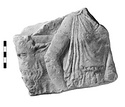
| Rough-picked back preserved; edges broken.
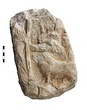
Preserved is part of the torso of a draped female figure, apparently moving to the right, partly facing. Her right, bare arm, slightly crooked at the elbow, ... 7 February 1933 ... Relief Fragment with Draped Female Figure and River-God |
Wall fragment with return. Unglazed on inside. Max. dim. 0.044. Prange, Niobidenmaler, p. 176, cat. no. A 100.
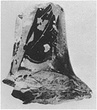
God or king (most of head, right shoulder) to right, dressed in a chiton.
Manner of the ... Ca. 460-450 B.C ... A 100.
God or king (most of head, right shoulder) to right, dressed in a chiton.
|
| Broken at right, setting tongue preserved.
Five figures enclosed by plain border. In center one figure kneels before a standing god and goddess, at the right. At the left of the kneeling figure a standing ... 19 April 1956 ... In center one figure kneels before a standing god and goddess, at the right. |
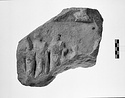
| Bit of left side preserved at lower left, and top preserved at upper right. Broken along diagonal at upper left corner and at the bottom. Molding at top. Original back surface scraped off.
Four, or perhaps ... 22 August 1977 ... Four, or perhaps five, worshippers standing in a row before a god (?). Part of another figure at right side.
|
| Broken top and bottom. From stem of thymiaterion; hollow on break at top, solid on bottom break.
Procession of four figures, upper parts missing. Hermes, goddess, god (end of short cloak hanging down) ... 14 April 1956 ... Hermes, goddess, god (end of short cloak hanging down) and a second goddess. |
Wall fragment from just below rim. Start of handle at far right. Glaze pitted and abraded in places. Max. dim. 0.112.
Symposion with a drunken Dionysos (upper part of god with wreathed head thrown back, ... Late 5th or early 4th century B.C ... Symposion with a drunken Dionysos (upper part of god with wreathed head thrown back, right arm over it, a drinking horn cradled in the crook of his left arm, a himation around his hips). |
| Broken at top, bottom and both sides. Rough-picked back preserved; small area of original surface at bottom.
Part of three figures, a pig and an altar. At left large figure wearing long garment. Behind ... 12 August 1977 ... Behind this group and the altar is a figure on smaller scale who raises his right arm, perhaps a worshipper before a god.
Pentelic marble. |
Rim and body fragment strengthened with plaster. Narrow reserved line on inside at level of rim junction. P.H. 0.157; P.W. 0.175.
Dionysos and satyr. At the left, Dionysos (head with woolen fillet and ... Ca. 440 B.C ... At the right, a satyr (part of back, most of legs missing) playing the aulos faces the god. Around his head is a wreath. |
Wall fragment of stand with part of black band on inside. Glaze flaked here and there. Max. dim. 0.082. LIMC II, 1984, p. 200, no. 85, s.v. Apollon.
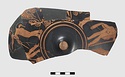
Apollo. The fragment preserves the chin, neck, long ... Ca. 460-450 B.C ... The fragment preserves the chin, neck, long locks of hair, and shoulders of the god standing frontally, head in profile to left, dressed in a chiton with a himation over it. |
| Mended from several pieces; both handles, small fragments from walls, chips from mouth and foot missing. Restored in plaster.
Pomegranate net above the picture. Rays around the base.
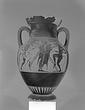
A) Dionysos between ... 15 March 1955 ... A) Dionysos between two dancing Satyrs. The god wears chiton, himation and wreath and holds the cornucopia. |
Body fragment. Max. dim. 0.06. Choes and Anthesteria, p. 87, cat. no. 213, fig. 41; T. B. L. Webster, ἈρχἘφ , 1953--1954 (1957), Oikonomos Memorial Studies 2, p. 196, fig. 1.
Comic mask placed on top ... Ca. 400 B.C ... For a brief treatment of the subject, see van Hoorn (Choes and Anthesteria, p. 25), who accepts Talcott's suggestion that 718 may "be a parody of the Mask-god, quite appropriate to the spirit of the feast," i.e., the resurrection of the liknites (ibid., pp. 24--25). |
Wall fragment of stand. Glaze pitted and flaked in places. P.H. a) 0.175, b) 0.086. E. Papoutsaki-Serbeti, Ὀ Ζωγράφος τῆς Providence, Athens 1983, pl. 33; K. Arafat, Classical Zeus, Oxford 1990, pl. 31 ... Ca. 470 B.C ... Zeus, Athena, and a god (Poseidon[?]). ... Behind her is the next god (head with fillet, right shoulder, and outstretched arm), standing to left, dressed in a long chiton. |
Wall fragment with start of rim. Narrow reserved band on inside near top. Max. dim. 0.044.
Wreathed head of man emerging from between a pair of wings. Preliminary sketch. Relief contour: profile. White ... Third quarter of the 5th century B.C ... The identity of the figure is puzzling because the presence of the beard rules out the usual characters who appear in a winged context, namely Triptolemos and Hyacinth, also Bellerophon and, occasionally, Apollo (for the latter, see the namepiece of the Painter of Vienna 202, in which the god rides a griffin: ARV2 1523, 1; Addenda 385). |
Six non-joining fragments of shoulder and wall, with start of handle at upper left of a. Max. dim. a) 0.079, b) 0.052, c) 0.052, d) 0.033, e) 0.041, f) 0.037. Choes and Anthesteria, p. 84, cat. no. 193, ... Ca. 410 B.C ... Fragment c (illustrated) preserves part of the body, legs, and right arm of the god sitting to left, drapery over his right thigh. |
Rim and body fragment, mended from several fragments and strengthened with plaster. Narrow reserved band on inside at rim; another 0.056 below rim. Glaze pitted and abraded in places, especially on rim ... Ca. 440-430 B.C ... All that remains of the god is a little of his drapery and his right hand holding the reins, as well as a bit of his trident, the prongs of which overlap the wings of the horses. |
All of mouth and neck, much of body restored in plaster and painted. Thin, black glaze on inside. Much of the glaze on the lower part fired red. Some abrasion to left of panel. H. to top of handle 0.245; ... Ca. 440-430 B.C ... At the left, a small satyr (legs, tail) stands before Dionysos, holding out a box or a basket decorated with a maeander pattern. The god (head, right arm, lower drapery, and feet missing) stands to right, looking back, a thyrsos in his left hand, a kantharos (half) in his right. |
Wall fragment from turn of shoulder. Glaze thin and dull on inside. Max. dim. 0.055.
Satyr (part of face, beard, ear, and hair) to right, wearing a spotted feline skin. Overlapping the locks of hair at ... Ca. 490 B.C ... Cf., e.g., the maenad with the fawn skin over her chiton who holds both a thyrsos and a snake on Munich 8732 = 2344 by the Kleophrades Painter (ARV2 182, 6; Paralip. 340, 6; Addenda 186); also the huge serpent held by Dionysos on Louvre Cp 10748, where the god attacks a falling giant (ARV2 187, 55; Addenda 188).
|
Wall fragment with start of rim, mended and strengthened with plaster. On the far right, start of handle. Reserved line on inside at top. Glaze misfired reddish and greenish in places. P.H. 0.22; max ... Ca. 430-420 B.C ... At the far left, hand of someone holding something, probably an aulos, then Dionysos (top of head missing) standing to right, wearing a himation, a wreath around his head, and holding his kantharos in his lowered right hand, his left raised slightly, acknowledging the youth standing frontally, wreathed head turned toward the god. The youth wears a himation, and in his hand he holds a trefoil oinochoe. |
About two-thirds of one disk preserved with a bit of connecting spool. Streaky glaze on underside of disk. Iron stain at top. Diam. 0.113. ILN, Oct. 19, 1935, p. 648, fig. 4; L. Talcott, Hesperia 5, 1936, ... Ca. 480 B.C ... Helios rising. The god stands in his chariot, frontally, head turned to right, a staff or a goad, probably the latter, in his right hand, reins in his left. |
Most of shoulder with start of neck, about half of body. P.H. 0.076; diam. at shoulder 0.082. H. A. Thompson, Hesperia 16, 1947, pl. 47:3; LIMC III, 1986, p. 454, no. 335, pl. 335, s.v. Dionysos; Burn, ... Ca. 410 B.C ... The youthful god sits to right on a decorated cloak, wearing high boots. |
| Much of the floor, part of the wall and rim, and the start of the stem preserved; two non-joining rim fragments with parts of handles and handle ornaments may belong. In medallion, a satyr holds a tray ... 7 June 1937 ... ADDENDA Added fragments give the following: On exterior, upper part of medallion with parts of three figures: Dionysos between maenad (right) and satyr (left). The god is ivy-crowned, nude save for a cloak, which falls across his left shoulder and is held in his right hand. |
Mended with missing pieces restored in plaster and painted, notable among them nearly half of the rim, a section of the wall at handle B/A, about half of foot. Narrow reserved line at rim on inside; another ... Ca. 430-420 B.C ... The youthful god (part of thighs missing), a himation around his hips and legs, reclines to left on a couch, looking back at a maenad dressed in a peplos who holds a tray with a cake on it, her right leg raised slightly. |
Four non-joining fragments, a -- c of shoulder, d of neck. Glaze misfired slightly on tongue pattern on fragment a. From a very large krater. Max. dim. a) 0.127, b) 0.15, c) 0.089, d) 0.093. G. Schwarz, ... Ca. 460 B.C ... Fragment a preserves the upper part of Zeus' face and wreathed head, the god facing to left. |
Thirty-two non-joining fragments of rim, wall, and cul. Narrow reserved band on inside of rim, another 0.082 below rim. Glaze pitted on some fragments; has a greenish cast here and there. Max. dim. P 7282 ... Ca. 440 B.C ... P 8445 b (illustrated) shows most of the head and part of the chest of the god standing frontally, his head turned to left. |
Mended with small missing pieces restored in plaster and painted. Lip offset on inside; foot offset on underside. Glaze slightly abraded on handles. H. 0.074; diam. of rim 0.18; W. with handles 0.238; ... Ca. 510-500 B.C ... In his lowered right hand he holds his kantharos; in his left, resting on his right thigh, he grasps the end of a branch of ivy, which fills the field in front of him. The god wears a long chiton with a himation over it. |
|
|