|
|
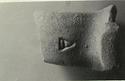
| Part of rim preserved. Well; top of fifth meter. ΑΔ (inc) Leica ... 22 April 1936 ... Well; top of fifth meter. |
| A large crumpled sheet of lead, apparently a cover of vessel (?). Agora sample no. 227. Well 15, about end of 5th meter. Leica ... 1 April 1939 ... Well 15, about end of 5th meter. |
| Point of pin broken off.
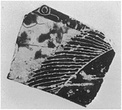
Bow has longitudinal ridge with cross-hatching in relief. Well in street of Roman Agora, 2nd meter.
Early Roman : 1st c. A.D. Leica, Various vii-87 ... 6 August 1946 ... Well in street of Roman Agora, 2nd meter.
Early Roman : 1st c. |
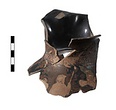
| Fragment from wall preserving part of a quadriga scene. Portions of the heads of three horses remain to left. The middle horse has applied white. Between temples of Apollo and Meter; pit f. Found with ... 10 March 1938 ... Between temples of Apollo and Meter; pit f. Found with mould for archaic statue. |
| Fragment of shoulder of an amphora(?) with the stump of a ridged handle. Horizontal ribbing below the handle.
Under the handle, between it and the neck, a painted inscription.
Coarse orange red micaceous ... 30 March 1934 ... 6.40m., last meter. |
| Storage amphora; one handle and part of the other missing; fat-bellied body with
greatest diameter near bottom; long, blunt-pointed toe; heavy collar-like rim.
Buff micaceous clay, unglazed.
On the outside ... 28 April 1936 ... Well; fifth meter a little above drain. |
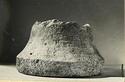
| Perhaps originally the foot of a table. The top broken off in antiquity, and worn. Roughly hollowed out inside.
Circular base with a vertical face below and concave profile above. Band around bottom picked; ... 21 March 1948 ... ADDENDA Found about a meter distant from the bust S 1319 (ΠΠ 372); and possibly used as a pedestal for that. |
Left to right. [--ανέ]θεκε ho.-
We might have expected ανέθεκεν in this inscription. The great majority of early Attic dedicatory inscriptions use the movable nu here, the only exceptions being where ... Early Corinthian ... The great majority of early Attic dedicatory inscriptions use the movable nu here, the only exceptions being where space or meter demand the shorter form: cf. |
| Neck and shoulder fragment from an oinochoe type III; non-joining fragment from lower edge of panel. Around the neck, a band of encircled palmettes; springing from both sides of this band, long narrow ... 26 May 1936 ... Top of 13th. meter. |
|
|