|
|
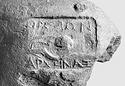
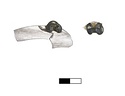
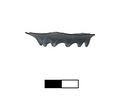
| Strigil. Finished 4th century B.C. fill under early Roman Agora floor. Θασίων
oil flask?
strigil
Ἄρχηναξ Leica ... 28 May 1951 ... 4th century B.C. fill under early Roman Agora floor. |
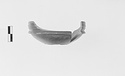
Point of pin broken off.
Bow has longitudinal ridge with cross-hatching in relief. Well in street of Roman Agora, 2nd meter.
Early Roman : 1st c. A.D. Leica, Various vii-87 ... 6 August 1946 ... Well in street of Roman Agora, 2nd meter.
Early Roman : 1st c. A.D. |
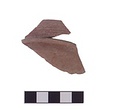
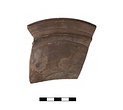
Four joining fragments give part of side and rim; groove around rim outside.
Flaky cinnamon-brown clay, orange-red glaze.
Sigillata. Samian? Well in street of Roman Agora. 2771 Leica ... 5-6 August 1946 ... Well in street of Roman Agora. |
Small fragment preserving part of rim and nozzle volute.
Red-brown glaze.
Red clay.
Type XX of Corinth collection. Cut through street of Roman Agora: layer 3a, pebble bedding for martyr. Leica ... 2 August 1946 ... Cut through street of Roman Agora: layer 3a, pebble bedding for martyr. |
| Small piece from flat floor, with rectangular stamp, illegible:
Good red glaze inside and out, chipped inside.
Sigillata. Well in street of Roman Agora. 2771 Leica, 93-43-19 PD 1172-7 ... 5-6 August 1946 ... Well in street of Roman Agora. |
Complete; mended from two pieces. Low broad foot with narrow foot ring; thick wall curving in to plain lip.
Micaceous gray clay; black glaze. Well in street of Roman Agora. Leica PD 1171-121 ... 6 August 1946 ... Well in street of Roman Agora. |
| Foot, center of floor and pieces of rim missing. Shallow bowl with keeled, grooved rim.
Light buff clay, firm dull red glaze.
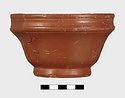
Sigillata. Well in street of Roman Agora. 2771 Leica, 94-44-13 PD 1171-50 ... 5-6 August 1946 ... Well in street of Roman Agora. |
Mended from several pieces; about one-half of rim missing. Small bowl on rather high flaring ring foot; keeled rim, concave, and with flaring lip.
Thin matte red glaze inside and out. Well in street ... 5-6 August 1946 ... Well in street of Roman Agora. |
| Anathyrosis on preserved edge. On top a mason's mark: ΑΡ. A shallow rectangular cutting and a deeper circular cutting at one corner of broad surface, from reuse as threshold block.
From Temple of Ares ... February 1949 ... Brought in from Roman Agora. |
| Fragment a): from angular shoulder, with small handle twisted back on itself on shoulder.
Fragment b) scrap with similar handle.
Very thin bluish glass. Other fragments probably from same jug stored in ... 5-6 August 1946 ... Well in Street of Roman Agora. |
Mended from a number of pieces; some wall and rim fragments, and the handle, missing. Large wide funnel, with neat flaring rim. Horizontal handle attached at junction of rim and wall.
Pinkish-buff clay; ... 5-6 August 1946 ... Well in street of Roman Agora. |
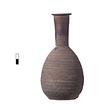
| Scattered pieces missing. Onion-shaped, large. Deep pear-shaped body; tall neck; flat rim.
Heavy gray fabric; shallow grooves on body; matte black glaze on neck.
Fragments of several unguentaria of ... 5-6 August 1946 ... Well in street of Roman Agora. |
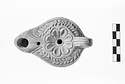
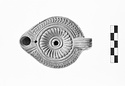
| Intact.
On disc, rosette of 8 petals framed by ring; herringbone pattern on rim. Solid grooved handle. On base, within two concentric grooves "A".
Purple-brown glaze.
Orange clay.
Late Roman.
Cf. Agora ... 28 June 1967 ... Orange clay.
Late Roman.
Cf. Agora VII, no. 1912 ... Lamp deposit beside Roman wall; removed in landscaping. |
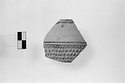
| Rim fragment from bowl or deep cup. Steep wall; plain rim thickened on inside. Rim undecorated, marked off by a groove above and below. On the wall, rows of applied dots.
Light buff fabric. Vitreous ... 5-6 August 1946 ... Well in street of Roman Agora. |
| Two joining sherds of rim and upper wall. ''Kalathos" cup, Knidian (?). Shallow conical body, projecting flange, vertical tapered rim. Shallow rippling (with faint rouletting?) covering exterior of rim ... 5-6 August 1946 ... Well in street of Roman Agora. |
Oinochoe: Italian?
Part of handle and mouth.
Slightly outturned rim. Large triple handle with appliqué head of Dionysos at base, facing into mouth of vessel. Head turns to proper left, has thick hair, ... Late Roman context |
Rim Of Large Bowl?
Small section of rim and stub of handle.
Rim steeply beveled to inside and slightly undercut; two shallow grooves below rim inside and two deep grooves outside. Handle round in section, ... Early Roman context |
Inscribed fragment of statue base.
A fragment from the top of a cylindrical base, crowned by a small moulding.
The base was later hollowed out and used as a well curb.
Four lines of the inscription preserved ... 14 June 1937 ... Found in the excavation for a modern cellar at the corner of Hadrian and Mnesikles streets, east of the Roman Agora. |
| Intact.
On disc, rays with two framing rings; two rings around filling hole. Herringbone rim. Solid grooved handle.
On base, within two concentric grooves: "X".
Orange-brown glaze.
Buff clay.
Late Roman ... 28 June 1967 ... Buff clay.
Late Roman.
Cf. Agora VII, no. 1606 ... Lamp deposit beside Roman wall; removed in landscaping. |
Plate.
About half of foot and small part of floor preserved, along with many small fragments.
Low ring foot; grooved resting surface. White fabric (10YR 8/2) with pale yellow surface (ca. 2.5Y 8/4), ... Context of before ca. 180 |
Flat bottom and convex side wall.
The letters -AI- (Greek?) incised on the resting surface after firing with a sharp point. Left to right?
Coarse, pinkish buff clay, unglazed.
Jugs with flat bottoms ... Early 7th c. A.D ... Jugs with flat bottoms are veryy late in the Roman period: cf. Agora V, pl. 35, th ejugs from Grup N. |
Most of handle and parts of foot, underside, and body restored.
Low foot; flat resting surface; flat underside with some string marks still visible. Straight lower body, convex shoulder. Tapering neck ... 150-110? (Roman context) |
Wall Fragment.
Single fragment, broken all around.
Vessel with nearly vertical wall and fairly small diameter. Interior glazed but somewhat irregular. Large appliqué grape leaf. Soft, fine, very micaceous, ... Roman context (no lot) |
Stamped Plate.
Center of floor preserved.
Convex underside, with trace of groove around edge. At center of floor, six-petaled rosette within hexagon with concave sides, all within circular field. Reddish ... Late Hellenistic? (Roman context) |
Filter Jug.
Wall fragment.
Wheelmade lower body joins moldmade upper body at an angle. Lower body nearly horizontal. Moldmade body: egg and dart below imbricate lotus petals with tips oriented towards ... Roman context (no lot) |
Plate.
Most of foot and part of wall preserved; badly shattered and flaking.
Low ring foot; broad, flat resting surface; flat underside. Sloping wall of fairly deep plate. Very porous, white core (2.5Y ... Context of late 2nd century after Christ |
Neck and one complete handle, stub of other, of unglazed amphora.
Two dipinti in red:
a) Beside handle:
b) On top of shoulder beside other handle:
Traces of second line below on edge of break.
Buff ... 5 August 1946 ... Well in street of Roman Agora, container 1. |
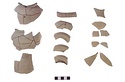
Four joining fragments preserve nozzle and part of lower wall. Filled out in plaster.
Round-ended nozzle; remains of applied ornament on sides and top.
Remains of thin brown wash.
Thin fabric, light buff ... 5-6 August 1946 ... Well in Street of Roman Agora. |
| About half, broken into many pieces, including half of base (a,b), wall fragment (c), most of rim (f-h), and loose handle (e). Round-bellied, tapering conically above; cupped rim, low neat foot, flattened ... 5-6 August 1946 ... Well in street of Roman Agora. |
Krater.
Part of moldmade body and wheelmade rim area.
Long petals with jeweling between them, with sightly concave wheelmade body above. Hard, fine, gray/light gray fabric (10YR 6/1) with some fine mica; ... Late Roman context (no lot) |
Large Vessel: Krater?
Part of wall and handle.
Rounded, moldmade shoulder with large egg and dart in relief. Base of horizontal handle, round in section, ending in rotelle. Fingerprint and glaze on lower ... Early Roman context (no lot) |
Bottom, handle, and two-thirds of body and rim restored.
Two grooves on exterior of rim. Light red fabric (2.5YR 6/6) with mica, small grits, and voids; gritty, shiny red glaze (2.5YR 4.8), with lower ... 100-25 ... Similar: P 22097 (Agora V, G 88, p. 30, pl. 5 [D 4:1, Layer II]).
... Δελτ 21, 1966, B1 1 [1968], p. 80, pl. 84:α, from late Hellenistic to early Roman potters' debris on Otho Street in Athens. |
Shoulder And Neck.
Part of shoulder and base of neck.
Slightly convex shoulder runs smoothly into neck. Decoration in brown glaze: row of dots around base of neck; rays alternate with dots on shoulder ... Mixed early and late Roman context |
Plate With Upturned Rim.
Three joining fragments of rim (a) and one fragment of floor (b).
Thick wall. Gently upturned rim. Very fine and hard gray/light gray fabric (10YR 6/1) with very little mica; ... Mixed Hellenistic and late Roman context |
Large Closed Vessel.
Single fragment, broken all around.
Probably from steeply sloping shoulder of large, closed vessel.
Vertical olive branch with white stem, orange leaves. Two swags or fillets attached ... Late Hellenistic and early Roman context |
Cup Or Bowl.
Wall fragment, broken all around.
Lower body curves in to foot, which is now broken away. Upper body nearly vertical, slightly convex, and decorated in relief: front half of bovine walking ... Late Hellenistic and early Roman context |
Plate Or Bowl.
Part of foot and floor.
Low, thick foot, concave to outside; rounded resting surface. Kiln support embedded in floor, with trace of another on underside. Hard, very pale brown fabric (10YR ... 2nd-century to early Roman context |
Plate.
Fragment of rim.
Large plate with rolled rim. Beginning of lug or handle at left edge of fragment. Hard, light gray fabric (5Y 7/1) containing abundant fine sand and a few larger black and red ... Late Roman context |
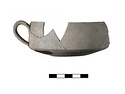
| More than half of side and rim missing. One vertical handle preserved, and trace of attachment of a second. Small flat bottom; gently sloping floor; nearly vertical walls, slightly tilted in; plain rim ... 5-6 August 1946 ... Well in street of Roman Agora. |
Cup Or Bowl: Pergamene Appliqué.
Center of floor, broken all around.
Slightly pointed underside; trace of foot. Appliqué is eight-legged creature (scorpion? lobster?). Front and back ends missing. Something ... Mixed late Hellenistic and early Roman context |
Imitation Blister-ware Aryballos.
Most of rim missing.
Slightly convex bottom, reserved. Squat body with greatest diameter just above foot. Body vertically combed. Low, thin neck; widely flaring rim ... 310-275? (late Hellenistic and Roman context) |
Rim Of Covered Bowl: Corinthian?
Fragment of rim with spout.
Rim inset from flange and inclined. Tubular spout with flaring mouth projects horizontally. Wall pierced for spout to communicate with inside ... Roman context |
Late Roman C plate fragment. Part of a stamped cross remains.
Purplish glaze inside and out.
Cf. Agora XXXII, no. 1407 (P 22799). Leica ... 20 April 1934 ... Late Roman C plate fragment. ... Purplish glaze inside and out.
Cf. Agora XXXII, no. 1407 (P 22799). |
Pyxis Lid.
Half of top preserved, with lower part missing.
Slightly domed lid offset from flange. Two grooves at center.
Vertical wall. On flange, alternating pointed and rounded lotus petals. Rounded ... Probably late Hellenistic (late Roman context [no lot]) |
Filter Jug.
Most of rim and end of spout restored.
Ring foot with deep groove in outer face; rounded resting surface; slightly convex underside. Wheelmade lower body meets moldmade upper body at angle ... Late Hellenistic to early Roman context (no lot) |
Aryballos.
Small chips of rim and foot missing.
Raised base with slightly flaring profile; concave underside.
Slightly pear-shaped body. Thin, low neck. Spreading cup mouth with angular profile. Rim ... Context of 75 to early Roman |
Canteen.
Mouth and upper body preserved.
Wheelmade body with sloping shoulder. Short neck. Deep cup mouth with slightly angular profile. Two strap handles from shoulder to well below rim. Very fine, ... Mixed late Hellenistic and Roman context |
| Several fragments preserve part of rim and wall of a deep Western Sigillata bowl; nothing of the foot; restored in plaster on analogy of P 3277. The rounded wall is divided into two parts by a broad moulded ... 5-6 August 1946 ... Well in street of Roman Agora. |
Large Kantharos(?): Pergamene.
Single rim fragment.
Wall flares out at bottom. Projecting molding below rim, with scraped groove at top. Below molding, ivy garland running right with incised dot rosettes ... Context of 3rd to 1st century, with late Roman intrusions |
Krater Or Plate.
Fragment of rim.
Flaring rim with overhanging lip, groove on top. Edge stamped with ovolo, with beading above. Very hard, fine, gray fabric (10YR 5/1) with little mica; very hard, shiny, ... Mixed Classical to late Hellenistic context, with late Roman disturbance. |
Medicine Bottle.
Half of rim missing; foot chipped.
Flat underside, pierced underneath. Irregular, angular profile with high shoulder. Vertical rim with groove at junction with body.
Micaceous, pink ... Late Hellenistic and Roman context |
Barbotine Cup Or Jug.
Lower body and most of wall and rim restored.
Ovoid body, upper two-thirds decorated with five rows of barbotine bosses. Body angles in to rim at top. Low rim, convex to outside ... Context of 110 to early 1st century after Christ |
Skyphos?: Pergamene Appliqué.
Rim fragment.
Rim beveled to inside, with groove below. Part of bunch of three ivy leaves, with one cluster of berries. Light red fabric (2.5YR 6/6); hard, shiny glaze, ... 75 to end of 1st century (Classical to early Roman context) |
Wall fragment, slightly flaring. Glaze cracked a bit on outside.
Scratch at lower right. Max. dim. 0.064.
Lower part of draped forearm and hand of figure, perhaps a child, either frontal or standing ... Probably late 5th century B.C ... The description of 284 on the Agora record card suggests that the hand is that of a child and restores the inscription to read: θυμε'λη . ... Bieber, The History of the Greek and Roman Theater, Princeton 1961, pp. xiv, 3, 14, and 56. |
Large Jug.
Over half of foot and underside and most of body restored; profile reconstructed rather than preserved.
Low, flaring ring foot; flat resting surface; convex underside.
Nearly spherical body ... Context of 50 B.C. to A.D. 50 |
Krater.
Part of rim and upper wall.
Two grooves at base of flaring rim with molded, overhanging lip.
Outer edge of molding stamped with ovolo; flat top of rim stamped with false guilloche; ridge between ... |
Neck only.
From a large neck-amphora. Collar rim concave on exterior; stubs of strap handles. Firm red glaze on top and outside of rim, and on outside of handles. Unglazed inside.
Similar exterior profile ... Context of late 5th c. B.C., heavily disturbed in Roman times. |
Mended from many fragments; stand almost complete, but bowl, except for lower walls, is missing. Two rows of vertical slots and two main decorated bands: above, flying birds alternate with chevrons; below, ... 9 August 1946 ... Street of Roman Agora, cut II, dug bedrock packing beneath earlier street 1. |
Two-handled Cup.
Foot missing; bottom and half of body restored.
Groove at greatest diameter. Rim convex to outside, with groove below lip. Narrow strap handles with one groove; small rotelles at arch ... Context of 100-75 |
| Mended from many fragments; pieces of rim and all at one side missing. Ring foot; rather high convex concave side wall, vertical lip with mouldings top and bottom.
Inside, at center, rectangular stamp: ... 6 August 1946 ... Well in street of Roman Agora. |
Passage; Roman. Διονυ̣[---]
[-]ου[---] Leica ... 3 April 1937 |
In relief, a horse, galloping right; the head missing.
Red glaze.
Late Roman A. Well, late Roman. Leica ... 27 April 1934 |
a) Two joining fragments from vertical rim of a large bowl. Lower part of rim concave, upper part rounded and decorated with rouletting.
Light reddish clay; good red glaze.
ADDENDA Added fragments: b), ... 5-6 August 1946 ... Well in street of Roman Agora. |
Wall fragment from rather low on the vase. Max. dim. 0.093.
Triptolemos (segment of wheel and wing of throne) to right. Relief contour. Rim of wheel incised (compass-drawn). Dilute glaze: decoration at ... Second quarter of the 5th century B.C. |
Hub not pierced.
Intact. Late Roman water channel.
Late Roman fill. 1757 Leica, XLV-42 ... 22 May 1939 |
Left side of face, hair, mouth of woman preserved.
Gouged style, hair in loops.
Traces of white slip.
Late Roman.
Yellow, red, black paint. Roman Complex, House A, late Roman fill. 815 Leica ... 11 April 1953 |
a) Fragment of floor. None of foot preserved. Stamped pattern, a square geometric ornament repeated between concentric grooves.
b) Rim fragment with heavy rouletting outside below rounded rim.
Probably ... 3 November 1949 ... Probably not from same plate.
Late Roman B.
Cf. Agora XXXII, no. 1119 (P 27154) (frag. b). |
Head of dog.
Unglazed.
Light reddish clay.
Late Roman.
Cf. T 1422 and T 1980. Late Roman. Leica ... 19 April 1934 |
Part of rim and scattered pieces missing. Nothing of handle preserved; there is no space for more than one. Similar to P 20830 (Ι 1418) but with a very low raised base and the profile of the sides curving ... 5-6 August 1946 ... Well in street of Roman Agora. |
Small piece of center of a Late Roman B or C bowl or small plate. The pattern seems to be incised rather than stamped.
Cf. Agora XXXII, no. 1358 (P 14496). Leica ... 13 April 1935 ... Small piece of center of a Late Roman B or C bowl or small plate. The pattern seems to be incised rather than stamped.
Cf. Agora XXXII, no. 1358 (P 14496). |
Fragments of "Late Roman Red" bowl. Rim fragments. Heavy flat-topped rolled rim. No decoration.
Late Roman. Late Roman filled gully. Leica PD 3083-142, DA 10001 ... June 1962 |
| Both ends and top cut away. Face of metope shows toothed chisel, face of triglyph finished with drove; back shows long vertical striations of a single point. Undercutting at middle of back for a shift ... 6 July 1966 ... Agora ... Roman Agora |
| Single rim fragment.
Low wall, narrow bifid rim. No decoration.
Normal orange-brown ware (slip rather darker than body).
Context and date: 3rd quarter of 5th c. A.D. Added 1 February 2006.
58 - (2.30-2.80m.) ... 8 March 1933 |
Head of dog figurine.
Broken away below.
White paint preserved.
Late Roman.
Cf. T 250. Fill of late Roman Building. Leica ... 1 April 1935 |
Lower part of unguentarium preserved, tapering to a small flat bottom.
Fine hard red clay; grey core and dark grey surface.
Stamped just above the bottom. Fill II. ΜΕΛΟΚ (Μ,Ε,Λ,Ο,Κ monogram in O) Leica ... 21 April 1936 |
Three non-joining wall fragments. Dull, hard glaze on inside. Max. dim. a) 0.091, b) 0.075, c) 0.071. L. Talcott, Hesperia 8, 1939, pp. 268--269, figs. 1, 2 (the fragments have been relettered since this ... Ca. 470-460 B.C. |
Complete mold for the back of woman 's head.
The hair in melon-waves.
Pale buff greenish clay.
Roman. Late Roman fill. Leica ... 14 February 1936 |
Profile complete. Mended with the missing pieces restored in plaster and painted, notably most of one side of the bowl, about half of the other, both handles. H. 0.077; rest. diam. at rim 0.185; diam ... Ca. 500 B.C. |
Head of a woman with high headdress.
Broken away behind and at neck.
Traces of white paint.
Late Roman. In late Roman fill. Leica ... 18 March 1935 |
Broken off at neck.
Mold made front and back and stuck together. Unglazed.
Red clay. Roman Building.
Red Hellenistic and Late Roman fill. Leica ... 25 February 1938 |
| Part of rim preserved.
Thyrsos. Finished Mixed fill in front of Fountain House; Hellenistic, early Roman and some late Roman. Θασίων
thyrsos
Τ̣ελ̣[εσήνωρ] Leica ... 4 May 1954 |
| Wall fragment of round-bottomed bowl.
Bowl with pattern of circles and dashes in zones. Agora sample no. 305. Burnt layer beside late Roman wall. 1414 Leica, LXXVIII-75 ... March 1950 ... Agora sample no. 305 ... Burnt layer beside late Roman wall. |
The left eye and part of the forehead and cheek preserved; otherwise broken.
Ample traces of white paint.
Late Roman. In late Roman deposit. Leica ... 2 February 1934 |
Tall neck of a miniature pot; hydria-lutrophoros. Trace of the attachment of one handle. Cloaked figure standing right. Red fill (early Roman) over Roman house. Leica ... 25 February 1936 |
Rising center. Stamped with cross, a double impressed circle within each angle.
Late Roman C. Chiefly late Roman context. Leica ... 11 April 1934 |
| The base of an open bowl, broken away above.
The foot is a series of small raised knobs. under level of top of Late Roman wall Late Roman fill under level of top of Late Roman wall. Leica ... 1 April 1936 |
Broken away at neck.
The features extremely faint.
Yellowish buff slip.
Light brownish clay.
Late Roman. Late Roman fill above floor of Kappa (K) Building. Leica ... 29 February 1936 |
| Rim to base fragment. Center of floor missing.
Flat base with slight inset. Groove on rim at lip; fine incisions mark off elements of rim on underside. Groove preserved on floor at break.
Hard-fired, ... 23, 31 May 1933 |
Head and considerable part of back preserved.
The features badly rubbed.
Red paint on hair and back of "chair".
Late Roman. Late Roman fill. Leica ... 3 June 1936 |
| Top and one end cut away, one end broken. Back rough finished with long vertical chisel strokes of a single point. Undercutting in middle of back for a shift bar. Metope faces finished with toothed chisel; ... 6 July 1966 ... Reused in south outer wall of Roman Agora between fountain and S.W. corner of the building. |
Stamped in the center with the figure of a lion(?), right.
Very thin red glaze.
Late Roman C. Late Roman fill. Leica ... 18 April 1934 |
Small piece from base; letters incised within two grooves.
No glaze.
Light red clay.
Type XXVII of Corinth collection, type 28 of Agora collection.
Latest Roman fill. Leica PD 1020, 1471 ... 19 April 1947 ... Type XXVII of Corinth collection, type 28 of Agora collection.
... Latest Roman fill. |
Preserved is only the face and front part of the headdress of figurine.
Moulded. Unglazed.
Red, slightly micaceous clay.
Late Roman. Black fill over strosis.
Late Roman. Leica ... 20 March 1935 |
Front of head only.
Gouged technique, very coarse. Traces of white paint (?) Unglazed.
Red clay.
Late Roman. ca. 2.10m. below surface Ca. 2.10m. below surface.
Late Roman. Leica ... 27 February 1936 |
Part of head only preserved.
Dull red paint laid over white slip. Eyes in added white.
Buff clay.
Late Roman.
Cf. T 3075. Late Roman fill. Leica ... 7 June 1937 |
From a late Roman C plate with ring foot and rouletting on the floor.
Cross incised underneath. Late Roman fill, disturbed. Leica PD 3083-22, DA 10008 ... 11 June 1935 |
Only the left side of the head of the cock preserved.
Couged technique. Heavy fabric, burnt gray.
Late Roman. Grey ash fill over curved foundation trench.
Late Roman. Leica ... 27 February 1934 |
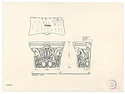
| Complete except for chips. Large Corinthian pilaster capital, somewhat crude workmanship and deeply undercut.
Front: two eggs on either side of a dart, surrounded by a palmette, flanked on either side ... 2 April 1973 ... A third capital, of the same series, though much worn, lies in the Roman Agora, just to the N.E. of the Tower of the Winds. |
End of nozzle and part of bottom.
Remains of letters in relief.
Black glaze.
Type XVIII (post Sullan) of Corinth collection, Miscelaneous Moulded type of Agora collection.
Hellenistic-early Roman fill ... 3 March 1936 ... Type XVIII (post Sullan) of Corinth collection, Miscelaneous Moulded type of Agora collection.
... Hellenistic-early Roman fill. |
Fragment of the rim and upper body. Palmettes above and below broad ridge on rim. Winged figures on body. Roman Bath; late Roman destruction fill in room with mosaic floor. 6067 Leica ... 18 September 1947 |
|
|