|
|
Turkish sherds from this level. No tins of pottery ... August 1951 ... Turkish sherds from this level. |
Earlier well northwest of well U 19:2 and cut by it, unexcavated; sherds and hydria gathered from party wall. Uncatalogued material: 26 sherds. Deposit created by Margie Miles, 1 inventoried object ... Late Geometric ... Earlier well northwest of well U 19:2 and cut by it, unexcavated; sherds and hydria gathered from party wall ... Uncatalogued material: 26 sherds. |
Deposit in a cutting in bedrock on Kolonos Agoraios. Sherds in container Lot ΠΘ 4a ... Probably 4th c. B.C ... Sherds in container Lot ΠΘ 4a. |
Exploration of packing below paving blocks of Panathenaic Way.
Uncatalogued material: 66 sherds, 2 objects (50A) and 43 sherds (50B). Coins:
26 April 1960 #1-#2
3 May 1960 #1-#4, #6-#9 Deposit created ... 1st c. A.D ... Uncatalogued material: 66 sherds, 2 objects (50A) and 43 sherds (50B). |
Small Pit in bedrock (diameter 0.70m). " A handful of contemporary sherds found with it, discarded." p. 1238 ... July 1957 ... " A handful of contemporary sherds found with it, discarded." p. 1238 |
Well at 20/ΙΔ.
No POU fill. Bottom packed with sherds, including roof-tile fragments. Above this, were six meters with a "fair quantity" of sherds; then the top meter and a half contained a great quantity ... Ca. 420-390 B.C ... Bottom packed with sherds, including roof-tile fragments. Above this, were six meters with a "fair quantity" of sherds; then the top meter and a half contained a great quantity of sherds. |
Small pocket with R.F. sherds and terracottas, perhaps thrown up by the diggers of a modern well nearby ... Ca. 375-350 B.C ... Small pocket with R.F. sherds and terracottas, perhaps thrown up by the diggers of a modern well nearby. |
Grave south of Hephaisteion. Grave I in notebook.
Four sets of lower leg bones. No offerings. No sherds. Lot 227 ? ... Byzantine ... No offerings. No sherds. |
Grave in cella of Hephaisteion. Grave XXIV in notebook. Two skeletons. No sherds. Coins:
23 February 1939 #4 Neg. KK 375 ... 23 February 1939 ... Two skeletons. No sherds. |
Scanty debris filling in a square pit with 4th. c. sherds at bottom. Notebook says 36-38/ΝΑ-ΝΒ and T 81 ... 1st. qtr. 4th. c. B.C ... Scanty debris filling in a square pit with 4th. c. sherds at bottom. Notebook says 36-38/ΝΑ-ΝΒ and T 81. |
Ancient fill in cistern tunnel leading to north; contained undisturbed fill which produced late Hellenistic sherds; it had been refilled in modern times ... 2nd c. B.C ... Ancient fill in cistern tunnel leading to north; contained undisturbed fill which produced late Hellenistic sherds; it had been refilled in modern times. |
Well at 35/ΛH. In the northern part of the market square, north of the altar of Ares. Stony fill with late Geometric sherds. Not dug ... Late 8th century B.C ... Stony fill with late Geometric sherds. Not dug. |
Byzantine Well at 66/ΛΑ.
Semi-curbed well at the west wall of the Byzantine room.
From the mouth of the well, a few brown glazed sherds ... Byzantine ... From the mouth of the well, a few brown glazed sherds. |
| Dorothy Burr Thompson ... Grave 27. In some records as Grave I bis. Bones discarded; nothing catalogued.
Notebook says: few burned bones, few burned sherds. Cf. negs. KK 228, KK 237 ... Probably Late Geometric or Early Geometric I ... Notebook says: few burned bones, few burned sherds. |
From the mouth to 10.50m. a fill of earth with mixed sherds, Roman 4th. c. to geometric. Probably dumped in to fill the well. From 10.50-17.75m. the fill was of broken bedrock, with a few sherds scattered ... 5th. c ... From the mouth to 10.50m. a fill of earth with mixed sherds, Roman 4th. c. to geometric. ... From 10.50-17.75m. the fill was of broken bedrock, with a few sherds scattered through it. |
"Red earth": Herulian destruction debris over Roman House and east of cistern B. Coins:
30 May 1935 #1-#8
31 May 1935 #1-#15 Sherds stored in container Lot ΠΘ 4b ... 27 May 1935
31 May 1935
3 June 1935 ... Sherds stored in container Lot ΠΘ 4b. |
Pit in bedrock in front of Shop VII (= Pit in Stoa Colonnade in front of Shop VII). It contained a miscellaneous collection of sherds which included one scrap of red-figure ... Ca. 475-460 B.C ... It contained a miscellaneous collection of sherds which included one scrap of red-figure. |
Firm fill over bedrock on east edge of section, north of the early (Archaic) peribolos wall. Uncatalogued material: 10 sherds, 30 fragments of plemochoai. Deposit created by Margie Miles, 4 inventoried ... 3rd quarter 4th c. B.C ... Uncatalogued material: 10 sherds, 30 fragments of plemochoai. |
Geometric Pit 58/ΛΒ.
It was started as a well, but after 2 meters crumbling bedrock must have discouraged the diggers. It produced only a few sherds, all of which were kept ... Geometric ... It produced only a few sherds, all of which were kept. |
P.H. 1.98m; greatest diameter 1.70; wall thickness 0.20. The walls are of rubble set in clay, and the bottom is flat. Pottery was coarse Byzantine sherds but discarded except for one graffito ... 25 May 1956 ... Pottery was coarse Byzantine sherds but discarded except for one graffito. |
| Dumped filling mostly of 3rd c. A.D., but dumped as late as 5th century. Nbp. 143: The fill in this cistern was of three kinds: to within .60m. of the floor plain broken bedrock with no sherds; then a ... 10-17 February 1937 ... Nbp. 143: The fill in this cistern was of three kinds: to within .60m. of the floor plain broken bedrock with no sherds; then a layer 15-20 cm. thick with Turkish sherds, and [then] Roman 3rd c. pottery, mostly fragments of micaceous red water jars, over the floor. |
Late fillings over early walls.
Tin 120 sherds put with those from the same fill dug 21 February 1934, just to the south. Coins:
21 February 1934 #3-#7
9 March 1934 #2 ... To 5th c. A.D ... Tin 120 sherds put with those from the same fill dug 21 February 1934, just to the south. |
Well at 112/Ν.
Shallow well with a short period of use. The scattering of fragments in the upper dumped filling is consistently earlier. Lot Τ 12 (all sherds saved) and Lot Τ 13a (Dirt Pile) ... 520-500 B.C ... Lot Τ 12 (all sherds saved) and Lot Τ 13a (Dirt Pile) |
Pit in bedrock (disturbed child's grave?). No bones or ashes. No lots.
No coins listed. P 14520 was certainly from the north end, doubtless a grave offering; few sherds (first half of 5th century) came ... Late 6th - early 5th c. B.C ... P 14520 was certainly from the north end, doubtless a grave offering; few sherds (first half of 5th century) came from the north end as well. |
Top fill to 1.00m. = dump of late Hellenistic ware mixed with some Roman of 2nd c. to early 3rd. c. Intermediate fill 1.20-2.00m. = dump with tiles and stucco, almost no sherds. Coins:
6 February 1937 ... 2nd-3rd c. A.D ... = dump with tiles and stucco, almost no sherds. |
Cistern (and passage) on the north slope of the Areopagus. Fill badly disturbed in modern and Turkish times. The few ancient sherds seem to be chiefly early Roman-1st c. B.C. (p. 256).
Some finds labeled ... 1st c. B.C ... The few ancient sherds seem to be chiefly early Roman-1st c. |
Pit (Well?) under Building A, Room 2. Coins:
9 May 1949 #1-#2
11 May 1949 #4
12 May 1949 #3 (not a coin, bronze fragment in lotted metal tins ΠΠ 295). Estimated Grid
Remains of coloring matter found with ... Hellenistic-Early Roman ... Estimated Grid
Remains of coloring matter found with 4th c. sherds. |
| Construction filling of well N 20:3 which was dug through this cistern; a few later sherds at upper levels may result from late repairs to well tiling. Coins:
6 April 1938 #14-#15
8 April 1938 #4 Some ... Second half 1st c. A.D ... Construction filling of well N 20:3 which was dug through this cistern; a few later sherds at upper levels may result from late repairs to well tiling. |
Pit at 23/ΚΣΤ Coins:
9 May 1935 #2-#17 "In addition to the catalogued pieces, it contained some coarse ware and a few glazed sherds, either painted or with simple sgraffito design" These all thrown. Hesperia ... 1100 A.D ... "In addition to the catalogued pieces, it contained some coarse ware and a few glazed sherds, either painted or with simple sgraffito design" These all thrown. |
Late Roman, perhaps as late as 7th c., but excavator noted small amount of material made close dating impossible throughout. Nbpp. 2448-2449: The fill of this well throughout is mixed and there are numerous ... Early to Late Roman ... Nbpp. 2448-2449: The fill of this well throughout is mixed and there are numerous Late Hellenistic sherds even at the top ... Because of the very small quantity of sherds ... and the mixed character of the entire fill more accurate dating is impossible. |
| A well at the northeast corner of Classical Building, behind back wall. Dumped fill appears to have occurred as a single event as there are joining sherds throughout.
POU date ca. first half 5th c. B.C.; ... 5th c. B.C ... Dumped fill appears to have occurred as a single event as there are joining sherds throughout.
... Pottery primarily of the mid 5th c. with the latest sherds dating to just before the last quarter of the century. |
Michael Laughy ... West and adjacent to Modern Wall 5, we excavated 12th-13th c. A.D. fill, in some places a half meter deep or more. The fill was remarkably uniform in content throughout. Typical pottery included: fine ... 12th-13th c. A.D ... Lot T 131:
amphora toe; coarse handles, body sherds, rims, bases; cooking ware; combed ware; ridged ware; slip painted; inscribed sgraffito; Byzantine lamp; monochrome sgraffito; polychrome sgraffito; monochrome glaze; brown and green ware; plain glaze.
sherds: 1824
"classical black glaze": 38
Lot T 143:
fine sgraffito; slip painted; inscribed ware; plain glaze; brown and green glaze; polychrome glaze; Byzantine lamp fragments; coarse handles, rims, bases, body sherds; cooking ware; earlier finewares; ridged ware; combed ware; amphorae fragments; bone.
sherds: 2037
"classical black glaze": 44 |
Nbpp. 3104-3105: Represents well deposit; the [baskets] from this layer showed no stratification. Containers marked "earth" presumably represent primarily Layer II.
... it is presumed that the sherds of ... Late 6th-7th c ... Containers marked "earth" presumably represent primarily Layer II.
... it is presumed that the sherds of Layer III, not differing appreciably from the heavy well deposit above were put into the well deposit container. |
Clearing bedrock on line of early (Archaic) peribolos wall, east of entrance on the south side, west end. Uncatalogued material: 50 sherds, 83 fragments. of plemochoai.
Classical Ware : lekythos; plemochoai ... Early 2nd c. B.C ... Uncatalogued material: 50 sherds, 83 fragments. of plemochoai.
|
Diameter of top of well 0.80m.
An early well east of Roman Building, north of Temple of Ares and thus in the region of the Mycenaean cemetery. Sherds almost entirely Mycenaean with nothing later and a ... Mycenaean ... An early well east of Roman Building, north of Temple of Ares and thus in the region of the Mycenaean cemetery. Sherds almost entirely Mycenaean with nothing later and a few earlier. |
A late curbed well. The filling consisted of clay and small stones. The sherds were uniform from top to bottom and appear to be late Byzantine. From measurements in notebooks (pp. 340, 729), S 2855 is ... Late Byzantine ... The filling consisted of clay and small stones. The sherds were uniform from top to bottom and appear to be late Byzantine. |
Geometric Well on the west side, in the line of the Roman Panathenaic way; 3.70m below paving block of street that overhangs well. It was neatly cut, 1.05m. in diameter, but it was dug only to a depth ... Late Geometric, end of 8th century B.C ... 86 objects, 9 bones, 398 sherds.
Large assortment of household pottery, with an admixture of early sherds, a few fragments of Corinthian ware, and household items such as loom weights, spindle whorls, iron objects, stone grinders. |
North of Eleusinion: Fill in Room 3 of Roman Building. 614 sherds (6 miniature shapes, 20 intrusive sherds).
Objects : terracottas; loom weights; spindle whorls; disks; handmade tray; lamps.
Early ware ... First half of 6th c. B.C.-Mixed Fill to ca. 480 B.C ... 614 sherds (6 miniature shapes, 20 intrusive sherds).
|
S.W. of Archaic Temple : Pocket in bedrock. The pocket was cut through a red clay floor. 71 sherds.
Objects: loom weights; lamp.
Early ware: Gray Minyan; Mycenaean; Protogeometric-Late Geometric; Subgeometric; ... Early 6th c. B.C. and earlier ... 71 sherds.
Objects: loom weights; lamp.
|
Grave 2 in notebook. The burial was destroyed by the digging of Pit A, at the edge of which was found a mass of sherds belonging to the grave amphora. Among the sherds were found small cups, fragments ... Late Geometric ... The burial was destroyed by the digging of Pit A, at the edge of which was found a mass of sherds belonging to the grave amphora. Among the sherds were found small cups, fragments of a skyphos, and a kantharos, together with a few remnants of a small child's skeleton. |
Fills from construction and reconstruction of a house. "Brown House" = House A (RSY Hesp. 20) (and pit under Layer 4) in the industrial area west of the Areopagus.
Under the original floor of this house ... Second half of the 5th. c. B.C ... Under the original floor of this house were sherds including two red figured pieces (P 17137, P 19880). The filling of the floor levels of the house after its plan was changed and it was reconstructed yielded fragments of various coarse amphoras and black glazed table ware; four sherds incised with the letter kappa suggest that this is the initial of the owner of the house of the second period.
|
Digging abandoned at 17.10m.
Nbp. 2863: The fill in the mouth to -6.50 was a dump of mixed hellenistic and late roman sherds. From -6.50 to -11.00m. small stones with a few late roman sherds 4th-5th c ... 4th-5th c. A.D ... Nbp. 2863: The fill in the mouth to -6.50 was a dump of mixed hellenistic and late roman sherds. From -6.50 to -11.00m. small stones with a few late roman sherds 4th-5th c. |
Pocket on the line of the early (Archaic) peribolos wall at entrance on the south side. Uncatalogued material: 215 sherds, 186 + frags. plemochoai and 4 objects.
Classical Ware : black glaze; mug; rilled-rim ... 3rd quarter 4th c. B.C ... Uncatalogued material: 215 sherds, 186 + frags. plemochoai and 4 objects.
|
A deep pit in bedrock over mouth of well. Context archaic, 6th c.
B.C., but with some traces of later disturbance. Found a circle for a well at the bottom, much water, no sherds.
Lay 2.20m south of Well ... 6th c. B.C ... Found a circle for a well at the bottom, much water, no sherds.
Lay 2.20m south of Well B (L 17:1). |
Well east of Geometric Grave. The upper part collapsed into a pit, cut into by Middle Geometric grave I 18:1 and by a Byzantine wall. Some evidence for period of use; little pottery. At the top a few Geometric ... Early Protogeometric ... At the top a few Geometric sherds, perhaps displaced from I 18:3. |
Well at 123/ΝΑ.
At the bottom a few water jars; above , a dumped filling with a small amount of pottery; at the top supplementary fill with scattered sherds.
POU, ca. 500 B.C.
Dumped filling, of ca. 500 ... 6th c. B.C ... At the bottom a few water jars; above , a dumped filling with a small amount of pottery; at the top supplementary fill with scattered sherds.
POU, ca. 500 B.C.
|
| Plundered Chamber Tomb. (Tomb XII). A few meters SE of the great white marble altar. The chamber is an irregular rectangle, oriented roughly N-S, with dromos leading in at a very gentle slope from the ... LH III A ... A very few sherds and fragments of bone were recovered from the upper levels of the collapsed bedrock with which it was filled.
It seems probable that the tomb collapsed before burials were made in it (the lower 1.80m of the tomb contained only collapsed bedrock and no sherds.) and perhaps the dromos may have been used as a sacrificial pit of some sort |
| In room A. Concentration of artifacts and burning in stratum, no pit discerned. The pyre lay below a Late Hellenistic fill with a smooth earth surface. It is described as a black patch of earth with sherds, ... 350-250 B.C ... It is described as a black patch of earth with sherds, resting on a rough and uneven surface topping a fill that dates largely in the 4th c., to at least 325, with seven Hellenistic sherds perhaps intrusive from the level above. |
| Tile-lined well. Excavation of the well terminated at 47.548m. due to cave-in danger. Cf. MC 1499 and L 5995 found in vicinity of well; also ST 897, ST 943 and MC 1384 plus coin N 12048 (ΒΕ-1403) found ... 15 June 1993
28 June 1993
23-30 July 1993 ... Pottery stored in tins (not mended or sorted) in stratigraphic sequence from top to bottom; all sherds kept. |
After the abandonment of the well and the collapse of the well-curb, the upper 2.00m. of the shaft were filled with a dump apparently dug up nearby. Material for the most part of the 5th c. B.C. but containing ... 7th c. A.D ... With 5th-4th c. B.C. sherds. |
Beneath layer 11. "Despite its extreme irregularity this pit may be an early well, for it would seem definitely to be an artificial cutting and sherds were found in its lowest part," (Nbp. 2095).
Contemporary ... SubMycenaean ... "Despite its extreme irregularity this pit may be an early well, for it would seem definitely to be an artificial cutting and sherds were found in its lowest part," (Nbp. 2095).
|
Well at 9/ΙΣΤ-ΙΖ has been cleaned and stripped of its tiles and original filling and bedrock thrown back into shaft.
Joins between sherds from all levels.
No coins or lamps. Containers examined 5 March ... 1st c. B.C ... Joins between sherds from all levels.
|
Mycenaean well under East Building Terrace steps (No catalogued pots). Rectangular in shape, 0.90x0.60m.
Abutting against the back of the East Building Terrace steps to the south. Yielded much thrown bedrock ... 14 July 1967 ... Yielded much thrown bedrock and a few Mycenaean sherds, with a few later intruders at the upper levels. |
Michael Laughy ... Debris pit, located in Room 2 of ΒΘ East. Pit measures ca. 2.30 by 1.70m., and nearly a meter deep. The pottery from the pit dates ca. 10th-12th c. A.D. The fill of the pit consisted of soft, black charcoal ... 10th-12th c. A.D ... Lot T 199:
coarse body sherds, handles, rims; base; amphora handle; combed ware; ridged ware; cooking ware; monochrome glaze; polychrome sgraffito (late Byz); monochrome sgraffito (12th - 13th c and 13th - 14th); monochrome with tripod still on sherd (13th c onwards); slip painted ware; green and brown glaze (Late Byzantine); slip painted (Early Modern)
(mostly 12th-14th c. A.D., but one suspicious piece Early Modern sherd, and one Turkish pipe)
sherds: 486
"classical black glaze": 17
Lot T 200:
coarse rims, handles; lamp fragments; Turkish pipe fragments; combed ware; ridged ware; cooking ware; Turkish imitation marbled ware; porcelain; monochrome glaze; inscribed sgraffito; slip painted.
sherds: 394
"classical black glaze": 8 |
North of Eleusinion: Loose fill in pit outside Roman Building. 14 inventoried items, 22 objects, 325 sherds.
Objects : terracottas; handmade object; large figurine; lamps.
Early ware : Gray Minyan; Mycenaean; ... 6th c. B.C. and earlier ... 14 inventoried items, 22 objects, 325 sherds.
Objects : terracottas; handmade object; large figurine; lamps.
|
Fill in abandoned cistern, lower terrace adjacent yo the Eleusinion on the north.
Uncatalogued material: 189 sherds, 4 objects. Many kernoi fragments.
Objects : loom weights; lamp.
Early ware : Gray Minyan; ... Mid. 4th c. B.C ... Uncatalogued material: 189 sherds, 4 objects. |
Fill around the upper block of the southwest corner of the early (Archaic) peribolos wall, south of the Propylon, and hard fill at the side of a trench for a modern wall.
Uncatalogued material: 181 sherds ... 2nd c. B.C ... Uncatalogued material: 181 sherds (of which 49 fragments of plemochoai), 3 objects, 1 bone. |
Ostrakon Pit (Horos Terrace Trench). Oval pit cut into bedrock. Packed filling of stones, coarse sherds and roof tiles; among these a few fragments of finer vases and 22 ostraka, probably from the ostracaphoria ... Ca. 490-480 B.C. and later ... Packed filling of stones, coarse sherds and roof tiles; among these a few fragments of finer vases and 22 ostraka, probably from the ostracaphoria of 482 B.C. |
Trial trench IV. A thin strip of undisturbed fill excavated on the north side of the upper terrace, just inside the line of the Archaic peribolos wall.
Probably this small patch of clay represents part ... Protoattic ... Uncatalogued material: 43 sherds and 6 figurines. |
| Shallow pit in bedrock on the upper terrace, ca. 3m. southeast of the Rocky Outcrop. Uncatalogued material: 46 sherds, 61 terracotta figurines and 4 objects.
Early ware : Neolithic; Gray Minyan; Mycenaean; ... Archaic with intrusions ... Uncatalogued material: 46 sherds, 61 terracotta figurines and 4 objects.
|
A great shaft 2.65m in diameter and over 10m deep cut out in the mid 1st c. to serve in some connection with the Brick Shaft system (U 22:1). Filled in to top (layer 2) in late 1st- early 2nd c. A.D. with ... 18 March 1937,
1-13 April 1937,
24 May-14 June 1937 ... A.D. with a fill of mostly Hellenistic sherds (dump). Above this dump was an accumulation of late 2nd- early 3rd c. period (layer 1). |
| Dorothy Burr Thompson ... Grave 1. Urn cremation (trench-and-hole), adult female 30-40 years old).
Mentioned as Grave XVII in Deposit list.
Consisted of a roughly circular pit, approximately 0.30-0.40m in diameter, cut into ... Late Protogeometric ... A few remnants of a stone packing beside the urn-hole, on the north side, probably once continuous with the packing around the urn, contained a few burned sherds, clearly pyre debris.
... See also P 34860-P 34866 catalogued as "sherds overlying tombs
F 16:3 & F 16:4". |
Cistern at the southeast foot of Kolonos Agoraios.
Nbp. 2369: Two chamber cisterns, 88/ΛΔ and 100/ΚΘ, united by a long straight passage running almost due N-S. A draw shaft at 95/ΚΘ is set just off the ... Late 2nd-early 1st c. B.C.-86 B.C ... Nbp. 1787: This cistern contained a hopeless mixture of sherds, from hellenistic to late roman ... One can say in a general way that the hellenistic fill lay over the bottom of this cistern and the roman above it, but every basket of Hellenistic contained also Roman sherds.
|
"Debris Pit" beneath starting line in Panathenaic Way.
Dug as
Trench B (1971), pp. 1631-1649 (notebook not seen, PF);
finds record both Layer 28 and beneath Layer 28.
Trench I, pit 16a, (1973), pp. 3010-3022 ... 2 August 1971
4-6 July 1973
27 June-11 July 1980 ... -Top of pit is thick sloping layer of almost pure dug bedrock with very few sherds.
-Below fill consisted of red clay from disintegrated mud brick, mixed with charcoal in large quantities.
|
| Bronze-casting pit and furnace against S apse of Church (106/ΛΕ). Late Roman sherds of the 4th and the 6th c. A.D. were found with fragments of moulds from bronze casting. The west end was destroyed by ... 5th-6th c. A.D ... Late Roman sherds of the 4th and the 6th c. |
| (Grave XXIX: EG).
Rectangular cutting with remains of charred human bones and both burned and unburned pottery fragments. Bones discarded.
Rectangular trench cut through earth into bedrock, oriented east-west ... Middle Geometric I ... Burned and unburned sherds representing at least nine vessels were found throughout the trench. |
| David Scahill ... At northeast corner of Classical Building II; on south side of dromos of Tomb K 2:5, and separated from it by ca. 0.6m of bedrock. Chamber cut through bedrock. The northeast corner of chamber defined ... LHIII A:1 ... Upper fill of stones and earth inside cutting with Geometric sherds. Partially articulated skeleton laid out against the north wall of the tomb, with feet to the east. |
| Not completely excavated due to instability of chamber walls and water. Sherds of all periods - Greek, Roman and Byzantine - were found in it [nbp. 424].
Re-examined in 2010. Photos and notes on NB pages ... 10th c. A.D ... Not completely excavated due to instability of chamber walls and water. Sherds of all periods - Greek, Roman and Byzantine - were found in it [nbp. 424].
|
Pit at 18-20/Λ-ΛΓ.
The cistern S 19:3 and the well S 19:8, together with a Roman well, S 19:1, had collapsed to form a large pit S 19:5. The upper part of the pit was dug to a depth of ca. -8m as deposit ... 7-8 April 1938
28 April-26 May 1938 ... Byzantine and Roman sherds found throughout, mixed with earlier material presumably deriving from cistern S 19:3 and well S 19:8. |
| Well at 89-90/ΙΗ-ΙΘ (diameter at top 1.10m), between the southeast corner over the mouth of of the Odeion and the Panathenaic Way. The well lay a thin layer of dug bedrock containing a few Hellenistic ... 650-625 B.C ... The well lay a thin layer of dug bedrock containing a few Hellenistic and earlier sherds. Fill in the well proper was a heavy dark fill. |
Road SE of altar, below 51.56m.
In 1981, p. 1883: "A single pass, ca. 0.03m. thick and we hit another surface, at 51.56m. which we take as Layer XV. Fairly loose gravelly fill under surface, sandy, greenish ... 1st c. B.C ... Masses of pottery at J/5-3/15,16." and "Patch of fill to south at a level of ca. 51.62m. which we take down ... Similar gravel and sand and sherds as above." |
Thra (ΘΡΑ) Well (East of Stoa Room 2). Heavy dumped filling, including figured, black and plain wares, and also a quantity of animal bones, mostly skulls of oxen. On many of these the horns had been sawn ... Ca. 520-480 B.C ... All sherds except ware fragments of household pitchers ie. amphora; semi-glazed kraters; handmade hydriai; casseroles etc saved. |
| Circular pit and irregular cutting north of it. Diam. of pit ca. 0.80m; Dimension of irregular cutting ca. 1.00x1.20m. The pit was dug into bedrock and filled with red earth which was packed with undisturbed ... Second half of 7th c. B.C ... On top were small sherds and broken figurines; below were stacked skyphoi, mostly on east side. |
| Well South of Soft Yellow Poros Foundation. Dumped filling of a collapsed well, that, due to hazardous conditions, could not be cleared below- 2.50m. The well was partly cut on the east side by a Byzantine ... Protogeometric-Early Geometric II, ca. 850 B.C ... Filling almost entirely later Protogeometric, with a few sherds of Earliest Protogeometric, all apparently drawn from disturbed graves.
|
| Rodney S. Young ... Grave 19 (In some records as Grave VIII). No remains, no burned matter or traces of burning.
JP
A small cutting with a single offering. The pit may have been for a simple child/infant inhumation, with ... Early Protogeometric ... The pit yielded no evidence of human remains, but a few small sherds were noted, one classified "Geometric" (not inventoried), suggested that this too, may have been a robbed Early Iron Age grave. |
| Dorothy Burr Thompson ... Grave 2. Urn cremation (trench-and-hole). In some records as XXIII.
Variously labeled as grid 7/Δ, 7/Γ and 7/Γ-Δ.
Rectangular pyre trench cut through earth into bedrock, with only the lowest 0.04m surviving ... Transitional Late Protogeometric/Early Geometric I ... The trench floor comprised what appeared to be scorched earth; it contained a few sherds, described by the excavator as being of "small bowls".
... See also P 34860-P 34866 catalogued as "sherds overlying tombs
F 16:3 & F 16:4". |
Well in Room 1 of south aisle of Stoa. The well is lined with bricks and tile. This lining is preserved to a level of 52.733 m., which is approximately the same as the level off the late threshold of the ... 5th-6th c. A.D ... Pottery dated in the 5th century with a few 6th c. sherds. |
Well 15: Mycenaean. It was situated about 35 meters down the slope northwest of the exit of the Mycenaean Fountain.
Well circular or roughly oval in section.
Diameter max. width to -4.0: ca. 1.50, below ... Late Mycenaean ... About 0.30m below, a late Roman pit which cut into the north side sherds occurred in fair quantity and the fill seemed to be pure.
|
| David Scahill ... Behind northeast corner of Classical Building; east wall C. Below Hellenistic levels and early Classical pit. Chamber cut through bedrock, depth ca. 0.90m., diameter ca. 2m., roughly square in shape, angling ... LH III A:1 ... Loose fill of stones and earth filling tomb with large number of geometric sherds ranging early to late Geometric. |
Fillings in a well on south slope of Kolonos Agoraios. The shaft reached a depth of 20.28m., but produced no use filling. The lower part, from water level at 12.60m. to bottom, provided only mud and gravel ... Ca. 425-400 B.C ... The lower part, from water level at 12.60m. to bottom, provided only mud and gravel with occasional thin streaks of sherds of the same period as the main dumped fill above. |
Well by Stoa Pier 8.
Mouth of well discovered in 1950 (p. 2287).
Dumped filling in the 4th c. B.C. but the bulk of the material of the 5th c. B.C. Fill contained much wood, bones, Mycenaean, Geometric, ... 5th c. B.C ... From POU and dumped fill (Lot ΣΑ 366: 52 fine ware and 27 coarse ware sherds, including: 3 mugs with horizontal ribs (one, third to fourth quarter of 5th c. |
Mycenaean Grave (grave with kylikes).
Small irregular pit (about 0.70m by 0.45m by 0.50m deep). it was full of Mycenaean sherds and fragmentary pots, mostly kylikes, but also contained occasional scraps ... Mycenaean IIIB-C ... Small irregular pit (about 0.70m by 0.45m by 0.50m deep). it was full of Mycenaean sherds and fragmentary pots, mostly kylikes, but also contained occasional scraps of bone and several small stone slabs lying in no order. |
| Rodney S. Young ... Disturbed burial (no remains), probably an infant pot inhumation.
Inhumation grave 17 in notebook. (E.L. Smithson: Grave XIX: PG).
Shallow oval cutting containing a banded amphora on its side, mouth ... LPG ... No bones or offerings; 4th. c. BC sherds in cutting. Both pots Protogeometric, the amphora probably intrusive in the 4th. c. |
| Eugene Vanderpool ... Mycenaean Grave under Stoa Terrace, at original north end of Stoa; and PG vases on patches of stones over this burial, and to NE (formerly P 8:7). Cf. Q 8:13. No remains. In some records as Grave XLV ... 1 December 1953 ... Loose filling above these patches of stone contained Mycenaean through Archaic sherds. |
| Grave 20 in notebook. Objects recorded in nb. from Grave 21 (earlier and disturbed by Grave 20) are included here. A pyre [using pieces of pots from Grave 21] was probably burned beside grave 20 and some ... Late Geometric ... Lot Β 307: sherds found in and over grave 20 but clearly belonging to grave 21. |
Well 19: Latest Mycenaean. Near Klepsydra. Diameter mouth 1.25-1.35m., narrowing about a third of the way down and becoming rectangular, 0.90-1.0 to a side. Muddy at m; water collecting rapidly at 8.m ... Late Mycenaean ... Lowest 0.50, very few sherds; all identifiable are Fountain types or earlier. |
| Anne McCabe ... Enchytrismos burial of an infant in Byzantine Room C, L/15-2/13, at 52.915m. Although disturbed by roots, the skeleton (AA 373) was articulated and lay parallel to Wall 1, with head at the NW and feet ... 14-15 June 2007 ... The skeleton was covered by a heap of coarse sherds (Lot ΒΗ 504) including a large one decorated with incised lines. |
Anne McCabe ... Pithos D, adjacent to Pithos A at the NE, is built of stone and broken tile, beehive-shaped, unlined, with no floor. The wall of Pithos D appears to have been cut by the construction of the mortar wall ... 4-6 July 2007
31 July 2007 ... The fill contained brown-glazed pottery and a few sherds of sgraffito ware. |
Roman well, stratified.
Finds from the earth (not recorded in a subdivision):
P 7995, P 8036, P 21834, SS 6338, IL 483, IL 486, BI 309, BI 310,
BI 314.
According to the excavator the shaft had been cleaned ... 2nd-4th c. A.D ... Despite the general paucity of the well fill (only 21 tins of pottery from -7.00m to bottom), a rather large number of amphorae, micaceous water jars and other handled containers were represented among the sherds and some stratification is apparent. |
Dromos of a Mycenaean Tomb at N end of Stoa Terrace (Burial 3). No remains. Perhaps to be associated with dromos of a Mycenaean chamber tomb (?) observed in this area (XIV, p. 2707).
Tomb found when workmen ... Myc. III A ... The cutting was filled with greenish earth and contained only two sherds. The chamber and its burials could not be excavated, if indeed they had been spared by the Stoa builders. |
| Marcie Handler ... The pyre was revealed under a layer of mixed fill with pottery dating from the 3rd century B.C. to the 1st century A.D. Five pots were immediately visible (BZ 1318-1321, 1333) in a shallow pit surrounded ... 23 June-4 July 2006 ... The remainder of the pyre pots were pieced together from the sherds in lot 1621. |
| Eugene Vanderpool ... Grave (adult female). (In some records as Grave XXXI).
The tomb was partly destroyed in antiquity; there are sherds of all periods down to Late Roman (and later) note din the fill immediately above it ... Middle Geometric I ... The tomb was partly destroyed in antiquity; there are sherds of all periods down to Late Roman (and later) note din the fill immediately above it. ... Excavating the green clayey earth below the tomb, largely redeposited and decomposed bedrock, the excavator quickly noted Protogeometric sherds, while the cutting itself for the well rounded out to a diameter of ca. 0.75m towards the bottom, slightly greater towards the top.
|
| C.G. Thomas ... Geometric grave. Bones discarded.
Tomb located about 2m west/west-southwest of the EG1 child inhumation, beneath the restored line of a hypothetical wall connecting the western "apse' and the south wall ... Middle Geometric II ... Remnants of a stone packing over the trench survived on the west side and for a short distance along the north.
Sherds, burned and unburned, were scattered throughout the fill. ... A few small and clearly earlier sherds in the fill, mainly Protogeometric, probably derive from earlier disturbed burials in the vicinity. |
| Homer A. Thompson ... Cremation burial (trench-and-hole) under S. edge of E-W Street, southern burial. In some records as Grave XLVI.
Neat trench, rectangular as preserved, but may have originally been square, cut partly through ... Early Geometric I ... The floor of the trench was not as heavily burned as that of other related cremation tombs, though there was within it,particularly toward the west, a thick deposit of ash, charcoal, and burned sherds, representing pyre debris. |
| Rodney S. Young ... Grave 7 in notebook (E.L. Smithson: Grave XXI: PG). Bones discarded. Disturbed and damaged cremation (originally trench-and-hole), the east end cut away, probably contained the burial urn.
JP
It consisted ... Late Protogeometric ... The trench contained pyre debris, including fragments of burned bone, alongwith ash and burned and unburned sherds. |
With cistern at 17/ΟΕ-ΟΣΤ (P 10:2), two chambers connected by a passage.
18/Π went out of use first and was closed off from 17/ΟΕ-ΟΣΤ; filled up at one time with material dating between 350 and 300 B.C ... 325-285 B.C ... After mending, remaining sherds restored to tins 442-446 and 447 was eliminated see p. 3867-3875. |
| Marcie Handler ... This pyre was found in the fill under Pyre J 2:23. Unfortunately, no floor surface was found between the two pyres. There were no complete vessels in this pyre. The sherds of the pyre vessels were mixed ... 275-250 B.C ... There were no complete vessels in this pyre. The sherds of the pyre vessels were mixed into the surrounding fill, but were confined to a small area just below and east of Pyre J 2:23 on the north side of Wall 4. |
| Extract from notebook ΠΘ XIX, pp. 3644-3646. Well at 105/ΝΗ (report on sorting of pottery, July 19, 1951 - H.S. Robinson).
"Not a useful well" HSR.
Well dug to 1.50m., vi/9/36; dug from 1.50m. to bottom ... Early Roman; use fillings of 2nd. c. B.C. and 1st. and 4th. c. A.D.; dumped filling of late 4th. c. (HSR)
Fill I: 2nd. c. B.C.
Fill II-V: to second half of 4th. c. A.D.
Fill VI: mixed to Byzantine ... (iv/23/37 #14). No sherds from this level were stored (p. 2735) but some were probably put in with basket 9, the final container from the well fill; cont. 9 could not be located when the pottery was sorted in 1951. ... From 20.20m. to 1.50m. the fill contained very few sherds (some hellenistic) with frags. of tile, brick, plaster and mosaic flooring. ... The top 1.50m. of fill contained mixed sherds with some Byzantine. |
| David Scahill ... Below packed clay floors in Room 2 of Classical Building II; bordered on east and south sides by polygonal cross wall and back wall extension for Classical Building. Late Roman wall and drain installation ... LHIII A:1 ... Loose fill of stones and earth with large number of Geometric sherds ranging from Protogeometric to late Geometric in date, from top of cutting extending down into layer of tomb contents. |
Mycenaean Tomb to E of Stoa Shop 19 (ΣΑ 2).
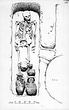
Found while digging just east of Stoa Shop XIX, when came upon some bones, Mycenaean sherds and a pot. As the excavation was enlarged the legs of two skeletons ... Myc. III A:2 (2nd half of 14th c.) ... Found while digging just east of Stoa Shop XIX, when came upon some bones, Mycenaean sherds and a pot. As the excavation was enlarged the legs of two skeletons were exposed in a trench about one meter wide, with the whole pot and the coil of lead wire found between two sets of legs. |
|
|