|
|
| North of House G (RSY=Pyre 13).
Concentration of artifacts, small pieces of bone, and burnt material in stratum, no pit discerned. The pyre is cut by the trench of a wall of a Roman house to north. It ... 290-250 B.C. |
| RSY Grave 51.
The grave lay on the slope of the Areopagus in Roman house O, just east of the line where the hillside is scarped for the foundation of the west wall of the house.
Cutting:the pit cut in ... Archaic period/6th or 7th c. |
Small pit north of Wall C (appr. 0.50 E-W x 0.35m N-S). Coins:
11 August 1994 #1125-#1127 ... 3rd c. B.C ... Small pit north of Wall C (appr. 0.50 E-W x 0.35m N-S). |
| Marcie Handler ... It was situated in the NW corner of Room 3 in the Classical Commercial Building, just S of Wall 11, the cross-wall that divides Room 3 from Room 4 to the north. The pyre pots were found surrounded by ... Late 4th c. B.C ... It was situated in the NW corner of Room 3 in the Classical Commercial Building, just S of Wall 11, the cross-wall that divides Room 3 from Room 4 to the north. ... The pyre deposit continued up to the north face of late Roman Wall C, suggesting that these lower courses of Wall C were packed into a narrow trench instead of built up within a wider foundation trench. |
Destruction debris in L.R. water basin, 6th-7th c. A.D, set against back wall of South Stoa II ... 6th c. or 7th c. A.D ... Destruction debris in L.R. water basin, 6th-7th c. A.D, set against back wall of South Stoa II. |
Well at 56/ΚΖ, just south of the south wall of the northern Late Roman Building ... Second half of 2nd c. - early 3rd c. A.D. |
| David Scahill ... Behind northeast corner of Classical Building; east wall C. Below Hellenistic levels and early Classical pit. Chamber cut through bedrock, depth ca. 0.90m., diameter ca. 2m., roughly square in shape, angling ... LH III A:1 ... Behind northeast corner of Classical Building; east wall C. Below Hellenistic levels and early Classical pit. ... Possible dromos cutting in northwest corner, running under wall C.
Loose fill of stones and earth filling tomb with large number of geometric sherds ranging early to late Geometric. ... At the floor of the tomb, bone fragments, broken pottery, two figurines and bronze implements along south wall. Pottery appears to be LH III A:1 with some possibly earlier. |
House C, Room 4 (Pottery dump of stamnos wall and fill below floor). Coins:
1 July 1947 #13
2 July 1947 #1
Coins from House IV:
14 May 1947 #1-#2
19 May 1947 #6-#7
20 May 1947 #32 ... First half 3rd c. B.C ... House C, Room 4 (Pottery dump of stamnos wall and fill below floor). |
Pit in House N, Room 2 (RSY, House C). Filling thrown in behind the west wall of the Great Drain South at the time of the building of the drain and the extension of House C.
Cf. Hesperia 20 (1951), pp ... Ca. 430-410 B.C ... Pit in House N, Room 2 (RSY, House C). Filling thrown in behind the west wall of the Great Drain South at the time of the building of the drain and the extension of House C.
|
Deposit at 42/ΙΕ beside rubble wall under modern cellar wall ... 5th c. B.C. |
| Pyre in House C, Room 12 (RSY=Pyre 9) in the industrial area west of the Areopagus.
Notebook refers to House N.
Beside west wall of room 12. Pottery, burnt bone, and cinders in a roughly round pit; disturbed ... Ca. 250 B.C ... Pyre in House C, Room 12 (RSY=Pyre 9) in the industrial area west of the Areopagus.
... Beside west wall of room 12. Pottery, burnt bone, and cinders in a roughly round pit; disturbed by Byzantine pit. |
Pocket behind heavy Roman retaining wall ... 4th c. B.C. |
N-S Cut on 20m. line (area of Road, area of Stoa, area N of Stoa)
various levels and dates over the three areas.
Investigations to the northwest of the market square in the area of the road that bordered ... Protogeometric to Late Roman ... B.C., with later (1st c. B.C.)
Layer VII: 4th c. ... Layer IV: 7th-3rd c. B.C.
Layer V: 8th-7th c. ... Plundered trench of early N-S wall: geometric to 4th c. |
Pocket in bedrock behind stepped retaining wall ... 7th c. B.C. |
| Kernos Pit #1 under Valerian Wall. P 30173-P 30174 added on May 7, 1973 ... 4th c. B.C. |
Geometric Well under Rubble Wall of Predecessor.
Classical pit above a Geometric well with a small amount of pottery from the late 6th to the middle of the 4th c. B.C. Estimated Grid ... Late 8th century B.C ... Geometric Well under Rubble Wall of Predecessor.
Classical pit above a Geometric well with a small amount of pottery from the late 6th to the middle of the 4th c. B.C. |
Dug as Tholos Trench V, Room E, burnt filling of plundered wall trench of S wall of court. See also lot Ζ 484 ... Late 6th c. B.C. |
| Anne McCabe ... Adjacent to the SW face of Byzantine Wall 14. The circular cutting, 0.90m in diameter, appeared at 53.504m under a layer of loose rubble (Lot 481). Wall of the well roughly built, consisting at the top ... 11-19 July 2006
24 June-21 July 2009 |
Wells at 24/ΙΓ at 26/ΙΑ near the SW corner of the market square, about 10m west of the Southwest Fountain House (the party wall between them broken through in antiquity).
Use filling middle to third quarter ... Ca. 550-525 B.C ... Wells at 24/ΙΓ at 26/ΙΑ near the SW corner of the market square, about 10m west of the Southwest Fountain House (the party wall between them broken through in antiquity).
Use filling middle to third quarter of 6th c. B.C., upper filling, 6th c. |
Ash and Carbon Dump in Corridor directly behind Room C of Brick Building.
This material comprises what appears to have been a household dump associated with the period of use of the Brick Building, but ... To mid-2nd century ... Ash and Carbon Dump in Corridor directly behind Room C of Brick Building.
... The dump is located in the corridor between the back wall of the Brick Building and the retaining wall behind the building , immediately east of the line of the dividing wall between Rooms B and C [City Grid: Q/18-11/2] |
Hephaisteion Garden; fill beside wall. Loose filling encountered in rescue excavation to examine wall found during construction of public toilet in Theseion Park, outside Agora area. SIR 1991
Originally ... Second half of 4th c. B.C. |
Clearing bedrock on line of early (Archaic) peribolos wall, east of entrance on the south side, west end. Uncatalogued material: 50 sherds, 83 fragments. of plemochoai.
Classical Ware : lekythos; plemochoai ... Early 2nd c. B.C. |
| Marcie Handler ... The Pyre was revealed in a layer of 4th c. fill in the north end of Room 6, just south of Wall 8. Room 6 is defined by the street wall (Wall A) on the west, Wall 7 on the east, Wall 9 on the south (preserved ... 4th c. B.C ... The Pyre was revealed in a layer of 4th c. fill in the north end of Room 6, just south of Wall 8. Room 6 is defined by the street wall (Wall A) on the west, Wall 7 on the east, Wall 9 on the south (preserved only as a stub on the east side of the area), and possibly Wall 8 or Wall 6 on the north.
2.5 meters SW of the pyre, a patch of floor surface at J/10-1/20 at 52.188 masl. was found. |
Material from trenches:
a) 1.00-7.00m. from East End of Stoa.
b) 18.40-21.40m. from East End of Stoa.
c) 46.60-48-60m. from East End of Stoa.
d) 51.00-53.00m. from East End of Stoa.
e) 79.00-81.00m. from ... 2nd c. B.C ... Material from trenches:
a) 1.00-7.00m. from East End of Stoa.
b) 18.40-21.40m. from East End of Stoa.
c) 46.60-48-60m. from East End of Stoa.
d) 51.00-53.00m. from East End of Stoa.
e) 79.00-81.00m. from East End of Stoa.
Includes drain trench in front of back wall of Stoa (some disturbed, some undisturbed fill), soft fill above stone drain, fill from within stone drain, channel behind stylobate. |
Investigations in the Hellenistic Metroon, various levels. Stoa Pits A, B, C, D, E, F, H and I (various layers).
Locations include:
SW corner of Primitive Bouleuterion; from contemporary filling alongside ... 8th-6th c. B.C ... Stoa Pits A, B, C, D, E, F, H and I (various layers).
... Levels include:
- 8th and 7th c. B.C.
- early 6th c. B.C. with much earlier material
- early to middle 6th c. B.C.
- first quarter of 6th c. |
Small pocket between the tumbled wall of large conglomerate blocks and Drain 2 ... 4th c. B.C. |
Investigations within the Stoa of Zeus, the north part, various levels.
Notebook references: Stoa Trench E Layers IV and V, Stoa Pits A, B and C, and Layers I and II of area between back wall and retaining ... 5th c. B.C ... Notebook references: Stoa Trench E Layers IV and V, Stoa Pits A, B and C, and Layers I and II of area between back wall and retaining wall of Stoa. ... Subdivisions: (from the deepest layers to the top):
.1=a) (Pre-)Persian
.2=b) Post-Persian Pre-Stoa
.3=c) Stoa and Stoa Annex filling |
Filling in the footing trench of the late Roman Fortification.
Includes Layer 1 and Layer 2 of Library Colonnade opposite Room 2. "Note: both these layers are fill thrown into V.W. footing trench." (nb.p ... End 3rd. c. A.D. |
Well at 19/ΛΓ.
The cistern S 19:3 and the well S 19:8, together with a Roman well, S 19:1, had collapsed to form a large pit S 19:5.
Top to -8.5m: Byzantine dump to 11-12th c. A.D.
-8.50m to -15.00m: 4th ... Mid 3rd century A.D ... Top to -8.5m: Byzantine dump to 11-12th c. A.D.
-8.50m to -15.00m: 4th c. B.C. fill from adjacent well, fallen in when tiles of this well removed and bedrock wall between two wells collapsed.
-15.00m to -17.00m: Fill of broken well tiles, bedrock and some pottery, none catalogued.
-17.00m to -17.30m: Original POU-Mid 3rd c., parallels to Group K. |
Well in front of Shop 15: Turkish (in line of Valerian Wall) Opened the well again in 1951, without realizing that it was finished. Found nothing in it. (p. 1468) ... 15th-16th c. A.D. |
Filling over and behind blocks of E. wall of Great Drain at 10-15/Α-Γ. Coins:
10 May 1954 #1-#2 ... 3rd c. B.C. |
| A well at the northeast corner of Classical Building, behind back wall. Dumped fill appears to have occurred as a single event as there are joining sherds throughout.
POU date ca. first half 5th c. B.C.; ... 5th c. B.C ... A well at the northeast corner of Classical Building, behind back wall. Dumped fill appears to have occurred as a single event as there are joining sherds throughout.
POU date ca. first half 5th c. B.C.; pottery in fill spans ca. last quarter 6th c.-430 B.C.; out of use ca. 430 B.C ... Pottery primarily of the mid 5th c. with the latest sherds dating to just before the last quarter of the century. |
| David Scahill ... Burial in Geometric well (J 3:8), in Classical Building II, Room I, next to south ashlar wall. "No grave goods!"
ADDENDA: J. Papadopoulos later associated P 34449 and P 34450 to that grave. (Cf. Agora ... Geometric ... Burial in Geometric well (J 3:8), in Classical Building II, Room I, next to south ashlar wall ... AA 362 a, b, c |
Firm fill over bedrock on east edge of section, north of the early (Archaic) peribolos wall. Uncatalogued material: 10 sherds, 30 fragments of plemochoai. Deposit created by Margie Miles, 4 inventoried ... 3rd quarter 4th c. B.C. |
Pit in Tholos Trench V (below Layer e).
In plan it would seem to have been oval, though its east end is c/../ by the south wall of the North Archaic Home. Its N-S width is 1.25m, its E-W length is 1.40m ... 7th-early 6th c. B.C ... In plan it would seem to have been oval, though its east end is c/../ by the south wall of the North Archaic Home. |
A shallow tiled well or reservoir set inside the South Stoa against its back wall. Its location in relation to the wall of the Stoa, and the fact that a lead pipe set through the latest floor of the Stoa ... 5th - 6th c. A.D. |
Red sandy earth at inner corner of heavy late wall at 12/ΛΖ.
A. Walker coin deposit. Coins:
27 March 1934 #1-#12
28 March 1934 #1-#2 ... 2nd-3rd c. A.D. |
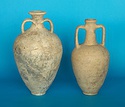
| Marcie Handler ... A deposit of six amphorae and one micaceous water jar was excavated between 20 June and 6 July 2005 in the area north of Wall K. The neck and one handle of one of the amphorae (BZ 1213) had been poking ... Ca. 1st c. A.D ... A deposit of six amphorae and one micaceous water jar was excavated between 20 June and 6 July 2005 in the area north of Wall K. The neck and one handle of one of the amphorae (BZ 1213) had been poking out of the surrounding fill since the end of the 2001 season. ... The second layer of fill (lot 1541) excavated around the amphora dated to the early Roman period (c. 1st century A.D.), and after we removed this layer of fill we revealed the outlines of five more amphorae and one micaceous water jar. |
The data in the Deposit Notebook is presented by trench; an attempt is made here to accumulate data from similar layers across the trenches. Subdivisions:
.1=Post Hadrianic cleanup
.2=Marble working waste ... 2nd c. B.C.-3rd c. A.D. |
Fill against back wall foundations of Royal Stoa I/6,9-4/8,14. Dug separately, these many fills contain material which joined horizontally and vertically all along back wall of Royal Stoa. Fill seems to ... 2nd/3rd quarters of 5th c.-420s |
| Initially uncovered with a diameter of c. 1.05m. Its south side extends under the south wall of the Classical structure and so clearly predates it. The highest preserved portion of the well shaft (at the ... 22 July-9 August 1994
26 June 1995
3-7 July 1995 ... Initially uncovered with a diameter of c. 1.05m. Its south side extends under the south wall of the Classical structure and so clearly predates it. ... It is not clear at exactly what elevation the lining wall originally began, but it seems unlikely that the entire shaft was lined, for the cutting in bedrock for the upper part of the shaft, where it is well preserved on the east side, lies directly above the inner face of the lining wall below. ... Because the south side of the well shaft projects beneath the E-W Classical Wall at J/6,7-2/20, we attempted to leave undug the portion of the well fill that underlies that wall. |
Lower fill may be original. Part of North side cut away by modern bothros wall. Fragments of Pilgrim Jug of Grey Ware, related to Turkish Grey Ware? ... 12th or 13th c. A.D. |
Deposit alongside Greek House I, perhaps giving the construction date of the second phase. Deposit list title it as : outside of east wall of Roman House H ... Last quarter of the 4th c. B.C. |
Well shaft cut through a cistern channel which was then packed with three amphorae (P 3123, P 3125, P 4201) of 1st or at latest early 2nd c. A.D. (These three amphorae could be considered with F 15:2) ... 3rd-4th c. A.D ... Upper fill to 5.50m produced little pottery and that of 5th c. coins to Honorius 395-423 A.C. ... Lower fill 9.10-9.60m, 4th c. (dump?). No coins.
... It seems more likely that tiles were robbed in late 4th c., one 1st c. amphora of packing fell in and then a 4th c. dump was dropped in, capped by tile fragments; later a 5th c. dump on top.
|
Well E (diameter 1.10-1.20m) just outside the northwest corner of the southwest Fountain House.
Dug initially as a pit (J 15:2) partially covered by an early Roman wall ... Early 7th c. B.C. |
Pocket on the line of the early (Archaic) peribolos wall at entrance on the south side. Uncatalogued material: 215 sherds, 186 + frags. plemochoai and 4 objects.
Classical Ware : black glaze; mug; rilled-rim ... 3rd quarter 4th c. B.C. |
| Disturbed pyre in NE stoa area.
In western room of westernmost shop building. A patch of ash i or at the level of layer 2 (lot Ι 189d), partially destroyed by modern wall. Pottery from layer 2 dates ... 400-350? ... A patch of ash i or at the level of layer 2 (lot Ι 189d), partially destroyed by modern wall. Pottery from layer 2 dates at least as late as the early 4th c. |
| Marcie Handler ... The contents of this Hellenistic cistern shaft were excavated in a series of layers: the preserved top of the shaft, six layers in the shaft and the fill within the tunnel. At the bottom of the shaft on ... POU: Mid-3rd c. BC
Dumped fill: after 225 BC |
Grave (?) under wall 4. Infant burial(?); a kados, P 16747, lying sideways with a tall cylindrical stand, P 16748, set over it as a cover; the upper parts of the pots cut away ... Late 6th. c. B.C. |
| Terracotta deposit in SW corner of Room K and E of Roman Wall L. Roman layer of red, compact earth.
Baskets 50,52,54. Coins:
18 July 2002 #1282
19 July 2003 #1295 ... 4th c. A.D. |
Fill around the upper block of the southwest corner of the early (Archaic) peribolos wall, south of the Propylon, and hard fill at the side of a trench for a modern wall.
Uncatalogued material: 181 sherds ... 2nd c. B.C. |
Fillings behind retaining wall and in road.
SW Building, rooms 3, north, south. Coins:
13 March 1934 #1, #2
14 March 1934 #37
15 March 1934 #37-#38
24 March 1934 #31 ... 6th c. B.C. and earlier |
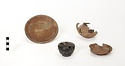
| The remains of a pyre disturbed by the construction of Wall 106. The compact, light brown soil contained some ash and bone and 5 nearly complete pots or saucers ... First half 3rd. c. B.C. |
Plaster dump at Q/2,5-6/7,9.
Layer 5 in "Wall Painted Room" of Roman House ε. Layer resting on bedrock and covered partially by good strosis (55.26m.). Fill was red with mudbricks, tiles, much plaster ... Late 1st-early 2nd c. A.D. |
Also noted as 32-33/Μ. The N wall collapsed. A very shallow deposit of ancient fill over its stuccoed floor. Coins:
10 May 1939 #3-#4 ... Hellenistic, 4th-early 3rd, Roman, 4th c. A.D. |
Burnt Layer inside retaining wall of Middle Stoa Terrace (Θ) and NW Corner of Middle Stoa, burnt debris inside terrace retaining wall (Ζ). Coins Ζ: Coins Θ:
1 June 1951 ... Mid-3rd c. A.D. |
First trial east Stoa colonnade, N. of S. wall III, layer 12.
Note quantities of cattle bones, the knuckles sawn off and many worked bits. Evidently a bone implement factory near by. [nbp. 2139] Coins: ... Late 3rd c.-earliest 4th c. A.D. |
| Bronze-casting pit and furnace against S apse of Church (106/ΛΕ). Late Roman sherds of the 4th and the 6th c. A.D. were found with fragments of moulds from bronze casting. The west end was destroyed by ... 5th-6th c. A.D ... Late Roman sherds of the 4th and the 6th c. A.D. were found with fragments of moulds from bronze casting. ... There is a tile floor set on bedrock and two brick piers of the south wall stand to a height of 1.12 m.; one scrap of the north wall establishes a width of 1.05m. |
Double Well by Entrance to Square Building (Well B)
Wall A (R 9:2) was Late Geometric or transitional well, into one-half of which a bothros had been sunk in Turkish times (16th c. A.D.)-R 9:3.
This bothros ... ca. 17th century A.D ... Double Well by Entrance to Square Building (Well B)
Wall A (R 9:2) was Late Geometric or transitional well, into one-half of which a bothros had been sunk in Turkish times (16th c. ... This bothros was lined on the side of the Geometric well by a wall made of rough stones and pink cement, supported by three small round wooden beams. |
Child's burial in south wall of Marble Worker's House.
Bones examined 20 June 1975 and found to be an immature animal, not human (canid-puppy?).
Identified as pyre by SIR. Set into a shallow roughly ovoid ... Late 4th c. |
Well at 71/ΛΒ (diameter ca. 1.10m) near the east wall of the entrance porch.
Narrows toward bottom, collapsed at top. Six footholds preserved at south, three at north, spaced at ca. 0.50m. Uniform fill ... Late 8th in early 4th c. B.C. |
Well at 115/ΣΤ (all the 5th c. fills of 116/ΣΤ). The lower part of the shaft contained a heavy deposit of pottery and other objects of the late archaic period, both coarse and finer wares; probably a post-Persian ... Ca. 500-480 B.C.-Roman ... Well at 115/ΣΤ (all the 5th c. fills of 116/ΣΤ). ... Top to -6.50m, 4th c. dump, with coins as late as Valens 364-378. ... Deposit Lists file has the 5th c. objects from this deposit listed together with those fallen in from D 15:2. |
| Eugene Vanderpool ... Mycenaean Chamber Tomb.
Although badly disturbed at various times in antiquity, it was clearly a chamber tomb with the chamber little more than a cubby-hole at the end of a steep dromos, entered at the ... Myc. III A-B |
| Pocket with burning at 60/ΚΗ. "Is this perhaps a disturbed pyre burial." [Nbp. 2928].
Identified as pyre by SIR.
Near north end of corridor, beside its west wall. Concentration of artifacts, tiny scraps ... 4th c. B.C. |
Classical commercial building, room 3, against south wall. Small fragments of pottery dispersed in fill overlying two floor levels (at 51.897 and 51.941 masl). Five objects of pyre type: ribbon-handled ... 4th c. B.C. |
A filling lying over a cobbled floor in a house-complex on the lower north slopes of the Areopagus.
Area in front of E-W retaining wall, just above cobble pavement, disturbed by coins and pottery as late ... 375-275 B.C ... Area in front of E-W retaining wall, just above cobble pavement, disturbed by coins and pottery as late as the 3rd c. |
| Anne McCabe ... Enchytrismos burial of an infant in Byzantine Room C, L/15-2/13, at 52.915m. Although disturbed by roots, the skeleton (AA 373) was articulated and lay parallel to Wall 1, with head at the NW and feet ... 14-15 June 2007 ... Enchytrismos burial of an infant in Byzantine Room C, L/15-2/13, at 52.915m. Although disturbed by roots, the skeleton (AA 373) was articulated and lay parallel to Wall 1, with head at the NW and feet SE. ... The layer in which the burial was set, and into which the footing trench along the N face of Wall 23 appears to have been cut,, was excavated from 52.911-52.555m with no soil change (Lot ΒΗ 505). |
Well Y, in area North of the West end of the Yellow Poros Foundation. The shaft had cut through the wall of an earlier well and the cavity had been packed with stones by the diggers of the new well. In ... Earth 5th c. B.C ... The shaft had cut through the wall of an earlier well and the cavity had been packed with stones by the diggers of the new well. ... Lots ΕΛ 49-50, added from filling over well (mid 5th. c. B.C.)
Lot ΕΛ 54, added from the earlier Well U 19:5. |
Channel J (in ΗΗ)
Cutting that probably originally held a drain. Packed with amphoras and other coarse pottery. It tapped the poros aqueduct wall just East of our explanatory trench at the East end of ... 1st c. B.C. - early 1st. A.D. |
Wells at 24/ΙΓ at 26/ΙΑ near the SW corner of the market square, about 10m west of the Southwest Fountain House (the party wall between them broken through in antiquity). ... Ca. 500 B.C ... Wells at 24/ΙΓ at 26/ΙΑ near the SW corner of the market square, about 10m west of the Southwest Fountain House (the party wall between them broken through in antiquity). Top filling disturbed, dumped fill ca. 500 B.C., use filling of late 6th c. B.C.; both filled at the same time. |
| Brian Martens ... It was partially excavated during the 2012 and 2013 seasons. The tomb, located at the center of Room III in the NE area of section ΒΖ, was found under fill surrounding perpendicular mid-to late 6th c ... LHIIIA ... N-S Wall 17 and E-W Wall 18 were found during the 2012 excavation season and were excavated below their lowest courses. ... Leveling fill over Walls 17 and 18 indicates disuse within the first half of the 5th c. B.C.
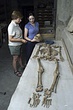
Disarticulated human remains (ten individuals including adults, children, an infant, and fetuses) were found in the cutting east of Wall 17 and at least one fetal rib was found in the cutting opposite at the west.
... Scarping revealed the blocking wall of the chamber. |
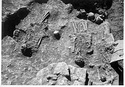
| Mycenaean grave to west of House N, room 5, with the burial of two young children. Rough rectangular cutting in soft stereo (0.95x0.64x0.28), lying under the western wall of a Geometric house, contained ... Myc. III C:1 |
| Sacrificial pyre in Poros Building, NW Room (RSY= Pyre 1).
Against east wall of room 5 west. artifacts, bone, carbon and ash in pit in floor sequence. the pyre lay below a floor covered with marble dust, ... Middle of 4th c. B.C. |
Well 12: Archaic.
It lies on a rocky ledge about thirty meters north of the Klepsydra, just east of the Panathenaic street. In spite of its depth, it produced little pottery and its contents were of slight ... 6th c. B.C.? |
Nb page 5044: Great shapeless pit with a well (62/Ξ) at its bottom which we were unable to dig because it was too dangerous. Fill in the pit was of sand and white ash. The finds and pottery 4th. and perhaps ... Late 4th.-early 3rd. c. |
| Sacrificial Pyre = Pit in floor (identified as pyre by SIR); with the characteristic small plates and saucers. "Saucer Grave" at 12/ΚΑ.
Dimensions: 2m (length)x 0.70 (width).
North of north wall of building ... First half 4th c. B.C. |
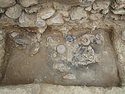
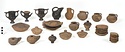
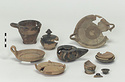
| Handler ... Found in an area of disturbed fill north of a floor surface in Room 4 of the Classical Commercial Building. The floor surface (n. 3 on the west side of Room 4) was preserved at 52.503-52.544 masl., and ... 2nd half 4th c. B.C ... The floor surface (n. 3 on the west side of Room 4) was preserved at 52.503-52.544 masl., and was excavated in Lot ΒΖ 1758 (2nd half of the 4th c. B.C.). The pyre was located in a shallow channel adjacent to the south face of Wall 4, where the floor surface was not preserved. |
| Pocket, identified as sacrificial pyre by SIR. Possibly disturbed. Outside south wall of building. Concentration of pottery in a small pocket below a "Hellenistic" fill. There is no mention of bone or ... First quarter 4th c. B.C. |
Soft Trench behind Stoa Stylobate, opposite Piers 21 and 22, along W face of Shop front wall. Herulian destruction debris at the north end of the Stoa of Attalos. Coins:
20 February 1954 #1-#2
22 February ... Late 3rd c. A.D. |
| Disturbed Pyre at 59/ΚΗ (ΚΖ), in the area of the Poros Building west of the Areopagus.
Against east wall of room 5 west. concentration of artifacts, ash, carbon and a few bones in stratum, no pit discerned ... 3rd c. B.C ... Against east wall of room 5 west. concentration of artifacts, ash, carbon and a few bones in stratum, no pit discerned. ... That is how the excavator interpreted it in the notebook, and the lamp and angular kantharos represent two-thirds of the classic pyre assemblage of the mid-3rd c. B.C. |
| Brian Martens ... Located in the southern section of Room I, now bound by the scarp of Wall U at the north,, the scarp of Wall L at the east,, and a modern pit at the south. At its now low elevations, excavated in the 2015 ... Third quarter of 5th c. B.C ... Located in the southern section of Room I, now bound by the scarp of Wall U at the north,, the scarp of Wall L at the east,, and a modern pit at the south. ... The fill is perhaps Persian destruction cleanup, deposited during the third quarter of the 5th c. B.C. |
| Marcie Handler ... Continued from 2000 season, 10-12 July 2000; BZ XXIII p. 4472.
The hoard was originally excavated during the 2000 season (Lot BZ 1049, 5th-6th centuries AD), from a higher elevation through a gap in the ... 10-12 July 2000
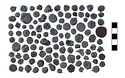
21-22 July 2003 ... The hoard was originally excavated during the 2000 season (Lot BZ 1049, 5th-6th centuries AD), from a higher elevation through a gap in the stones of Wall A, and was thought to be the bottom of a foundation trench for the wall. ... Coin hoard (mostly illegible) 4th c. A.D.
Foundation trench of N/S street wall, in ash pit. 53.505m-53.089m. |
| "Room D" is the triangular area at L/15,16-2/10,12, NW of Wall 1, in E corner of basement of No.3. Hastings Street, bounded by the NE and SE walls of basement).
Bell-shaped vessel built of horizontally-laid ... 10th-11th c. A.D. |
| Laura Gawlinski ... Coin hoard of Athenian tetradrachms. Dug into fill under floor (floor level not preserved) on east side of Strategeion near the NE corner of room formed by the eastern poros block wall and an east-west ... Second half of 4th c. B.C ... Dug into fill under floor (floor level not preserved) on east side of Strategeion near the NE corner of room formed by the eastern poros block wall and an east-west polygonal crosswall. ... Dug into two layers of fill, Lots S 295 (ca. 475 B.C) and S 296 (last quarter of 6th c. B.C.) |
| Mycenaean Small Chamber tomb.
The cist measures 1,90m E to W, 0.75-0.90m N to S, max. depth -1.30m. Nothing was found in it; cleaned in modern times and used as a cesspool. Some of the SW part of it had ... Myc. IIIA, early 14th c. |
| Laura Gawlinski ... Bronze foundry north of bridge on Piraeus street, east of Great Drain.
Keyhole-shaped bronze casting pit, cut into bedrock.
2016: Continuation of the excavation of a rectangular pit with foundry debris, ... Late 6th-early 5th c. B.C.
(Late Archaic/ Early Classical) ... Pit cut into bedrock at west and north; fill continues beneath later wall (“Wall A”) at east. ... Seven standing mudbricks line the bedrock wall at south, surrounding a ceramic stand, hand-formed on a cut bedrock base. ... Very little pottery: most is archaic or earlier, but some sherds may go down towards the middle of the 5th c. BC. No evidence that casting took place in the pit itself.
|
| Marcie Handler ... Pyre under floor no. 9 in the center of Room 4. It was adjacent to the southern face of Wall 4, but at lower elevation than the lowest course of the wall foundation (which was found at 52.250 masl.), suggesting ... 375-350 B.C ... It was adjacent to the southern face of Wall 4, but at lower elevation than the lowest course of the wall foundation (which was found at 52.250 masl.), suggesting that the pyre was deposited during a phase of the building that predates Wall 4. ... The oblong pit for Pyre J 2:30 was cut into Floor no 10 (removed in Lot ΒΖ 2122) and was covered by Floor no 9 (removed in Lot ΒΖ 2120), both of which dated approximately to the last quarter of the 5th c. B.C. The top surface of Floor no 10 was found at 51.977-52.072 masl, and the edges of the cutting for the pyre pit were found at virtually the same elevation (51.933-52.003 masl). |
Enchytrismos burial of an infant at the E. corner of Byzantine Room G.
The burial was in brown fill flecked with charcoal and containing brown-glazed pottery (Lot ΒΗ 472). The pot was embedded upside ... Byzantine 10th/11th c. A.D. |
| Pyre in House N, room 4 (RSY=Pyre 7), in the industrial area west of the Areopagus.
Pottery, mall pieces of calcined bone, log, wood cinders, and charcoal in diamond-shaped pit in floor sequence. The pyre ... Late 4th-early 3rd c. B.C. |
Two chambers connected by a tunnel, all filled at the same time, but with slight Hellenistic disturbance. Chamber A, to west at 14/ΛΗ, B to east at 14-15/ΛΒ on grid for section RR.
Cistern system ca. 20.00m ... Ca. 325-275 B.C ... Basically a single dumped filling; the presence in the filling of a few later objects ... possibly as late as the second half of the 3rd c., probably indicates a supplementary filling. ... In the early 3rd c. B.C. very possibly ca. 277/6 (see Garden article), the southerly side of Kolonos, outside the Precinct Wall, was levelled off and the double cistern were cut down and filled p. 833. |
Evidence of stratification into five layers, although joins between the layers. Layer VI added when the construction of the Roman building above required it. No subdivisions assigned.
Flask-shaped cistern ... Early 3rd-late 2nd c. B.C. |
Michael Laughy ... West and adjacent to Modern Wall 5, we excavated 12th-13th c. A.D. fill, in some places a half meter deep or more. The fill was remarkably uniform in content throughout. Typical pottery included: fine ... 12th-13th c. A.D ... West and adjacent to Modern Wall 5, we excavated 12th-13th c. ... At the time of this summary, the legible coins are Frankish, and date to the early 13th c. A.D.
Coins: ΒΘ-96; ΒΘ-98 -128; ΒΘ-135 -145
Pottery lots: T 141, T 143
Notebook: ΒΘ VIII
Baskets: 43, 57; pp. 1557, 1587
X-Section: pp. 1460, 1500
Grid: K/6,9-3/5,9
Elevation: 54.544-54.111m. |
| Mycenaean tomb: Myc. III A:1-2.
SAI
Small rectangular chamber, 2.30m wide by 1.80m deep,, entered from the east through a dromos 1.10m wide which contracted to a doorway 0.92m. wide. the doorway preserved ... 2nd half of 14th c ... SAI
Small rectangular chamber, 2.30m wide by 1.80m deep,, entered from the east through a dromos 1.10m wide which contracted to a doorway 0.92m. wide. the doorway preserved its rough stone blocking wall to a height of 0.70m to 0.80m., and the dromos the firm red earth with which it had been packed to a height of 1.30m.
... The ceiling of the chamber had collapsed at least as early as the 6th c. B.C. Two skeletons were found lying in order, their heads toward the east and their legs doubled up. |
A well about 2.00m. SE of the Tholos precinct wall. The presence of the water-clock strengthens the probability, suggested by its location, that the well served one of the public buildings in the neared ... Ca. 410-390 B.C ... SE of the Tholos precinct wall. The presence of the water-clock strengthens the probability, suggested by its location, that the well served one of the public buildings in the neared neighborhood. ... The upper contrasts sharply with the "canonical" late 5th c. fill; very scrappy; very limited variety of shapes. |
| Pyre(?) in House N, S.W. Room. (=House C, Room 10)
In room 10. Vessels from an earlier pyre were found dispersed in the makeup of the latest "floor" in the room, with tile fragments trodden into its surface ... First quarter of the 4th c. B.C ... (=House C, Room 10)
In room 10. ... This layer and the one below it run over the wall between rooms 9 and 10,so either they postdate the destruction of the house or indicate yet another change in its plan. |
Pits in area 96-100/ΝΕ-ΝΘ (lower east slopes of Hill of the Nymphs, near extreme west edge of excavated area).
Shallow pit in bedrock against N. face of wall. dMax. depth 0.20m.d.
Many fills in areas ... Ca. 325-300 B.C ... Shallow pit in bedrock against N. face of wall ... At that time the first three of these groups were called first half of 4th. c., but it is plain from the lamps, etc. that all are second half. |
Investigations to the south of the Metroon, in the passageway between the Metroon and the Tholos; accumulated layers, from the Geometric and earlier periods to the 3rd and 2nd centuries B.C.
Cf. Hesperia ... Geometric to second c. B.C. |
| Pyre in House D, Room 4 (RSY=Pyre 4) in the industrial area west of the Areopagus.
Notebook refers to House N.
Pottery belongs late in third quarter of the 4th. c. BC. Pyre burned near beginning of last ... 350-300 B.C ... Pottery belongs late in third quarter of the 4th. c. BC. Pyre burned near beginning of last quarter.
... The pyre pit was dug through layer 1 and into layer 2, both of which overlay the foundation of the wall between rooms 3 and 4. |
| James Artz Pirisino Daniele Kylindreas Miltiades ... Excavation in Room 3 of ΒΘ West revealed 5 ceramic vessels in a row against the eastern face of Wall 12. 3 complete vessels (ΒΘ 122, 124, and 125) were catalogued, along with the base of a plain glazed ... 9th-11th c. A.D. |
Mycenaean Well (S/1,2-13/20,14/1). Underneath the NE Room of the Library of Pantainos, along its S side, as a cutting in bedrock containing reddish fill with bits of green bedrock. The feature is rectangular ... 30 June-23 July 1975 ... The presence of Roman pottery and the absence of pottery from intervening periods (5th-4th c. B.C.) seems to indicate that the shaft of S 13:2 may not have been filled to the top originally (or the fill settled over centuries), and had been covered in some way, not to be rediscovered until the early Roman period.
The location of the well immediately beside a wall of the library main room, as well as the coincidence of the top edge of the well with the bottom level of the library Main Room wall, would suggest that the shaft was cut into during preparations for the construction of the library, which also removed any structural remains that may have been associated with the use phases of the Classical wells.
... LHIIIA (layer IV)
1st c. A.D. (layers I-III), Roman pottery from 66.10-65.00masl ? |
|
|