|
|
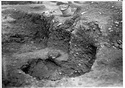
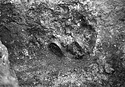
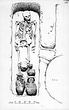
| Dorothy Burr Thompson ... Grave 1. Urn cremation (trench-and-hole), adult female 30-40 years old).
Mentioned as Grave XVII in Deposit list.
Consisted of a roughly circular pit, approximately 0.30-0.40m in diameter, cut into ... Late Protogeometric |
| Dorothy Burr Thompson ... Grave 2. Urn cremation (trench-and-hole). In some records as XXIII.
Variously labeled as grid 7/Δ, 7/Γ and 7/Γ-Δ.
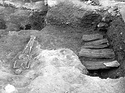
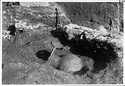
Rectangular pyre trench cut through earth into bedrock, with only the lowest 0.04m surviving ... Transitional Late Protogeometric/Early Geometric I |
| Dorothy Burr Thompson ... Grave 4 in notebook. (E.L. Smithson: Grave XLIV). No remains (not really a grave, note on p. 331).
Roughly rectangular patch of unworked fieldstones, measuring about 1.20x0.80m neatly laid on bedrock, ... 19-21 March 1932 |
Rectangular shaft at northwest foot of Areopagus; dumped filling of second half of 4th c. B.C. Pit at 16/Δ-Ε recorded one time as an extension of shaft 17/Δ-Ε (see L 506 and nb.p. 395), but items from ... Ca. 325-275 B.C. |
Child's burial in south wall of Marble Worker's House.
Bones examined 20 June 1975 and found to be an immature animal, not human (canid-puppy?).
Identified as pyre by SIR. Set into a shallow roughly ovoid ... Late 4th c. |
| Cistern and well in Marble Worker's House. Coins:
5 August 1968 #1-#6 (#5 and #6 disintegrated. Missing 19/7/1973)
6 August 1968 #1bis-#25 (#5 in Lot 503 not a coin but bronze bits of nail. #6 not a coin ... 325-275 B.C. |
Furnace Dump from N. Hypocaust in Bath to East of Poros Building. Coins:
26 March 1948 #4-#8
27 March 1948 #1-#3
29 March 1948 #2-#7
1 April 1948 #2-#3
3 April 1948 #14-#15
7 April 1948 #16-#27
8 April ... Second half 3rd c.-first half 4th c. A.D. |
| Although separated by a sterile rocky fill the two use fillings are apparently one continuous accumulation (GRE).
Packing around well includes SS 14261, P 25943-P 25953. These are not given a subdivision ... 350-300 B.C. to ca. 225 B.C. |
| Stucco-lined bottle-shaped cistern, with tunnel and subsidiary manhole, in SW Baths, Room Α 10. Homogeneous dumped fill, mostly of mold-made bowls and and molds for terracotta figurines. Sixteen stamped ... 225-190 B.C. |
Roman Group L.
Layer I (cont. 59-64) Pre-Herulian second half of 3rd c. (bottom, 15.95-13.90).
Layer II (cont. 42-58) 4th c.-first quarter of 4th c. (11.90-13.90).
Layer III (cont. 17-41) -4th c. (10.00 ... Second half 3rd c.-early 5th c. A.D. |
Bottle-shaped cistern with dumped fillings on NW slopes of Areopagus; appears not to have been finished in antiquity: the walls and floor show no traces of stucco.
Lower filling, ca. 375-340 B.C.
Upper ... Ca. 375-275 B.C. |
Unfinished well, all one fill; solid bedrock at a depth of -2.47m.
It contained masses of broken rooftiles and probably was used as a refuse pit after the sack of Athens by Sulla.
Twenty-three stamped ... Early 1st c. B.C. |
| This filling is the largest deposit of its time found in the Agora. It may be compared with H 6:5 and with N 7:3.
Dug in soft bedrock to a depth of 11.40m; footholds cut on opposite sides of the shaft ... Ca. 490-450 B.C. |
A well on the NW slope of the Areopagus; unfinished well-shaft dug to a depth of only 3.05m., and refilled with broken pottery and other debris. The shaft clearly was begun with the intention of digging ... Ca. 520-480 B.C. |
| Unfinished well-shaft with debris filling (apparently of the Sullan sack), on the lower NW slopes off the Areopagus. Abandoned due to poor quality of bedrock.
Three closely contemporary fills, considered ... End 2nd c. B.C.-second quarter 1st c. B.C. |
| Identified as Pyre by SIR.
Debris filling of the middle of the 4th c. B.C. including the remains of a sacrificial pyre.
Objects dispersed in red-clay fill uncovered in removal of modern staircase. A broken ... 4th c. B.C. disturbed |
Martyr at Δ6. Top strosis (Byzantine-Turkish) discarded.
Strosis 2, late Hellenistic (Lot ΔΕ 21)
Strosis 3, early Hellenistic (Lot ΔΕ 22)
Strosis 4, to mid-4th c. B.C. (Lot ΔΕ 23)
Nothing catalogued from ... To mid-4th c. B.C. |
Fills associated with construction of New Bouleuterion, i.e. inside porch, unused foundation trenches on west side and south side ... Down to last quarter of 5th c. B.C. |
Accumulated fillings in the Bouleutrion Plateia beginning in late 5th c. B.C. and continuing into the 3rd c. A.D., reaching a depth of 0.20-0.30m. (Hesp. 6 (1937), p. 168. Subdivisions:
.1=Layer I
.2=Layer ... 5th c. B.C.-3rd c. A.D. |
Accumulated filling over Bouleuterion Plateia, Layer II. Coins:
8 May 1935 #1 ... 1st or 2nd c. A.D. |
Filling of early N-S road and related fills, in the area of the Geometric Cemetery south of the Tholos; various levels including plundered foundation trench.
For late, disturbed or uncertain levels over ... 7th-6th c. B.C. |
Area of early road and Geometric Cemetery: late, disturbed or uncertain levels. Includes Geometric/Proto Attic material thrown in the Turkish well at 35/Δ. Includes between road and bedrock in Β'. Four ... 5 May 1934
19-23 March 1935
2 April 1935 |
| Grave 19 in notebook. Bones only AA 3.
Length 2.15m; width 0.63m; depth 0.52m.
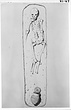
Woman' skeleton with head at north. Cover slabs piled at foot of grave, probably by the diggers of Well J 18:8, who rifled ... Late Geometric |
| Pit with burned debris north of the ancient road leading from the Agora to the Dipylon Gate, probably to be associated with the Persian sack [deposit notebook]. Also includes a similar filling lying over ... Ca. 500-470 B.C. |
Well at 16/Γ = Well at 15/Β.
Dug to 14.90m. and abandoned due to influx of water. Coins:
15 May 1936 #1
20 May 1936 #2-#5
18 June 1936 #1, dump ... 3rd c. B.C. |
| Herm head deliberately buried in a pit with coins of the 2nd half of the 4th c. Head found at an elevation of 51.907. Bottom of the pit at 51.637 m. Coins:
27 June 1972 #199-#205
Bits of bronze, iron ... 2nd half 4th c. B.C. |
Essentially uniform fill of III-IV c. A.D. with a Byzantine upper fill. Coins:
14 June 1937 #1-#3
15 June 1937 #2
16 June 1937 #1
17 June 1937 #1-#2
18 June 1937 #1-#4
19 June 1937 #1-#4
9 June 1938 #1-#3 ... Late 3rd-mid-4th c. A.D. |
| Second century B.C. fill with early 13th c. A.D. fill in mouth.
The Byzantine objects from the mouth are P 13713-P 13718, L 3585.
Lower fill contained bones of many infants and dogs.
The bones from this ... Mid-2nd c. B.C. |
The East Chamber of a double cistern lying between the northeast corner of the Theseion and the Annex to the Stoa of Zeus Eleftherios. ... Both chambers went out of use as water containers simultaneously ... Ca. 200 B.C. |
| A cave-in not long after the digging of this shaft destroyed its possible usefulness as a well and thereafter it was used as a dump. Two principle periods of such use were noted, and within these several ... Ca. 575-480 B.C. |
Estimated Grid ... Ca. 510-480 B.C. |
Containers Lot Α 306-Lot Α 340. Estimated Grid ... Ca. 575-535 B.C. |
Well on Slopes of Kolonos, apparently with two periods of active service. The earlier dating from ca. the turn of the era well down into the 1st c. A.D. Probable that the well was never cleaned out in ... POU Early to second half 1st c. A.D. |
Cistern system West of Bouleuterion: (see also B: cistern system to West of Tholos). Third Chamber from North. A well was dug through the bottom in Byz. times. Cf. deposit F 9:2. Coins:
3 May 1934 #1 ... 160-140 B.C., with Byz. disturbance
Early 3rd to late 2nd c. B.C. POU |
May be of Hellenistic origin when cistern system went out of use.
For a general note on the cistern see Nb. ΟΕ III, pp. 246 ff.
Objects from B 586 various depths (no subdivision): S 2324-S 2330,
P 34894, ... Late 2nd-early 6th c. A.D. |
Well (stone-curbed shaft) near middle of Tholos which served the prior building.
Period of Use dated to ca. 500-480(?) B.C., Upper fill dated to ca. 480-470 B.C. or soon after in Agora XXX (a gradual ... Ca. 500-480 B.C. |
See cistern system wells F 11:2 and F 12:3, part of Tholos water system. Estimated Grid ... Ca. 350-294 B.C. |
Exploration over bedrock inside the Tholos; levels of 6th c. B.C ... 6th c. B.C. |
| Roasting pits associated with the archaic buildings which preceded the Tholos ... Ca. 500-470 B.C. |
Investigations in Room to N of Tholos, various layers and periods. ... 470 B.C.-post-Herulian reuse |
Well 8 (in Tholos), put out of use by a fall of the rock walls and replaced by well G 11:3. Scanty use filling at and near the bottom, separated by a mass of fallen rock from a debris filling in the upper ... Ca. 550-500 B.C. and 480 B.C. |
Rodney S. Young ... Grave 1 in notebook. Slightly disturbed by the digging of Pit A.
A large oil jar/amphora lay on its side with a flat stone stopping its mouth. The three small vases offered at the burial were found, together ... Ca. 600 B.C. |
Grave 2 in notebook. The burial was destroyed by the digging of Pit A, at the edge of which was found a mass of sherds belonging to the grave amphora. Among the sherds were found small cups, fragments ... Late Geometric |
Grave 3 in notebook. Grave partly destroyed by well B. Skeleton and offerings lost. The amphora mouth was doubly stopped by the bases of two other amphoras, one in its neck, the other in its mouth ... 750-725 B.C. |
| Rodney S. Young ... Grave 4 in notebook. Amphora, no other pots but carbonized remains of food offerings. Over urn two stone slabs, on top, mass of small stones containing Late Geometric sherd ... Late Geometric |
| Rodney S. Young ... Grave 5 in notebook.
The grave had been somewhat disturbed by the digging of Well B. The hydria lay on its side; in it was found the skeleton of a small child lying on its side with the knees drawn up ... Late 8th-early 7th c. B.C. |
Indicated as "Grave 6" in notebook but recognized as not a grave: "probably a rubbish pit" [deposit notebook summary]. Concentration of pottery, burning, animal bones, snail shells and seashells, probably ... Late 4th-early 3rd c B.C. |
| Grave 7 in notebook. Area disturbed in Roman times; outlines of the shaft had been obliterated.
The northwest end, however, was preserved in a cutting in the rock of the sloping hillside. This cutting, ... 750-700 B.C. |
| Grave 7b in notebook. Inhumation in Tholos Cemetery; The skeleton positioned directly below the male in Grave 7, but with direction reversed, i.e., head at southeast end. Most grave offerings at lower ... 750-725 B.C. |
| Grave 8 in notebook.
Inhumation in Tholos Cemetery. Length of shaft 1.75m; Width at upper end 0.95m; Depth from cover 0.70m.
One end cut into sloping rock.
Skeleton of a woman, with head southeast. Most ... 750-725 B.C. |
| Urn Burial in Tholos Cemetery. Grave 9 in notebook.
Amphora containing bones of a small child. Little pots had been put under its neck ... Late 8th-Early 7th c. B.C. |
| Rodney S. Young ... Grave 10 in notebook. No remains. Probably grave of a woman.
Only a small portion of the inhumation pit was preserved at the northeast edge of pit A, a large oval cutting of modern date dug for the construction ... Middle Geometric II |
Grave 11 in notebook. Grave disturbed by diggers of pit A.
Only skull and left arm of man's skeleton remained in position, head toward N.E. Cover slabs were piled near head ... Late Geometric |
Grave 12 in notebook. Probably an adult burial ... Late Geometric |
| Rodney S. Young ... Grave 13 in notebook.
Two skeletons of small children lay in a pithos which had been put on its side; its mouth was stopped by a stone slab.
Most offerings were inside the pithos, but two kantharoi and ... Late Geometric |
| Grave 14 in notebook.
Length of shaft 2.12m; width 0.46m; depth from cover 0.60m. Man's skeleton stretched NE-SW with head at NE. Offering at foot of shaft, with the skyphos in the mouth of the pitcher ... 750-725 B.C. |
Rodney S. Young ... Grave 15 in notebook.
Skeleton of infant inside the hydria which lay on its side, its mouth stopped by cup; a pitcher stood by the neck of the hydria ... 750-725 B.C. |
| Grave 16 in notebook.
Length of shaft 1.81m; width 0.64m; depth from cover 0.54m.
Skeleton of a woman , head at northwest end. Most of pots piled over feet and legs of skeleton at southeast end.
An iron ... 750 B.C. |
Rodney S. Young ... Grave 17 in notebook. No offerings.
Amphora containing skeleton of small child was laid on its side in pit. RSY
Lot Β 304 Fill over Grave 17 ... Early 6th century B.C (?) |
| Burned Deposit. A thick deposit of ash, cinders and pottery fragments extending alongside wall of cemetery. Character of pottery like the pyre of F 12:2 ... Late Geometric |
From disturbances in original floor of Tholos with ash and burning. Probably reflects the military and political conditions of 307 B.C.
The broken pottery, both that left lying on the floor of the building ... Ca. 340-295 B.C. |
Circular well cut through the old road after it had gone out of use, and filled probably at the time of the building of the drain and building A, and the throwing of fill over the road ... Ca. 430-400 B.C. |
| Located in Tholos Trench E, beneath floor, beneath layer III.
Diameter 1m. Cf. P 4952 with fragment from this deposit and E-F 12-14.2.
Similar the well filling, H 6:5 Originally called H 12:5
Ann Steiner ... Ca. 470-460 B.C. |
Kitchen Dump in Tholos Trench T ... 375-350 B.C. |
| Grave 20 in notebook. Objects recorded in nb. from Grave 21 (earlier and disturbed by Grave 20) are included here. A pyre [using pieces of pots from Grave 21] was probably burned beside grave 20 and some ... Late Geometric |
| Grave 21 in notebook. Grave twice disturbed. Of the skeleton only the thigh bones were found. No offerings.
Objects listed in nb. as from Grave 21 are taken to be with grave 20 (probably pyre objects) ... Late Geometric |
Green Earth at 03-04-05/ΚΑ-ΚΔ, to at least -3.50m. near the southwest corner of the market square. Terracotta figurines; lamps; fragmentary pottery ... Ca. 500-475 B.C. and later |
| Identified as pyre by SIR.
In room E. Burnt "pocket" found while digging red earth that contained late Hellenistic pottery, including a fragment of Pergamene (discarded). No pit was discerned, but concentration ... 3rd quarter 4th c. B.C. |
| In room A. Concentration of artifacts and burning in stratum, no pit discerned. The pyre lay below a Late Hellenistic fill with a smooth earth surface. It is described as a black patch of earth with sherds, ... 350-250 B.C. |
Tiled well, ca. 30m south of the Tholos. Associated with Building D. Hellenistic Group A with Late Roman fill in upper 3.00m. Objects A 245 and P 4597 are from fill on floor around well-head, contemporary ... 325-260 B.C. |
The following objects may be from this level or from the 'Mixed Classical Level at 10/Δ: SS 449, SS 450, SS 451 (nbp. 186, 2819). Coins:
4 March 1933 #1-#6 (cf. #7-#13)
7 March 1933 #39 ... 150-86 B.C. |
Sandy Intrusion. Coins:
15 May 1933 #1-#25 A. Walker coin deposit ... 2nd c. A.D. |
| Laura Gawlinski ... Circular pit uncovered in Early Building II, south of Room E latrine, adjacent to the preserved latrine floor surface. Continues beneath the latrine surface and the western scarp (unexcavated). Fill relatively ... Late 5th c. B.C. |
| Laura Gawlinski ... Fill excavated south and west of Early Building Ii, Room E latrine, with a high concentration of votive material, such as pyre saucers, miniature loom weights, and ribbon handled plates. Some traces of ... 400-350 B.C. |
Tiled well near the SW corner of the market square between the Southwest Fountain House and the Great Drain, three fills noted: lower fill of earth and stones with a few fragments only of coarse pottery ... 4th-2nd c. B.C.
100-70 B.C. |
Connected with G 14:3.
There was a layer of Late Roman fill. It rested over a layer of 2nd c. B.C Hellenistic and then another of 4th c. B.C Hellenistic; the passage between the two cisterns contained ... Late Hellenistic |
Two narrow trenches at right angles to each other.
Small deposit in bedrock cutting Good black glaze ware ... 430-420 B.C. |
Wells at 24/ΙΓ at 26/ΙΑ near the SW corner of the market square, about 10m west of the Southwest Fountain House (the party wall between them broken through in antiquity). ... Ca. 500 B.C. |
Wells at 24/ΙΓ at 26/ΙΑ near the SW corner of the market square, about 10m west of the Southwest Fountain House (the party wall between them broken through in antiquity).
Use filling middle to third quarter ... Ca. 550-525 B.C. |
Brown fill (Lebes fill) over bedrock, (28)30-32/Δ-Ε. Some later disturbances. Coins:
1 March 1932 #9-#10 ... Early 6th c. B.C. |
Coins:
20 February 1932 #1-#2 ... 4th c., with Roman intrusion |
| Lucy Talcott ... Light-boned person. Bones discarded. No grave goods ... LH III/EPG (date uncertain) |
Filling on bedrock.; accumulation extending to about the middle of the 6th c. with earlier material. Some later intrusions to late Roman (?) ... Ca. 600-550 B.C. |
Well on the lower north slope of the Areopagus. The pottery apparently belongs to a filling of one period, since it exhibited no marked difference in character to the bottom. No where was the deposit very ... Ca. 410-390 B.C. |
Pit H ... Second half of 4th c. B.C. |
No independently datable objects. Coins:
17 February 1932 #29
18 February 1932 #4 ... 325-300 B.C. |
Dumped filling in a well on the west slope of the Areopagus (apparently separate, no mends between them, but differing little in date) the bottom filling apparently thrown in towards the beginning of the ... Ca. 425-400 B.C. and earlier |
Middle Helladic Pit at NW corner of church of St. Athanasius Estimated Grid ... Middle Helladic |
| Hellenistic filling in N.W. corner of Section (39-46/ΙΘ-ΚΓ inclusive). Coins:
14 July 1931 #42, #64
15 July 1931 #6 but grid 42/ΚΔ, #34-#37
16 July 1931 #15-#16
17 July 1931 #4-#12
18 July 1931 #1-#5, ... 4th.-early 2nd. B.C. |
Investigations to the south of the Metroon, in the passageway between the Metroon and the Tholos; accumulated layers, from the Geometric and earlier periods to the 3rd and 2nd centuries B.C.
Cf. Hesperia ... Geometric to second c. B.C. |
G-H 11-12 was probably extended to G-I and is hereafter G-I 11-12. Asterisk: G-H 11-12* |
Investigations in the area around the Tholos, especially to the east and south of the building, between it and the Great Drain, and not otherwise specified as deposits.
This "deposit" has no form. It ... various levels and dates |
Shallow pit containing pottery, burning and tiny fragments of bone. A dumped group of pottery in an amphora pit, ca. 1.00 m. in diameter, 0.60m. in depth. Many tiny fragments of bone were in the fill ... 375-325 B.C. |
Pit in shop I of Roman Stoa, 2.50m. behind the Royal Stoa. Most of the pottery dates to the third quarter of the 5th c. B.C. Many of the vessels were marked with a ligature, indicating that this was the ... 3rd quarter 5th c. B.C. |
Investigations within the Stoa of Zeus, the north part, various levels.
Notebook references: Stoa Trench E Layers IV and V, Stoa Pits A, B and C, and Layers I and II of area between back wall and retaining ... 5th c. B.C. |
Deposits containing much ash and charcoal, probably to be associated with the Persian sack. Layers IV-VI of trial pit between Stoa piers IV and V ... 1st quarter 5th c. B.C. |
A dumped filling including red figured fragments of the second quarter of the 4th c. B.C. Coins:
25 June 1931 #12 (in strosis above pottery deposit) 15 November 1952, going through the containers Tin 59-Box ... Ca. 375-350 B.C. |
A well behind the Stoa of Zeus. Noted as the finding place of the bronze head of Nike, B 30.
Two Rhodian stamped amphora handles. Fragments of only two bowls ... 260-210 B.C. |
A very homogeneous dumped filling and no period of use. Apparently a failure as a well.
T 263-T 289 resorted and reduced August 1967. Cf. BI 157 "from behind the curbing of the well by Stoa pier 3." Estimated ... Ca. 470-460 B.C. |
|
|