|
|
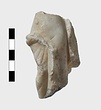
| Small fragment, all save one complete flute and the annulets, broken away.
Very good work.
Pentelic marble.
Temple of Ares.
Disturbed area above Stoa. Leica, LIX-51 PD 733, DA 12321 ... 6 April 1933 |
Mouth and handle missing.
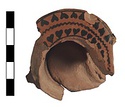
Jug of Vraona Shape (ABV 443-444). Concave bottom. Unglazed, except for strokes on the body and shoulder.
Athens, Agora Museum, Acropolis North Slope A-P 1036: Hesperia, VII, ... Early 5th c. B.C ... Athens, Agora Museum, Acropolis North Slope A-P 1036: Hesperia, VII, 1938, p. 192, fig. 28, is very close. |
| Single fragment broken all around. Top of calyx of fronds visible. At left a man seated on ground, facing right. He wears chitoniskos, pilos and legging or boots, and is bearded. He looks up to a standing ... 1940 |
| Full length apparently preserved.
Short section of a horn, one end neatly cut off, the other roughly whittled. A vertical hole down the center may be artificial.
"It is an antler, probably cervus elaphus ... 7 June 1937 |
| Base and part of floor and about one-quarter of rim and wall preserved. Ring foot; out-turned rim.
Scattered stamped palmettes and rouletting on floor.
Pinkish-buff clay. Black glaze much peeled, fired ... 8 August 1949 |
About a third. Lid missing. Full profile, save for edge of lip.
Tripod foot, concave wall. Inset flange for lid. Glazed inside, on outside of flange and horizontal top of wall, a band round the middle ... 550-525 B.C ... Cf. the slightly later pyxis, from the Acropolis North Slope, Athens, Agora Museum A-P 1007: Hesperia, VII, 1938, p. 192, fig. 28, small and with banded wall. |
Foot and decorated skirt of figure; purple paint. Same pot as AP 1889. Carl Roebuck, Nb. No. 6.
Well A. 121 ... 9 April 1938 |
Legs to right; vine; lion.
Joined to AP 1864. Carl Roebuck, Nb. No. 6.
Well A. 134 ... 11 April 1938 |
Female with red panel; part of second figure.
Joined to AP 1845. Carl Roebuck, Nb. No. 6.
Well A. 141 ... 12 April 1938 |
Athena; white traces.
Joins with AP 1903. Carl Roebuck, Nb. No. 6.
Well A. 159 ... 15 April 1938 |
Man with hat, arm over head. Other object (toes?). Same pot as AP 1831. Carl Roebuck, Nb. No. 6.
Well A. 159 ... 15 April 1938 |
Snakes; purple paint aegis. Joins with AP 1888. Carl Roebuck, Nb. No. 6.
Well A, 11.60-12.20m. 166 ... 16 April 1938 |
Leg with greaves and drapery. Carl Roebuck, Nb. No. 6.
Well A, 12.80-13.40. 180 ... 19 April 1938 |
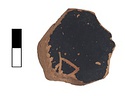
| Part of rim of heavy vase.
Running scroll on top.
Black glaze on outside. Oscar Broneer, Nb. No. 4.
Well V, depth 1.30-1.50m. 23 ... 13 April 1937 |
| Stem and small bit of bowl.
Roughly cut letter Δ.
Black glaze. Oscar Broneer, Nb. No. 4.
Well V, depth 1.80-2m. 36 ... 15 April 1937 |
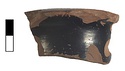
| Small kothon of red dish clay with black decorations. Glaze badly worn. Oscar Broneer, Nb. No. 4.
Well V top. 12 ... 12 April 1937 |
| Two fragments of handle of large vase with vine patterns on ends.
Black glaze. Oscar Broneer, Nb. No. 4.
Well V. 64 ... 21 April 1937
29 April 1937 |
| Preserved from waist to ankle, broken off above and below. Edges of drapery chipped off.
Small Aphrodite, type of S 757, weight on left leg, right hand held drapery, attachment of right arm visible on ... 11 July 1978 |
| Inscribed fragments.
Fragment ΙΙ 70 a), inscribed face and left side preserved.
Three lines of the inscription preserved.
Fragment ΘΘ 100 b), inscribed face only preserved.
Five lines of the inscription ... a) (ΙΙ 70) 15 March 1937
b) (ΘΘ 100) 14 April 1937 |
| Inscribed block of early Christian Epitaph.
Broken away at the bottom and along the edge of the left side; on the right side a moulding.
On the top end a dowel cutting. At the lower end of the inscribed ... Summer 1933 ... Sironen (1997), p. 196, no. 137 ... Hesperia 16 (1947), p. 48, no. 28 ... Agora XVII, no. 1083, p. 192. |
|
|