|
|
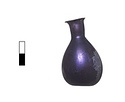
| A short-necked bottle shaped like an unguentarium.
Thin fabric; purple glass. Cemetery at corner of Piraeus and Herakleidou Streets, grave F. 66 Leica ... April 1937 ... Cemetery at corner of Piraeus and Herakleidou Streets, grave F. |
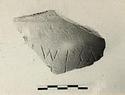
| Fragment from wall of heavy open pot, probably a semi-glazed krater.
Inscribed outside:
Black glaze wash, inside only. Foundations of Cemetery west wall. 8394 Leica ... 9 April 1949 ... Foundations of Cemetery west wall. |
| Part of high foot ring preserved. On floor of plate, part of border and row of eggs inside row of palmettes.
Cf. Agora XII, no. 1022. Found prior to excavation; exact provenience unknown. (Lenormant ... February 1936 ... (Lenormant Street Cemetery area. |
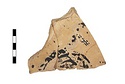
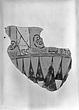
| Fragment from the shoulder. Parts of two standing figures holding a branch upright between them. Double spirals in the ground.
Black glaze much flaked. Cf. F-G 12:1 N.E. corner of Cemetery, layer II, ... 28 May 1938 ... N.E. corner of Cemetery, layer II, stone packing in corner. |
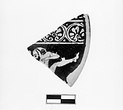
| Fragment from the edge of a flat pyxis lid or bobbin(?). Leg and upper body of silen running right, head turned back left. A band of circumscribed palmettes above. Reserved band at edge. Underside unglazed ... 8 April 1949 ... Cleaning around west wall of cemetery; washed down from dump. |
Both handles and foot missing.
Ribbed lower wall, pointed; flaring rim. Scraped line on lower wall just above junction of lower wall and foot.
Also ribbed but slightly later, Brussels A 1713: CVA 3(3) ... Ca. 350 B.C ... Also ribbed but slightly later, Brussels A 1713: CVA 3(3) pl. 3(138) 17; Alexandria, from the Hadra cemetery: Bull. soc. arch. |
Squat ovoid body on ring foot; flaring rim with interior flange; rolled handles. Attic household ware; glaze wash inside, and traces of a glaze band below the handles.
On a somewhat more slender example ... Context ca. 435-425 B.C ... On a somewhat more slender example in the National Museum, Athens 2593, the conical lid, similar to 1558, is preserved; close, but the lid missing, Athens, Acropolis Museum from the Syntagma cemetery: Ἐφ., 1958, p. 93, fig. 159 (Grave LIX = 79, 1). |
Fusiform body on flaring base slightly concave beneath. Thickened lip with rounded outer profile; heavy strap handle. Highly micaceous reddish fabric, very thick and heavy; unglazed. East Greek.
Young ... Context ca. 550-525 B.C ... For the shape in Corinth see Corinth, XIII, North Cemetery, pl. 32, Grave 219-2 and -4; Grave 220-2 and -3. |
| Fragment from neck, broken all around. Head and shoulders of a bearded figure to right. The head and face in outline, the cloaked shoulders in black; incision for beard and folds of cloak.
In the field ... 28 May 1938 ... N.E. corner of Cemetery, layer II, stone packing in corner. |
| From a large closed pot. Around the bottom, a double series of rays below a triple ground line on which walk to the right the remains of four persons in long dresses, one of them dotted and another filled-in ... 15-16 February 1935 ... Green fill, overlying part of Geometric cemetery. |
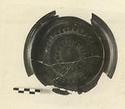
| Mended from many fragments; parts missing. Rather deep center inside. Underside, sides flare from base ring to downturned rim. Handles hollowed along outside by a broad groove. Black bands and rosettes ... card: mid-5th. c. B.C ... Lenormant Street Cemetery area. |
| Repaired. Half the rim missing. Glazed over all, top and bottom. Broad scotia below rilled rim outside. Ring foot, within which two slightly raised circles. Stamped pattern: small central circle, around ... 18 March 1936 ... Lenormant Street Cemetery area. |
| From the shoulder of a round-bodied pot. Mended from two pieces. Part of a panel, bordered below and to the left by three lines. Horse left. In field, guilloche, zigzag and lozenges. Below, vertical wavy ... 16 March 1935, 30 May 1938 ... Fragment b) found in northeast corner of cemetery, layer III. |
Flaring ring foot; horseshoe handles. Reserved: underside with two circles and dot; outer edge of foot; zone above foot decorated with lines; handle-panels; inside of rim. Added red: two lines below handles ... Ca. 425 B.C ... From a closely contemporary grave in the Lenormant Street cemetery, P 10284 Hesperia, VI, 1937, p. 363, fig. 24; A.J.A., XL, 1936, p. 202, fig. 23; Hesperia, XXXII, 1963, pl. 39, D 6. |
| About one-quarter of side preserved.
Flat bottom; nearly straight side wall slightly thickened at lip; nozzle unbridged. The rim projects slightly at the outside; not on the inside.
Attic clay, slipped ... Middle 6th century B.C ... Accumulated road metal of early north-south road along west side of Market Square and related fills in the area of the Geometric cemetery south of the Tholos. |
| About one-quarter of side preserved.
Low flat base, convex side wall continuous with narrow inward-tilted rim, but set off from it by a raised ring. Side wall outside.
Brownish black glaze outside; inside ... 11 February 1935 ... Accumulated road metal of early north-south road along west side of Market Square and related fills in the area of the Geometric cemetery south of the Tholos. |
| a) Part of a very large shallow conical lid, decorated outside with rays around handle-base, then bands and step-pattern. Interlacing incised palmettes, and dots between lines around outer edge.
Attic ... 11 March 1935, 28 May 1938 ... Second fragment from N.E. corner of cemetery, layer II, stone packing in corner. |
| About half the back part, preserved; mended from several pieces.
Shallow flat-bottomed lamp, with outward sloping rim and large looped strap handle, base to outer edge of rim. Incised on rim, double zigzag ... 11 February 1935 ... Accumulated road metal of early north-south road along west side of Market Square and related fills in the area of the Geometric cemetery south of the Tholos. |
Foot missing.
Neck-pithos with deep ovoid body and heavy collar rim. Decoration of raised ridges: a pair at junction of neck and shoulder, and two pairs on wall. Black glaze, thin and uneven, outside ... Found used as a burial urn; burial of ca. 525-500 B.C ... The missing bottom should be restored with a high flaring ring foot like that seen on oil jars such as 1501, Pl. 64; this foot is preserved on a pithos of the same type found in the Trachones cemetery.
Large collar-rimmed pithoi are best known from rep- resentations in vase-painting; see p. 193, note 1. |
Rim and wall.
One-handler (?). At edge of break below, a little of a raised edge. Suspension hole in rim. Light red clay with small white bits; warm buff surfacing. Matt black glaze wash on rim, just ... Context ca. 420-400 B.C. and earlier ... Similar partial glazing is found on plain phialai in different fabrics and from different sites; cf., from Athens, Syntagma Cemetery (Acropolis Museum): Ἐφ., 1958, pl. 23 below (Grave XLIV = 65). |
|
|