|
|
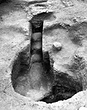
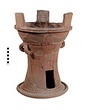
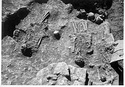
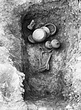
Grave (?) under wall 4. Infant burial(?); a kados, P 16747, lying sideways with a tall cylindrical stand, P 16748, set over it as a cover; the upper parts of the pots cut away ... Late 6th. c. B.C ... Infant burial(?); a kados, P 16747, lying sideways with a tall cylindrical stand, P 16748, set over it as a cover; the upper parts of the pots cut away. |
| Debris filling in a bronze casting pit and workshop, characterized by mold fragments but including also a few plain vases and fragments of wine jars. Third quarter of 4th. c. BC.
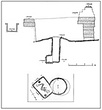
The pit was cut into the ... Ca. 350-325 B.C ... Debris filling in a bronze casting pit and workshop, characterized by mold fragments but including also a few plain vases and fragments of wine jars. ... The pit was cut into the soft bedrock to a depth of -1.43m and is 1.70m wide at its broadest extremity. The ground plan is that of a slightly lop-sided keyhole. |
Cistern chamber in the area of the southeast Temple, the mouth cut back in antiquity ... Late 4th - early 3rd c. B.C. |
Debris filling in a pit cut in bedrock at W side of House H, Room 10 ... Ca. 425-400 B.C ... Debris filling in a pit cut in bedrock at W side of House H, Room 10. |
| Cistern in the valley between the Areopagus and the Hill of the Nymphs. Simple, flask-shaped chamber withdraw-shaft; no tunnels. Mouth cut away in Byzantine times. Lower filling, 3rd c. B.C. Coins:
25 ... 25-30 April 1947 |
| Mycenaean tomb: Myc. III A:1-2.
SAI
Small rectangular chamber, 2.30m wide by 1.80m deep,, entered from the east through a dromos 1.10m wide which contracted to a doorway 0.92m. wide. the doorway preserved ... 2nd half of 14th c ... Mycenaean tomb: Myc. III A:1-2.
SAI
Small rectangular chamber, 2.30m wide by 1.80m deep,, entered from the east through a dromos 1.10m wide which contracted to a doorway 0.92m. wide. the doorway preserved its rough stone blocking wall to a height of 0.70m to 0.80m., and the dromos the firm red earth with which it had been packed to a height of 1.30m.
Only the lower 0.50m of the chamber had been hewn from bedrock, the upper part being cut from very compact gravelly earth. ... Several earlier interments had been swept aside; some bones were found in the corners of the chamber. others in a small pit (0.55x0.30x0.23 deep)near the southeast corner |
| Side-chamber at the bottom of a circular shaft. AA 27; ST 103 from shaft above burial. PD 427 ... Neolithic |
| A cave-in not long after the digging of this shaft destroyed its possible usefulness as a well and thereafter it was used as a dump. Two principle periods of such use were noted, and within these several ... Ca. 575-480 B.C. |
| Extract from notebook ΠΘ XIX, pp. 3644-3646. Well at 105/ΝΗ (report on sorting of pottery, July 19, 1951 - H.S. Robinson).
"Not a useful well" HSR.
Well dug to 1.50m., vi/9/36; dug from 1.50m. to bottom ... Early Roman; use fillings of 2nd. c. B.C. and 1st. and 4th. c. A.D.; dumped filling of late 4th. c. (HSR)
Fill I: 2nd. c. B.C.
Fill II-V: to second half of 4th. c. A.D.
Fill VI: mixed to Byzantine ... Robinson).
"Not a useful well" HSR.
Well dug to 1.50m., vi/9/36; dug from 1.50m. to bottom (22.80m.), iv/9/37 - iv/23/37. Cut in bed-rock (no tiles reported); diameter at mouth: 1.04m.; depth 22.80m.
... One coin (iv/9/37 #1) of Constantine II (323-361 A.D.) suggests a late 4th cent. date for this destruction fill. |
Well at 69/ΛΕ (diameter 0.95m).
Narrows at bottom. Footholds on east and west. Uniform fill. Bones found in the well make it likely that it had cut through a grave, as it was itself overlain by one ... Late 8th c. B.C ... Bones found in the well make it likely that it had cut through a grave, as it was itself overlain by one. |
Trench at O/7,8-6/1,5. Layer 5 of Trench A cut in Rooms 1 and 2 of Greek House γ. Soft green clay with bones, ash, much pottery. Probably leveling fill ... Archaic ... Layer 5 of Trench A cut in Rooms 1 and 2 of Greek House γ. |
Mixed filling in a well cut rectangular pit. Debris of the second half of the 5th. c., deposited as late as the second quarter of the 4th. c. B.C ... 4th c. B.C. and earlier ... Mixed filling in a well cut rectangular pit. |
| Homer A. Thompson ... PG grave to NW of Pier 19 (Grave 4).
It consisted of a rectangular pit, oriented north-south, cut into bedrock. Only the lowest part of the tomb pit was preserved; the upper part was cut away in the Classical ... Earlier-Developed Protogeometric ... It consisted of a rectangular pit, oriented north-south, cut into bedrock. Only the lowest part of the tomb pit was preserved; the upper part was cut away in the Classical period. ... On it were a few bone fragments of a child and six vessels.
|
| Pyre in cut in E-W street, layer 7 (Pyre 14). North edge of Piraeus street, west of the Great Drain Bridge, in the area west of Areopagus.
RSY-Pyre.
Pottery, a little burnt bone, and patches of charcoal ... 250-240 B.C ... Pyre in cut in E-W street, layer 7 (Pyre 14). ... The pyre was uncovered in digging a thin layer rich in marble chips. ... Organic material:" a minimum of bits of burned bone". |
| Grave 8 in notebook.
Inhumation in Tholos Cemetery. Length of shaft 1.75m; Width at upper end 0.95m; Depth from cover 0.70m.
One end cut into sloping rock.
Skeleton of a woman, with head southeast. Most ... 750-725 B.C ... One end cut into sloping rock.
Skeleton of a woman, with head southeast. |
Stuccoed pit, 2m x 2.50 m, rock-cut. Coins:
26 March 1937 #1 (not a coin) ... Ca. 400-350 B.C ... Stuccoed pit, 2m x 2.50 m, rock-cut ... Coins:
26 March 1937 #1 (not a coin) |
| Rodney S. Young ... RSY/JP Disturbed Geometric burial over "Sacrificial Pit VI" (Grave B 21:22). Grave IX in notebook. Bones discarded?
Pottery found in the upper filling of a sixth century cremation pit, which had perhaps ... Middle Geometric II/Transitional to Late Geometric ... Pottery found in the upper filling of a sixth century cremation pit, which had perhaps cut through a Geometric inhumation to which the disturbed human bones close by may have belonged. |
| Margaret Crosby ... Grave, disturbed.
Rectangular cutting in bedrock 1.70m long and 0.60m deep. The north half was cut away by a modern cellar wall and only 0.20-0.10m of fill was left. A the bottom there was a thick layer ... 510 - 490 B.C ... The north half was cut away by a modern cellar wall and only 0.20-0.10m of fill was left. A the bottom there was a thick layer of burning. also present fragments of long bones and ribs, probably animal. |
| Grave 3 in notebook. Outside Archaic cemetery, inhumation burial. Deposit list says black glaze pithos (P 8922) containing the bones of a child and four small vases. The pithos lay on its side with the ... Last quarter of 6th century B.C ... Deposit list says black glaze pithos (P 8922) containing the bones of a child and four small vases. ... The bottom had been cut by a late fifth century well and the upper side was caved in. |
Well shaft cut through a cistern channel which was then packed with three amphorae (P 3123, P 3125, P 4201) of 1st or at latest early 2nd c. A.D. (These three amphorae could be considered with F 15:2) ... 3rd-4th c. A.D ... Well shaft cut through a cistern channel which was then packed with three amphorae (P 3123, P 3125, P 4201) of 1st or at latest early 2nd c. ... At 5.50 a group of fallen wall tiles arched over shaft which was empty to below 8.00 (at water level).
... It seems more likely that tiles were robbed in late 4th c., one 1st c. amphora of packing fell in and then a 4th c. dump was dropped in, capped by tile fragments; later a 5th c. dump on top.
|
|
|