|
|
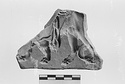
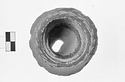
| Part of the mold for the upper part of a lamp.
The groove around the rim and the ivy leaf pattern of the upper body preserved.
Type XIX or XVIII of Corinth collection, type 46C of Agora collection. House ... 22-24 July 1947 ... House H, Room 10; brown fill, mixed Hellenistic. 4th. to 2nd. century B.C. |
| The legs and the part of the body of a lion or panther walking right. Animal leg with drapery falling over is preserved, suggests it had rider (who perhaps holds a staff?).
Part of the lower edge preserved ... 29 May 1947 ... Loose Hellenistic fill; mixed 4th. century to Hellenistic. |
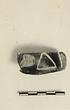
| Dull buff clay, darker inside; red paint on neck.
Cf. Dumont (1872), pl. IX, 3. Par: Dumont 1871, Pl IX,3*
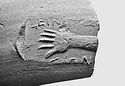
Dip: red paint on neck* Finished 4th century B.C. and Hellenistic fill. Δεινώ̣π̣ας̣
hand
[Θά]σιο̣ν ... 14 March 1936 ... 4th century B.C. and Hellenistic fill. |
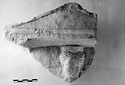
Face of terracotta figurine. 4th century or Hellenistic. End of nose and head from ears back gone. Fine work. Wavy hair. Head turned to right. Reddish clay. Munsell (fabric/surface) 5 YR 6/4 light reddish ... 14 December 1933 ... Face of terracotta figurine. 4th century or Hellenistic. |
Complete except for a few chips.
Low foot; rounded resting surface; convex underside. Very slight groove above foot. Convex wall. Rim concave on top, with ridge at inner edge. Thick, shiny red glaze, ... 325-300 ... Other concave-rim plates from Hellenistic contexts: 818, 819, and P 21010 (H--K 12--14), very crudely made, but possibly dating in 4th century; P 1092 and P 1093 (H 17:5), also possibly 4th century. |
| Part of rim and side with one horizontal handle attachment at left.
Incised on side.
Black glaze.
Type VI (early 4th. century variety) of Corinth collection, type 23C of Agora collection.
In Hellenistic ... 27 February 1936 ... Type VI (early 4th. century variety) of Corinth collection, type 23C of Agora collection.
... In Hellenistic and early Roman fill. |
Parts of wall and one-third of rim missing.
Flat bottom with hole in center, broken away from flat surface to which it was once attached. Squat body with distinct shoulder.
Outwardly thickened rim, with ... 4th century? |
Half of rim and large parts of wall restored.
Rounded resting surface (worn); convex underside. Flaring rim with taut molded profile; inner wall straight. Slightly rising spurs with flaring sides. Dull ... 265-250 |
Fragment of upper part of lower body, broken all around.
Wall is decorated with ribs; top of one rib preserved, outlined by painted ridge. There is also paint in the triangular area between the petals ... Late 4th century? |
Over half preserved; rim chipped, knob missing. Darkened by fire.
Small, domed lid with projecting rim. Three holes (probably originally four) pierced through dome. Micaceous, light reddish brown fabric ... 4th century? |
P 17703 a, b, c
Three sections preserve over half of foot and part of lower wall (a), part of rim (b), and about one-fourth of lid (c). Burning on edge of rim.
Flat underside. Projecting molding at bottom, ... 4th century |
Part of dome, flange, and cylinder preserved.
Flange has thickened edge; face reserved with two grooves. Reserved band with two grooves surrounds dome. Lustrous black-to-green glaze ... Late 4th to early 3rd century? |
Lid.
Broken all around, with knob missing.
Knob or stem made separately, with two square moldings at base.
Decoration in red glaze: lotus petals with dotted ribs alternate with plain petals on wall ... Disturbed 4th-century context |
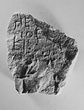
| Broken on all sides.
Parts of four lines of the inscription preserved.
Hymettian marble. Found in mixed Hellenistic and Roman context, outside the Market Square, to the southwest, in the disturbed area ... 4th. century B.C. |
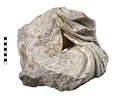
| Fragment from a large draped statue, probably in himation. It is not immediately apparent to what part of the statue it belongs. Joint-surface for an inset member shows that the statue was pieced.
Carefully ... Late 4th c. B.C. or Hellenistic ... Carefully worked, the thick-textured drapery suggests late 4th century or Hellenistic.
|
| Complete except for chips, glaze badly worn. Underside recessed, concave. Foot slopes up toward interior yielding resting surface toward outside. Rim convex and drooping toward outside. Added white garland ... 13 May 1971 |
Handle and part of rim missing.
Slightly concave underside, reserved and painted with miltos.
Globular body curves out smoothly into flaring rim. Handle round in section. Dull brown to shiny black glaze ... 4th century? |
| Inscribed fragment.
Only the upper left hand part remains.
A stele with gabled top, the mid-part of its front deeply cut back to hold the relief; a figure of the Mother seated on her throne, facing front ... 4th. century B.C. |
Type A Pyxis.
Foot and lower body preserved.
Ring foot with three wide areas cut away to make tripod support; rounded resting surface; slightly convex underside. Cylindrical body, slightly concave. Fairly ... Context of 325-200 with late Hellenistic disturbance |
Aryballos: Impressed Decoration.
One-third of rim and part of body restored, including center of floor.
Flat bottom. Profile in two stages divided by concave band bounded by groove above and below. Stamped ... Context of second half of 4th century and early 3rd century, with a few late 3rd-century pieces |
|
|