|
|
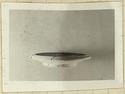
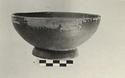
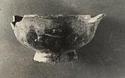
| Mended from two fragments; complete save for minor fractures.
Buff clay. Thin black glaze on the inside; the outside, and the rim with two grooves, unglazed. Well. Leica, 4-310 PD 347 ... 21 March 1933 ... Hesperia 3 (1934), no. A 3, fig. 2. |
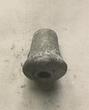
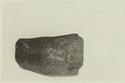
| It has an elongated concave conical shape. Unpainted.
The clay buff, but the surface bluish gray in part. S.W. passage of cistern.
Hellenistic group B. Leica, 4-321, XXXIX-64 ... 19 April 1932 |
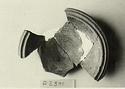
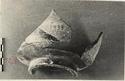
| Mended from five pieces; part of rim and side missing. Low ring base; low flaring sides; ridged rim with two grooves.
Light reddish buff clay; thin brownish black glaze on interior; exterior unglazed ... 17 March 1932 ... Hesperia 3 (1934), no. C 2. |
| A deep plate, or shallow bowl; the profile complete; not quite half of the rim preserved. Rounded rim; rather high ring foot.
Poor black glaze. Well, in north cistern arm. Leica ... 3 March 1934 ... Hesperia 3 (1934), no. E 2. |
| Mended from several fragments; most of one side missing. High ring foot; out-turned rim.
Wide hatched band around center, inside, enclosing four very small palmettes.
Attic clay. Silvery-gray glaze, ... 22 April 1932 ... Hesperia 3 (1934), no. D 2. |
| Broad; broken at curve.
Coarse greyish-red clay, light slip. Worn.
Impression set carelessly, very close to neck. Incomplete right end. Below surface. Θρά̣σ̣ω̣ν̣(ος)
Θηρο̣κ̣ρ̣ά̣(τευς)
(Ν retr, Σ lunate, ... 17 March 1932 |
| Broad, ribbed; junction with neck not preserved.
Coarse red clay, large gray core. Ἐπὶ Σ[ωσίφρο]
νος [Εὐφρο]
σύν[ου anchor]
Κνί[διον] pt l. Leica ... 19 February 1932 |
| Fragmentary. Outcurved lip.
Covered inside and out with dull black glaze. Several more similar fragments found. Cistern. Leica ... 1932 |
| Fragments missing from the rim. High base ring, coarsely moulded; deep body; the rim thickened by being rolled inward.
Buff clay. Metallic black glaze. Cistern. Leica ... 3-12 March 1934 |
| Much of the side wall lacking; broken. All of rim missing. Heavy base ring; the upper wall slopes gently outward in a straight line; there is a slight indentation at the junction of floor and side wall ... 3-12 March 1934 |
| Broken and lacking fragments from the side and rim. Restored in plaster. High flaring base ring. Hemispherical bowl. Lip flat on top and sloping inward. On the floor, a double circle of light rouletting ... 3-12 March 1934 |
| Only parts of the rim and side wall remain. High base ring; shallow bowl; broad offset rim; outer edge slightly upturned.
Metallic black glaze. Cistern. Leica ... 3-12 March 1934 |
| Broken and lacking much of its side wall. Heavy base ring, slightly flaring; flaring down-turned rim with two shallow furrows.
Buff clay. Cistern. Leica ... 3-12 March 1934 |
| Broken and lacking much of the side wall. Heavy flaring base ring, gently concave floor with high upper wall and out-curved lip.
Covered with metallic black glaze which has largely flaked away from the ... 3-12 March 1934 |
| Broken and lacking much of the side wall. Heavy flaring base ring, gently concave floor, with high upper wall and out-curved lip.
Metallic black glaze. Buff clay. Cistern. Leica, 4-334 ... 3-12 March 1934 |
| Broken and lacking much of the side wall. Heavy flaring base ring, gently concave floor with high upper wall and out-curved lip.
Buff clay. Metallic black glaze. Cistern. Leica ... 3-12 March 1934 |
| Broken and lacking much of the side wall. Heavy flaring base ring, gently concave floor with high upper wall and out-curved lip.
Buff clay. The glaze has fired to a uniform red inside and out. Cistern ... 3-12 March 1934 |
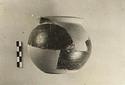
| Handle, much of lip, and side wall missing. Restored in plaster. Flat bottom, slightly inset from side wall; spheroid body; low rim, slightly outcurved. A line of glaze has been scratched away at the junction ... 3-12 March 1934 |
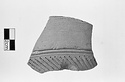
| Fragment of shoulder which is bordered by two wheel-run grooves. Within the grooves are oblique lines of punctured dots produced by pressing into the soft clay the teeth of a short length of comb. Another ... 1932 |
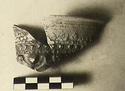
| Two rim fragments. Pattern of rosettes and leaves in upper zone.
Good fabric; the glaze almost completely flaked. Cistern. Leica PD 315 ... 1932 |
|
|