|
|
Small fragment.
Clay: fine grey (burned); black glaze inside and out. Assembly Place, behind retaining wall of Period II ... 1931 ... Assembly Place, behind retaining wall of Period II. |
Fragment of rim only.
Clay: fine reddish; black glaze inside and out. Assembly Place, behind retaining wall of Period II ... 1931 ... Assembly Place, behind retaining wall of Period II. |
Clay; dull buff, yellow on surface; fine but containing some grit. Assembly Place; Filling of Period II;
Along with Hellenistic and Roman Sherds ... 1931 ... Assembly Place; Filling of Period II;
Along with Hellenistic and Roman Sherds. |
About half restored in plaster.
Concave wall, carried down to form a foot ring.
Rim slightly rounded above.
Good black glaze. Behind Retaining Wall of Period II ... 1931 ... Behind Retaining Wall of Period II. |
Rim fragment from a large black-glazed skyphos, heavy-walled type.
Scratched around the rim outside: ΓΟΛΥΞΕ
Glaze inside, firm black; outside thin lack to red, much peeled. Behind Retaining Wall of Period ... 1931 ... Behind Retaining Wall of Period II |
Fragment from lower wall, with part of foot.
Foot flaring to sharp edge; underneath reserved; with part of one glazed circle.
Lower wall, reserved, decorated with thin 'rays'; good black glaze. Behind ... 1931 ... Behind Retaining Wall of Period II. |
Ring foot inset; broad ribbing on body; nicked ridge at base of neck; lip sharply out-turned.
Excellent glaze; resting surface reserved, and the space inside the foot; scraped groove above foot. Behind ... 1931 ... Behind Retaining Wall of Period II. |
Head, left arm and body below waist are missing.
Across the back the remains of the curved top of a large rectangular vent. A draped female figure sits on a throne, holding a flower to her bosom with ... 25 June 1934 ... Assembly place, filling of Period III, cleaning around stairway of Period II. |
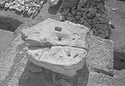
| Three joining fragments forming most of the upper part of a pedestal which had been used twice for giant figures.
Cuttings of top include: lewis hole in middle; two dowels for statue in Period I; one pry ... August 1946 ... Cuttings of top include: lewis hole in middle; two dowels for statue in Period I; one pry hole for statue in Period I; three shift holes for the same; two clamp cuttings for repair for Period II; one dowel hole for statue for Period II.
|
| Clay; russet, fine, micaceous. Assembly Place; Filling of Period III ... 1931 |
Small open bowl on ring foot; inside, six palmette stamps linked around a central circle; the stamps are small, carefully made, and heavily 'framed'. Reserved: centre within foot, inside a lightly moulded ... 1931 ... Behind Retaining Wall of Period II. |
Fragment of rim and body only.
Flat rim, projecting over sides. Shallow body, straight sides.
Clay: fine, grey (burned); black glaze inside and out (except inside curve). Assembly Place, filling of ... 1932 |
No. 43.
Vestiges of a device or letters. The handle may belong to an earlier period. Nb. No. 5. Wall Trench E. 1111 ... Latter 4th - 3rd century BC |
I. A girl, wearing chiton and himation, stand in profile at right, looking toward a youth. He stands facing, but looks left towards the girl; he wears himation, fillet, and carries a staff in his left ... 23 June 1934 ... Assembly Place, Filling of Period III, Clearing around Stairway of Period II. |
NM 16167
Complete but for handle.
Black glaze.
Other examples: Ath.Mitt. 28, 1903, Beil. XXIV,4; Hesperia 19, 1950, pl. 104, b; Kerameikos V, 1, pl. 111, inv. no. 831. The tankard developed from the ... MG II |
| Finished Assembly Place; From pocket in bedrock.
22m. N.W. of N.W. corner of Bema of Period III ... 1932 |
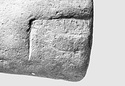
Left to right. -ΑΕ
Perhaps a ligature combining alpha and epsilon.
For graffito ligatures in general, see Karl Lehmann, Samothrace 2, II, The inscriptions on Ceramics and Minor Objects, New York, 1960, ... For graffito ligatures in general, see Karl Lehmann, Samothrace 2, II, The inscriptions on Ceramics and Minor Objects, New York, 1960, p.30, note 18. Although they occur from the Archaic period onward, graffito ligatures are not common until the Hellenistic period. |
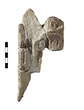
Female figure, seated right on a rectangular seat (?), leaning on her right hand. She wears a thin chiton with embroidered bodice, a white hair ribbon and bracelet. In the upper left corner of the fragment ... November 1932 |
Part of Eros flying to right, a large palmette, head and neck of swan to left, and part of a winged figure (Eros or Nike?) to right. Pairs of straight strokes (?) on rim. At the centre a moulded ring, ... 1931 |
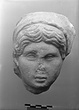
| The head of a woman from a relief, apparently to be seen half-facing. Her hair is parted in the middle, and waved low on the forehead and temples. She is veiled, the veil being set well back, so that it ... Period of Trajan (?) ... Drilled for setting on base.
Period of Trajan (?) ... Leica, 5-270, II-24, II-25 |
|
|