|
|
Horseshoe-shaped, open below and at side. Horizontal rolled handle at back; rising spurs at open ends of rim; two holes in wall.
For somewhat earlier versions see, e.g., P 8396 D 11:5 Agora, VIII, pl ... Context ca. 575-540 B.C ... V, 4, left; and references, Agora, VIII, p. 103 under 624. |
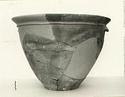
| Numerous fragments preserve base, much of walls and part of rim; completed in plaster. Large lekane on flat bottom; flaring walls; flaring rim above a ridged line; lug handles.
Buff clay. Notebook references ... 8 April 1958 ... Notebook references before lifting of pot call it "Pithos E". |
Finely profiled foot. Fat body, broad incurving rim; spout just below top; strainer at base of spout. Vertical handle at right angles to spout. Impressed pattern on top: nine linked palmettes with horseshoes ... 450-425 B.C ... A near match is P 10281, from the same burial and deco- rated with the same palmette stamp; publication references as for 1197. |
| Inscribed fragment.
Broken all round.
Fragment from the list of the Argives who fell at Tanagra.
Pentelic marble.
ADDENDA Joins with I 551, I 2006, I 3285, I 4893.
I 2006, g.v. for list of fragments, ... 5th. century B.C ... I 2006, g.v. for list of fragments, and references.
Transferred to the Epigraphical Museum on 3rd. |
Half missing.
Rim flat on top; rolled handles with ribbon ends; massive echinus foot. Glaze wash inside, on wall outside to near bottom and on foot; rim and handle unglazed, except for a band of glaze ... Context ca. 600-570 B.C ... For the 7th century history of the shape, see the references above (Brann). |
Triton?
Base of chalice, trace of torso, and acanthus skirt preserved; partly restored.
Trace of lower right side of torso of figure, below which is thick, twisted belt or sash from which hangs acanthus ... 200-175 ... See references under 1389. |
Shoulder And Neck.
Part of shoulder and base of neck.
Slightly convex shoulder runs smoothly into neck. Decoration in brown glaze: row of dots around base of neck; rays alternate with dots on shoulder ... Mixed early and late Roman context ... For rays see references under 1508. |
Plate.
Foot and center of floor preserved.
Ring foot, pierced for hanging; rounded resting surface; convex underside. Scraped groove around medallion, with boukranion within it.
Dotted fillets with ... Context of before ca. 180 ... For references to boukrania see 1672. |
Moldmade Bowl.
Wall fragment.
Moldmade body. Parts of two petals or leaves, diagonally ridged, with heavy, dark central ribs. Very pale brown fabric (10YR 8/3); shiny, pale aquamarine exterior surface, ... Context of before ca. 180 ... Others with the same pattern but without the brown accenting of the ribs are Tarsus I, no. 183, p. 225, fig. 132 (with additional references) and fig. 170:A; Langlotz 1932, no. 929, p. 164, pl. 252 (from Crete); Bissing 1902, no. 18019, p. 100. |
Holes in wall, mouth missing, and foot chipped but otherwise intact; much wear under handle.
Beveled resting surface; unglazed underneath. On body careless grooving, vertical to right of handle, at angle ... 225-200 ... For incised stem on ivy garland see 193 and references cited there. |
| Mouth and most of foot missing. Thin disk foot.
On shoulder, short rays and lotus buds, stalks skipping one.
Quadriga right; a warrior (helmet, corselet, chiton and greaves) mounting the chariot; he holds ... 2 June 1954 ... XXII:20, XXIV:1a-b, very close; and the references there. |
Body.
Flange chipped; body partly restored.
Ring foot; rounded resting surface; convex underside. Slight flange at bottom of wall. Body slopes inward towards top. Inset rim.
Decoration in orange glaze ... Context of 115-86 ... CV:934 (a thymiaterion) and references under 1507. |
| Fragments from the list of the Argives who fell at Tanagra.
Fragment Η 104 a), broken all round.
Three letters preserved.
Fragment Κ 136 b), broken all around.
Eight lines of the inscription preserved ... a) (Η 104) 6 March 1933 ... I 2006, g.v. for other pieces and references.
Tranferred to the Epigraphical Museum on 3rd. |
Upper part only.
Broad projecting rim with sharp handle-ridge below it; tall wide neck set off from shoulder by light ridge; sloping shoulder; strap handles. Light reddish buff clay with pale buff slip ... Context ca. 425-400 B.C ... A shape common in Rhodes throughout the 5th century, with minor variations; see, e.g., for an example with un- usually broad rim, Leipsic 3305: CVA 1(14) pl. 50(690) 4, with references to examples from Ialysos; other examples from Ialysos, cf. |
Handle and much of wall missing; profile not complete.
Ring foot; ribbed body. Around the neck, olive wreath in added clay with traces of gilding.
Besides the pieces catalogued that have added clay and ... 325-310 B.C ... Besides the pieces catalogued that have added clay and gilding, 130, 131, 134-136, eight other fragments with similar decoration were inventoried; references to Kopcke's cata- logue (see p. 21, note 40) are added in parentheses:
P 1925 Q 13:6 (Kopcke 202) P 4409 F 12:3-U
(Kopcke 205)
P 2556 F 16:6 P 8275 C 12:2
P 3920 K 14:1 (Kopcke 198) P 10746 (Kopcke 199)
P 4396 F 12:3-U (Kopcke 206) P 26052 L 17:7
(Kopcke 204) |
| Broken behind, just above and just below the knee, and to right.
Draped right knee, slightly bent, from a life-size statue from akroterion of Temple of Ares.
Good workmanship.
Pentelic marble.
Joins Nike ... 16 June 1951 ... For references to other akroteria from Agora see: Hesperia 22 (1953), pp. 141-147, pls. 47-48.
|
| Eight pieces make up to two non-joining fragments.
a) Preserves part of the wall and bottom. Wall slightly concave in profile; ridged and grooved around lower edge; above this, a band of notched verticals ... 29 April 1939 ... AJA (1946), p. 481, nos. 75-80, for references to and discussion of this fabric. |
Bowl With Outturned Rim.
Three-fourths of wall and rim restored.
High, flaring ring foot with deep groove near bottom; steeply beveled, concave resting surface; convex underside. Angular body. Wall slightly ... Context of 115-50 ... Rouletting bounded by inscribed circles is a commonplace of Italian black wares (see, for example, references under 1643 and 1644). |
Stamped Plate.
Center of floor preserved.
Convex underside, with trace of groove around edge. At center of floor, six-petaled rosette within hexagon with concave sides, all within circular field. Reddish ... Late Hellenistic? (Roman context) ... They also occur in the east in ESA, black glaze, and gray ware: Samaria III, no. 33, p. 258, fig. 52:33, no. 6, p. 260, fig. 53:6 (with additional references, black glaze); Pagenstecher 1913, nos. 2, 9, p. 30, fig. 35 (gray ware) and p. 143, fig. 150:b (black glaze); Antioch IV, i, Shape 30, p. 12, fig. 3:2 (black glaze); Tarsus I, nos. 41, 42, 138, pp. 213, 221, figs. 120, 121, 127 (local glazed ware); Hama III, ii, p. 67, fig. 30 (ESA). |
| Base, neck, handle and part of shoulder and upper wall missing.
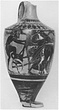
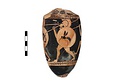
Wall zone bounded below by pomegranate band, above by simple maeander; palmettes on shoulder.
Three warriors (shields, helmets, spears) ... 29 May 1954 ... Haspels (1936) p. 69 ff., and the references there (=VA, p. 26; Caskey, Attic Vase-Paintings, p. 11).
|
|
|