|
|
Abandoned digging at 12.85m. due to collapse of side walls. Well H contents probably thrown in to Well I during cleaning in early Roman times; the pottery from the two wells is similar. Cf. E 14:6 ... 350-250 B.C ... Well I |
Abandoned digging at 6.25m. due to water level. Tile well could be associated with a bit of late Roman wall to the south, with floor level about one meter above that of pebble floor. Well tiles were not ... 14-22 April 1948 ... Well I |
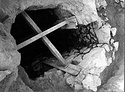
Well I: archaic. On the northwest slope of the Acropolis below the Klepsydra. Diameter ca. 1.10m. Water level ca. -9.50m. Substantial use filling in the lower 0.75m. In the upper debris filling both the ... End of 6th c. B.C. - Early Byzantine ... Well I: archaic. On the northwest slope of the Acropolis below the Klepsydra. |
Large pit in the bedrock over Wells H and I. Fill of the pit thrown in after filling of Well H, containing almost entirely coarse ware. First 4m of Well I, filling the same. Below that Well I fill similar ... Late Roman- 1st c. A.D. (mainly early ?) ... Large pit in the bedrock over Wells H and I. Fill of the pit thrown in after filling of Well H, containing almost entirely coarse ware. First 4m of Well I, filling the same. Below that Well I fill similar to that of Well H. |
| A tile lined well under Room I of Byzantine House.
A concrete shaft belonging to the mill cut off the top of the well and left in place 3 complete sets of tiles and most of a fourth set. All but the lowest ... 17-18 c. A.D ... Well Under Room I of Byzantine House |
Well at 74/Ι, on the lower north slope of the Areopagus.
Use fill from early 1st to 3rd c. A.D.
Dump fill from 4th c. A.D. Coins
9 April 1938 #2
9 May 1938 #1 Container 20 (lost) p. 1529 ... 1st c. to 3d c. A.D ... Roman Well at 74/I |
| Well at 52/Ι, on the lower northeast slopes of the Areopagus. It was cut down and re-used in the late Roman period, in connection with the water channel. Use fill of 1st to early 2nd c.
Dump fill 5th to ... Early to Late Roman ... Roman Well at 52/I |
| Located in Middle Stoa, west, south aisle, beneath pressure pipe (cf. A 4900). The siting of the well is remarkable in its proximity to Well I 13:3, also Geometric in date, which was found in 1968 only ... Second half of 8th c B.C ... The siting of the well is remarkable in its proximity to Well I 13:3, also Geometric in date, which was found in 1968 only some 1.70m to the northwest (under the Klepsydra Drain).
|
Well at 62/ΙΑ, 63/ΙΑ, at the northwest foot of the Areopagus. Use filling in the lowest meter of the shaft.
The upper part of the shaft was filled with clay containing only occasional fragments of pottery; ... Ca. 600-540 B.C ... Well at 62/ΙΑ, 63/ΙΑ, at the northwest foot of the Areopagus. ... T 80 from Roman fill above well.
Apparently the well was in use by a household both careful and conservative for something over two generations ... Note that pp. 70 and 76 are in NB. I, ΣΤ not ΣΤ'.
"In notebook references this well has been commonly placed in 62/ΙΑ. |
Homer A. Thompson ... Well at the northwest foot of the Areopagus. Use filling of the Roman period. After the abandonment of the well and the collapse of the well-curb, the upper 2m of the shaft were filled with a dump apparently ... 1st-3rd c. A.D., 5th century ... Well at the northwest foot of the Areopagus. ... After the abandonment of the well and the collapse of the well-curb, the upper 2m of the shaft were filled with a dump apparently dug up from nearby. ... Same deposit with I 16:2. |
Well at 75/ΚΖ (75/ΚΗ, 76/ΚΣΤ-ΚΖ). A dumped filling; an accumulation for the most part of the late 6th and early 5th centuries.
Tiled well; of the lining only a single set of tiles, of unusual make, remained ... Ca. 450-425 B.C. |
A late curbed well. The filling consisted of clay and small stones. The sherds were uniform from top to bottom and appear to be late Byzantine. From measurements in notebooks (pp. 340, 729), S 2855 is ... Late Byzantine |
Near the SW corner of the market square beneath the north part of the Heliaia (?).
No clear distinction in the filling, either of date or of character, could be observed but the presence of a number of ... Ca. 625-570 B.C. |
Coins:
16 April 1934 #2
17 April 1934 #1 ... Late Roman- Ca. A.D. 400 |
Digging terminated at 14.50m. due to falling bedrock. Scanty pottery remains at 10.00m. In the mouth and upper part of the shaft was a heavy dumped filling of much shattered fragments, for the most part ... Last quarter of 5th c. B.C. |
Well east of Geometric Grave. The upper part collapsed into a pit, cut into by Middle Geometric grave I 18:1 and by a Byzantine wall. Some evidence for period of use; little pottery. At the top a few Geometric ... Early Protogeometric ... Well east of Geometric Grave. The upper part collapsed into a pit, cut into by Middle Geometric grave I 18:1 and by a Byzantine wall. ... At the top a few Geometric sherds, perhaps displaced from I 18:3. |
| Laura Gawlinski ... Well in courtyard of Early Building I, adjacent to wall of Room B. Tile lined; upper course in situ, lower two collapsed probably in antiquity. Letters inscribed on rims (eta, phi, omicron, theta). Medium ... First quarter of the 4th c. B.C ... Well in courtyard of Early Building I, adjacent to wall of Room B. ... Well contained three main dumped fills: a slightly later fill perhaps for leveling after filling settled (Layer I and perhaps Layer II), a fill with ceramic and some stones (Layer III and perhaps Layer II), and a fill with large stones, tiles, and collapsed well lining (Layer IV).
Layer I 58.03-57.40m., softer brownish fill
Layer II 57.40-57.16m., sandier fill with streaks of charcoal
Layer III 57.16-56.24m, similar to Layer II, increase of stones and tiles
Layer III/IV 56.24-56.07m., transition between fill of Layer III and Layer IV
Layer IV 56.07-54.94m., fill primarily consisting of large stones, tiles, and collapsed well lining (little soil or ceramic) |
| At the northwest foot of Areopagus. Square stone-curbed well with no clear evidence for a period of use; appears to be a single dump ... Ca. 500 B.C. |
| Well I: PG, ELS. The collapsed well north of the Middle Stoa Terrace. This pit, or shallow well, into which a Turkish storage pit lined with stones was set, produced purely Proto-Geometric pottery and ... Protogeometric ... Well I: PG, ELS. The collapsed well north of the Middle Stoa Terrace. This pit, or shallow well, into which a Turkish storage pit lined with stones was set, produced purely Proto-Geometric pottery and one Mycenaean figurine ... From the disturbed filling overlying mouth of well, P 26312. |
Well beneath 4th c. Klepsydra Drain, within foundations of west end of the Middle Stoa. Diameter 0.90m, cut through bedrock, with handholes on sides. Top 4.50m. dumped fill; 4.50-6.15m. period of use ... Mid-8th c. B.C. |
|
|