|
|
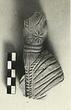
| Highly micaceous brownish clay, with grey core.
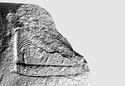
Burning torch.
Early Thasian. Stp: v lrg lets(VG)*Dim: W 0.048*Msc: the tips of the flames
which show only on this ex(VG 18.xi.52)* Finished In late fill ... 10 April 1935 |
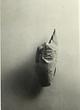
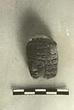
| Part of conical tip of unguentarium preserved.
Fine, hard orange-pink clay, with black core; buff slip; a streak of brownish-red glaze down one side shows the upper body was glazed.
Small roughly circular ... Late Roman |
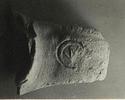
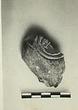
| Coarse red clay, slipped.
For the type of handle and stamp, cf. Hesperia 3 (1934), pp. 266 ff. Stored with “άγνωστα”.
Par: for type of hdl and stp see Grace 1934, nr 266 ff* Destruction fill of late Roman ... 11 April 1935 |
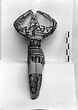
| Broken away behind and at neck. Nose badly damaged; mouth, chin and eyes slightly.
Female head, rather more than life-size, with hair parted at center. A little way back is a sunken band with small holes ... 9 April 1935 |
| Fragment a) Seated draped figure, the arms held up to the sides of the head in a gesture of lamentation.
On the back of the head, painted locks; the nose, although it is broken off with the top of the ... 8 April 1935 |
| Broken off at neck.
She wears a high coiffeur on top of her head, over hair parted in the middle.
Unglazed.
Micaeous brownish red clay.
ADDENDA: Same mold as T 1095 and T 1532. Modern fill. Leica ... 10 April 1935 |
| Broken away all around.
Signed.
For the same signature see T 603 and probably also T 471.
ADDENDA: Incised in wet clay the letters: P O
Φ
Late Roman.
Destruction fill of late Roman Building. Leica ... 9 April 1935 |
| Broken all around.
Gouged folds; and gouged decoration, hatching and startss on the drapery.
Red clay; buff surface.
Late Roman. Destruction fill of the late Roman Building. Leica ... 10 April 1935 |
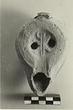
| First interpretation: head of figurine.
The figure wears a high ornamental headdress. Pierced eyes. The curiously distored mouth suggests a mask of some sort.
Buff clay, thin purple red wash. Red earth ... 9 April 1935 |
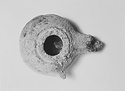
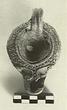
| A flat-bottomed straight-sided lamp with open top and unbridged nozzle.
At top of side at back a vertical handle (?) broken away.
Heavily corroded. Tile drain, east of Burnt Building ... 11 April 1935 |
| On bottom, inside concentric grooves, part of a signature.
Red clay and glaze.
Type XXVIII of Corinth collection.
Cf. Corinth IV, ii, pp. 102-114, nos. 786-1412, pls. XIII-XIX.
ADDENDA: The signature ... 4th. century A.D. |
| Ring base, convex upper and lower body, meeting at an acute angle. Fairly long nozzle. No handle; pierced lug on one side. Flat raised ring around filling hole, a groove around it. Rather high base, rising ... 300-250 B.C. |
| Rim, disk and handle preserved and part of nozzle.
Part of bottom below nozzle preserved with part of the typical "A" in relief.
Thin black wash.
Gray-buff clay.
Type XX of Corinth collection. Leica PD ... 10 April 1935 |
| Nozzle and greater part of disk and rim preserved.
The narrow rim has an ovule pattern, broken by a raised knob in the middle of the side. A small circle takes the place of the ovule on each of nozzle, ... Latest 1st.-early 2nd. centuries A.D. |
| Vertical loop handle and top of nozzle missing.
Upper walls slope in to the flat narrow rim which has no visible decoration; possibly one had shallow herringbone. Two large filling holes; broad channel ... 9 April 1935 |
| Fragment of wall and base.
Around the lower side walls a broad band of small impressed circles. On the flat base, within two grooves, the first and fainter letters of the signature.
Unglazed.
Buffy-brown ... 9 April 1935 |
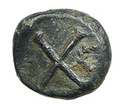
| A: head of Athena, right, in crested helmet.
B: plain.
Cf. IL 434 for same type. Entered as coin, no. 7, for the day. Below road. Leica ... 10 April 1935 |
| About one-sixth preserved. Restored in plaster. Ring foot, convex side and flat thickened lip.
Very micaceous red clay. Unglazed. Grave 18. The skeleton of a child was found lying on this fragment. The ... 9 April 1935 |
| Krater rim fragment. Flat top surface preserved. On outer face of rim, maeander, left; below, part of floral ornament?
Thick greenish black glaze; incised inside: Although from apparently same context ... 8 April 1935 |
| Krater base fragment, glazed inside and with rays outside.
Incised inside: Modern fill. Leica DA 15249 ... 8 April 1935 |
|
|