|
|
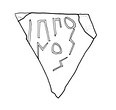
| Layer of crushed bedrock with ostraka, behind Classical Building ... 17 June-17 July 1996
28 July 1997 |
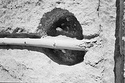
| Located in Middle Stoa, west, south aisle, beneath pressure pipe (cf. A 4900). The siting of the well is remarkable in its proximity to Well I 13:3, also Geometric in date, which was found in 1968 only ... Second half of 8th c B.C. |
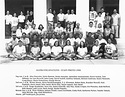
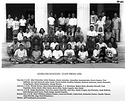
| Agora Excavations, staff and volunteers, 1996 ... Horizontal (normal) ... July 1996 |
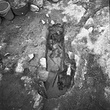
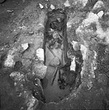
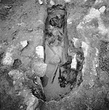
| Roman Temple North, J/4,6-2/18, Grave J 2:10. From east ... Craig Mauzy ... AMS west Horizontal (normal) ... 2 Aug 1996 |
| Roman Temple North, J/4,6-2/18, Grave J 2:10. From east ... Craig Mauzy ... AMS west Horizontal (normal) ... 2 Aug 1996 |
| Roman Temple North, J/4,6-2/18, Grave J 2:10. From east ... Craig Mauzy ... AMS west Horizontal (normal) ... 2 Aug 1996 |
| Agora Excavations staff 1996 ... Mounted Horizontal (normal) ... July 1996 |
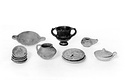
| Excavation of this pit began in 1995, tentatively identified as a pyre. This proved to be so with continued excavation in 1996. The deposits J 2:8 and J 2:9 were combined to become J 2:9. Miniature vessels ... Ca. 300 B.C. |
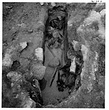
| David Scahill ... Roman temple north. Adult male inhumation. Pit tomb, partially stone-lined ... Late Mycenaean or Final Mycenaean/Submycenaean |
| Dimensions: 1.10m in diameter and 1,36m deep.
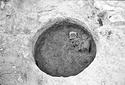
It could have been started as a well but then abandoned at a shallow depth (perhaps due to Persian invasion of Athens). BG vessels (including one inscribed ... 500-470 B.C. |
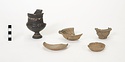
| The remains of a pyre disturbed by the construction of Wall 106. The compact, light brown soil contained some ash and bone and 5 nearly complete pots or saucers ... First half 3rd. c. B.C. |
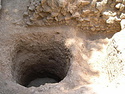
| The pit consists of an unlined, circular shaft measuring 1.10m. in diameter and at least 2.23m. in depth. The sides of the shaft have roughly cut hand-/foot-holds at irregular intervals and locations ... Late Roman to end of 4th c. A.D. |
| Tom Milbank ... An unlined and relatively narrow (ca. 0.82m. in diameter) well cut through hard-pack and bedrock. Although three periods of use can be discerned in the stratigraphy of the well below a depth of ca. 5.47m., ... Middle Geometric I |
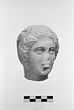
| Broken at neck, nose and chips missing from face.
Head of youth, hair tied in a narrow fillet. Hair parted in middle, descending from crown in a series of waves or long curls. Head tilted slightly to ... Late 5th century B.C. |
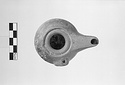
| Intact except for chips on foot and rim.
Globular body. Thick bottom on low disk foot with central disk on underside. Pierced lug handle. Moulded ring around filling hole.
Glazed black only inside with ... 3 July 1996 |
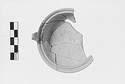
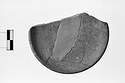
| About three-quarters preserved, made up from ten joining fragments. Missing part of rim and body on side opposite handle. Slightly concave base with string marks. Convex body, flaring rim, flange on interior ... 13 June 1996 |
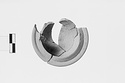
| Pyre lekanis. Eight joining fragments preserve more than half; missing parts of base, body and rim. Unglazed miniature lekanis with disk foot, slightly concave underneath (string marks). Convex body with ... 13 June 1996 |
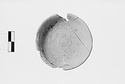
| Four joining fragments, preserving about half saucer, missing parts of base, body, and rim. Unglazed shallow pyre saucer with concave base, convex body, plain rim.
Fine pinkish-buff fabric with mica ... 13 June 1996 |
| Almost complete; several chips joined at rim, small sections missing from rim.
Unglazed small pyre saucer with concave base (faint string marks), slightly convex wall with outurned rim.
Fine buff clay ... 13 June 1996 |
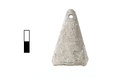
| Intact.
Conical. Suspension hole pierced 0.005 from top. Uneven underside with small raised ring as foot.
Encrustations covering entire surface. Yellow brown discoloration on surface. South of wall 2, ... 31 July 1996 |
|
|