|
|
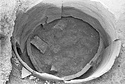
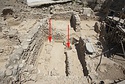
| A tile lined well under Room I of Byzantine House.
A concrete shaft belonging to the mill cut off the top of the well and left in place 3 complete sets of tiles and most of a fourth set. All but the lowest ... 17-18 c. A.D. |
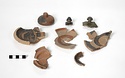
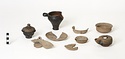
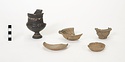
| Deposit of terracottas, molds and pottery in a shallow pit sloping downward from north to south. This deposit was located beneath a layer of fill under a Late Roman plaster floor (Lots ΒΕ 2093-2095). The ... 1st c. A.D. |
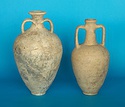
| Marcie Handler ... A deposit of six amphorae and one micaceous water jar was excavated between 20 June and 6 July 2005 in the area north of Wall K. The neck and one handle of one of the amphorae (BZ 1213) had been poking ... Ca. 1st c. A.D. |
| Marcie Handler ... The remnants of a disturbed pyre in a layer of dumped Hellenistic fill. The fill was found in the area on top of and east of the eastern wall of the Classical Commercial Building at its north end. Fragmentary ... Ca. 225 B.C. |
| Marcie Handler ... The contents of this Hellenistic cistern shaft were excavated in a series of layers: the preserved top of the shaft, six layers in the shaft and the fill within the tunnel. At the bottom of the shaft on ... POU: Mid-3rd c. BC
Dumped fill: after 225 BC |
| Marcie Handler ... The Pyre was revealed in a layer of 4th c. fill in the north end of Room 6, just south of Wall 8. Room 6 is defined by the street wall (Wall A) on the west, Wall 7 on the east, Wall 9 on the south (preserved ... 4th c. B.C. |
Brian Martens ... This deep stratum (ca. 030m) is delayed Persian destruction cleanup deposited in the 470s B.C. it contains about one generation's worth of pottery, almost exclusively dating between about 500-470 B.C ... 29 June-19 July 2017
12–15 July 2022 |
| The remains of a pyre disturbed by the construction of Wall 106. The compact, light brown soil contained some ash and bone and 5 nearly complete pots or saucers ... First half 3rd. c. B.C. |
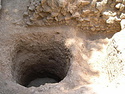
| The pit consists of an unlined, circular shaft measuring 1.10m. in diameter and at least 2.23m. in depth. The sides of the shaft have roughly cut hand-/foot-holds at irregular intervals and locations ... Late Roman to end of 4th c. A.D. |
| Tom Milbank ... An unlined and relatively narrow (ca. 0.82m. in diameter) well cut through hard-pack and bedrock. Although three periods of use can be discerned in the stratigraphy of the well below a depth of ca. 5.47m., ... Middle Geometric I |
Original bottom of pithos was damaged (probably by ground water) and a second, higher bottom consisting of squarish terracotta tiles laid. Fill above second, higher floor was unusually rich in pottery ... Byzantine |
Room 8, Pit 1 in Layer 2. Notebook ΒΕ XII is missing ... 11th c. A.D. |
| David Scahill ... Behind northeast corner of Classical Building; east wall C. Below Hellenistic levels and early Classical pit. Chamber cut through bedrock, depth ca. 0.90m., diameter ca. 2m., roughly square in shape, angling ... LH III A:1 |
East of Classical Building II backwall, above Mycenaean chamber tomb K 2:5. Rough circular pit of reddish brown fill cut into geometric fill that extends down inside tomb. Some evidence of burning on pottery ... Ca. 460 B.C. |
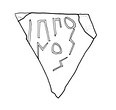
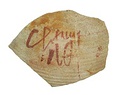
| Layer of crushed bedrock with ostraka, behind Classical Building ... 17 June-17 July 1996
28 July 1997 |
Ione Shear ... Tile burial of an adult male found in 1991 on top of cover slab of south channel of river ... 27 June-3 July 1991 |
| Pit in Layer 9, lined on the sides and bottom with small stones ... Late 5th c. B.C. |
Found while cleaning wall running east-west over 57. Contained late glazed pottery ... Byzantine |
| Anne McCabe ... Adjacent to the SW face of Byzantine Wall 14. The circular cutting, 0.90m in diameter, appeared at 53.504m under a layer of loose rubble (Lot 481). Wall of the well roughly built, consisting at the top ... 11-19 July 2006
24 June-21 July 2009 |
|
|