|
|
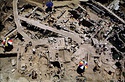
| Preliminary Report on the 1998 Excavation Season ... John McK. Camp II ... Most work this year was concentrated to a new area at the extreme northwest, where a modern building had been demolished. Fill from modern to Byzantine times were excavated. The principal feature uncovered ... 8 Jun-31 Jul 1998 ... The work in and around the Classical commercial building behind the Painted Stoa also continued. A Mycenaean chamber tomb was found under the floor of one of the rooms. The date of the tomb seems to be 14th century B.C.
A second chamber tomb was found a bit further north, rich in finds, including two bronze daggers and one knife blade.
|
| Section ΝΝ: 1947 ... Rodney S. Young ... Excavation continued in section ΝΝ with the aim of clearing the area for the new museum. Because of the unforeseen depth of filling, the area remained unfinished.
Several features were dug and examined ... 10 Mar-3 Nov 1947 ... A number of burials were excavated, amongst them a Mycenaean chamber tomb.
|
| Sections ΝΝ-ΞΞ 1948
Early Houses ... Rodney S. Young ... Excavations were confined to a strip on the west side of the Great Drain where four houses of the 5th and 4th centuries B.C. were excavated and examined in their relationship to the Great Drain. In the ... 13 Mar-29 Apr 1948 ... In the area of Houses 3 and 4, eight pyres were found. A Mycenaean burial of two small children was found in a pit under House 3. It should probably be associated with the chamber tomb dug out in the previous season. |
| Agora Excavations Preliminary Report - Summer 2014 ... John McK. Camp II ... Excavations in 2014 were carried out in three sections: ΒΘ, ΒΓ and ΒΖ.
In Section ΒΘ, overlying the Painted Stoa, the Byzantine houses of the 11th century A.D. were further exposed in the western part ... 9 Jun-1 Aug 2014 ... In Section ΒΖ, excavation continued in early layers in the area north of the Classical Commercial Building. A Mycenaean chamber tomb, collapsed in antiquity and cleaned out and filled in the late 8th century B.C., was partially excavated. |
|
|