|
|
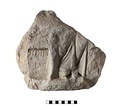
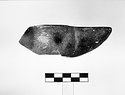
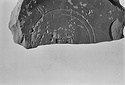
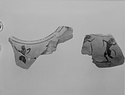
Fragment of archaic figure, seated. Head and limbs missing. Red, white, and tawny yellow paint. Munsell (fabric) 5 YR 6/4 light reddish brown; (paint) 10 R 4/4 weak red, 2.5 Y 6/8 olive yellow, and 8/N ... 17 October 1932 |
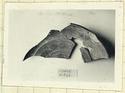
Plate.
Most of foot and part of wall preserved; badly shattered and flaking.
Low ring foot; broad, flat resting surface; flat underside. Sloping wall of fairly deep plate. Very porous, white core (2.5Y ... Context of late 2nd century after Christ |
| Fine buff clay, slightly micaceous. Nb. No. 3. Trench A, Assembly Place; filling of Period III. ΘΑΣΙΟΝ ΔΑΜΑΣΤΗΣ ΘΡΑΣΙΠΠΟΣ 437 ... 13 Mar 1931 |
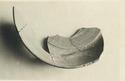
Moldmade Bowl.
Wall fragment.
Moldmade body. Parts of two petals or leaves, diagonally ridged, with heavy, dark central ribs. Very pale brown fabric (10YR 8/3); shiny, pale aquamarine exterior surface, ... Context of before ca. 180 |
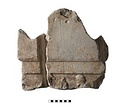
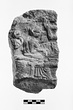
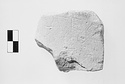
| Fragment from bottom of inscribed grave relief.
Back rough picked, bottom somewhat more smooth top and sides broken.
To left, high chair seat faces right; drapery falls back a little between the front ... 4 February 1932 |
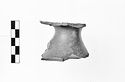
Bowl and lower part of stand missing; much of flange chipped away.
Hollow, vertically grooved stand, flaring widely to bottom. Molded flange at base of bowl decorated with incised cable above dotted ovolo ... Late 2nd to 1st century? |
Half of rim and part of body alone preserved.
Straight sides; flat top with groove around the edge. Very small filling hole. Pierced lug on left side.
Clay: fine gray (burned); red brown glaze inside ... 1931 |
| Cf. Pridik (1917), pl. VIII, 14. Par: device like that of Pridik 1917, Pl 8, 14 but diff stp(VG)*
Dte: poss period I(VG)*
Rdg: Bon 1957 nr 744 w/ rdg =HROSTRATOS= (prob wrong)(VG)* Finished Late Roman ... 25 February 1937 |
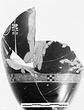
Two non-joining fragments, a of wall, b of rim and neck with start of handle zone at far left. Glaze pitted on inside of a. Max. dim. a) 0.077, b) 0.14; W. of rim 0.025; H. of neck 0.063. W. B. Dinsmoor, ... Ca. 480 B.C ... Thompson, Garden Lore of Ancient Athens (Agora Picture Book 8), Princeton 1963, fig. 1; Schleiffenbaum, Volutenkrater, p. 322, cat. no. ... This is from near the handle zone, because there is no black background next to the palmettes on the left. ... Hektor may have looked something like his counterpart on the volute-krater in London by the Berlin Painter that names the figures (E 468: ARV2 206, 132; Paralip. 343, 132; Addenda 194) or the kalpis in the Vatican, H 545, by the Eucharides Painter (ARV2 229, 38; Paralip. 347, 38; Addenda 199). |
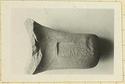
| A square bottle with narrow neck, flared rim and broad flat handle.
Broken into many fragments, but apparently complete as it lay.
Glass light green to clear. For context see Hesp. 26 (1957), p. 101. South ... 9 May 1956 ... Agora XXXIV, no. 284, p. 132, ill. 8, fig. 17, pl. 25. |
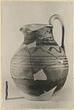
Mended with small missing pieces restored in plaster and painted. Lip offset on inside; foot offset on underside. Glaze slightly abraded on handles. H. 0.074; diam. of rim 0.18; W. with handles 0.238; ... Ca. 510-500 B.C ... Camp, The Athenian Agora: Excavations in the Heart of Classical Athens, London 1986, pl. 8, opp. p. 135 (I); LIMC III, 1986, p. 460, no. 428, pl. 349 (B), s.v. Dionysos; p. 782, no. 310, s.v. Eos; Human Figure, pp. 142--145, cat. no. 51; Robertson, AVP, p. 83, fig. 72 (A); M. ... E 468 (ARV2 206, 132; Paralip. 343, 132; Addenda 194). |
| The lower body complete; the shoulder fragmentary; the start of the neck only preserved, and of the handle only the lower attachment. Ring foot. Bands on the handle; the body glazed solid except for a ... 28 February 1936 |
| From an unglazed pot; inscribed on the outside. Red sandy fill over road. B' building fill. Leica ... 12 March 1935 ... Hesperia Suppl. 8 (1949), p. 399, pl. 58:11 ... Agora XXV, no. 132, p. 48, fig. 8. |
| Upper part of inscribed grave relief.
Mended from two fragments found on different dates.
The smaller left piece was found first; the two fragments do not meet along front edge; may have been cut apart ... 4th. century B.C. |
| Fragment from an inscribed Herm.
Broken at top, right side, back and bottom.
Part of the chest, and a strand of hair left preserved.
Part of eleven lines of the inscription preserved.
Pentelic marble ... Ca. 166/7 A.D. |
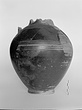
Mycenaean amphora. Incomplete.
Buff clay, coarse ware. Oscar Broneer, Nb. No. 5.
Aglaurion, 8-9.50m. 132 Leica DA 9842 ... 25 August 1938 |
| Part of back of rim and upper part of discus preserved.
Stamped circles on rim beside handle; mast and sail of ship on discus, square rigged type, with peak. Surfaces of sail and spars divided into small ... 16 April 1936 |
| Single red glazed wall fragment. On the inside are inscribed the letters of the name and patronymic of Themistokles:
Pinkish-red, fine-grained fabric with black glaze fired orange-red on both sides ... 9 July 1996 ... Agora XXV, pp. 102-132 ... Hesperia 86 (2017), p. 466, no. 8, fig. 5. |
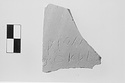
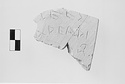
| Single wall fragment. White incrustation on interior. Unglazed wall fragment; inscribed on the exterior the name and demotic of Themistokles:
Joins with P33626, joined February 2005.
Light pinkish-orange, ... 28 June 1996 ... Agora XXV, pp. 102-132 ... Hesperia 86 (2017), p. 471, no. 25, fig. 8. |
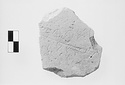
| Single wall fragment of large coarseware vessel. On exterior is inscribed part of the name and demotic of Themistokles:
Pinkish-buff, medium-grained fabric with white and micaceous inclusions and lighter ... 11 July 1996 ... Agora XXV, pp. 102-132 ... Hesperia 86 (2017), p. 471, no. 24, fig. 8. |
| Two joining fragments, broken all around, preserving part of the wall of a coarse-ware container. Exterior inscribed with the name and demotic of Themistokles:
Fine-grained, reddish-pink clay with buff ... 9 July 1996 ... Agora XXV, pp. 102-132 ... Hesperia 86 (2017), pp. 470-471, no. 23, fig. 8. |
| Filter jug. Part of shoulder and neck preserved. Horizontal shoulder with ridge at top. Strainer in neck, with six holes around outside. Funnel mouth with widely flaring rim. Groove inside rim. Triple ... 10-11 March 1936 |
| Nozzle and part of one side remain.
Vertical wall; narrow rim bounded by a scraped groove.
Unususally long nozzle and narrow rim.
Glaze black to red.
Type VII of Corinth collection, type 24A (?) ofg Agora ... 24 May 1954 |
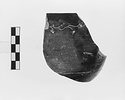
| Bottom, handle and small fragments missing; restored in plaster. Rounded body with short neck, wide trefoil mouth; band handle. Glazed to point of greatest diameter, then banded; wavy line in zone at level ... 8 June 1946 |
| The tenon for setting and the mid-part of the plaque remain. A draped figure is seated on a stool, facing right. Behind him stands a boy, resting his left hand on the handle of a large krater that stands ... 1 May 1934 |
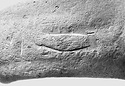
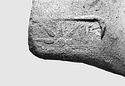
| Round stamp with boukranion; traces only of letters. East of Stoa, rooms 13-16; early Roman fill, disturbed. [ Ἐπὶ Ἀπολλωνίδα Διοσκουρίδα Κνίδιον]
boukranion (letters or dots between ... 22 May 1950 |
| From a Samian B bowl or plate with wide plain ring foot. Two grooves around center of floor.
Traces of rectangular stamp at center of floor: Brown gravelly early Roman fill over strosis. 432 Leica, ... 5 April 1939 |
| Two joining pieces preserve section from lip to lower wall including lower attachment of handle. Strap handle. Below lip, ivy in incision and applied yellow. Below handle attachment a groove wheel run ... 5-9 August 1968 |
| Single fragment, broken all around. Ostrakon from the neck of a coarse-ware vessel. Inscribed on the outside the end of the name and demotic of Themistokles:
Pinkish-buff, medium grained clay with small ... 15 July 1996 |
| Typical Knidian shape.
Typical Knidian clay.
Impression incomplete above, incomplete and dam,aged to right. Careful delicate letters, with apices and broken-barred "alpha".
Same die as SS 263, better ... 3 March 1933 |
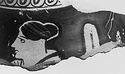
| From the shoulder of a closed pot (pelike?) with the start of the neck, and a trace of the handle attachment at the left. Egg pattern at base of neck. On the wall, the head of a draped woman, left, her ... 17 October 1947 |
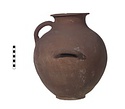
| Household Hydria. Lip chipped. Vertical handle broken but preserved. Very rotund shape. Ring foot, flat projecting rim. Fine slip much worn.
Reddish-brown micaceous clay. Well L, box 6. Context ca. 575-550 ... 16 July 1959 ... AgoraPicBk 26 (2006), p. 8, fig. 4 ... Agora XII, no. 1591, pl. 71 ... Agora XXXI, pp. 132, 147, 172. |
| Single fragment, broken all around, from the wall of a large closed vessel. Large coarseware sherd with the name and demotic of Themistokles inscribed on the exterior.
Orange, medium-grained clay with ... 9 July 1996 ... Agora XXV, pp. 102-132 ... Hesperia 86 (2017), p. 470, no. 22, fig. 8 ... Hesperia 68 (1999), p. 273, no. 41, fig. 20. |
| Fragmentary lower body, mended from several pieces. For the shape cf. P 15840 and P 15841.
Reserved: groove above and below ring at junction of body and foot; underside of foot (the foot itself missing) ... 12-15 April 1939 |
| Mended from many pieces; fragments missing from rim and walls, and part of both handles; bowl restored in plaster. A scraped groove around the moulded foot.
Fairly good black glaze over all, much chipped ... 10 April 1934 |
| Four fragments, that make up to two, preserve part of closed pot, probably a kothon. The full depth of the downturned lip preserved on fragment a).
a) Maenad dancing right, looking back left; traces of ... 8 June 1938 ... Hesperia 15 (1946), p. 132, no. 24, pl. 22:8 ... ABV, p. 111, no. 43 ... Agora XXIII, no. 1262, pl. 89. |
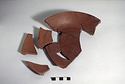
| Part of P 1521. Late Roman A bowl fragment. The low ring base is about one-quarter preserved with a corresponding section of convex side and ridged rim. Band of conventionalized flowers on the interior ... 6 May 1933 |
| Part of P 1521. Late Roman A plate fragment mended from five pieces. A bit of the rim and about one-third of the bottom of the plate preserved. Low ring foot; curving sides; downward rim with two grooves ... Card: ca. 440-500 A.D. |
| Mended from many pieces and restored in plaster. Heavy vertical rim with two grooves; below, on the outside, a broad band of rouletting. Inside, at least three groups of wheel-run circles.
Fine red clay ... 17 March 1933 |
| Late Roman B fragment. About a third of the bowl is preserved. On either side of a central medallion is a Christian monogram; the whole design surrounded by a circle of lozenges and a series of concentric ... card: ca. 440-500 A.D. |
|
|