|
|
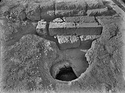
Pit (Well?) under Building A, Room 2. Coins:
9 May 1949 #1-#2
11 May 1949 #4
12 May 1949 #3 (not a coin, bronze fragment in lotted metal tins ΠΠ 295). Estimated Grid
Remains of coloring matter found with ... Hellenistic-Early Roman ... under Building A, Room 2 ... Coins:
9 May 1949 #1-#2
11 May 1949 #4
12 May 1949 #3 (not a coin, bronze fragment in lotted metal tins ΠΠ 295). |
From kiln in house of 7th c. B.C. (=Building A), to southeast of Tholos. Tholos Trench U, furnace ... 675-625 B.C ... B.C. (=Building A), to southeast of Tholos. |
Double Well by E. Entrance to Square Building (Well A) (formely a O 8:1) Coin
21 April 1951 #1 (disintegrated) Carefull there is two O 8:1, the actual one is a filling around rubble wall at 35/ KE.
Estimated ... 750 to early 7th century B.C ... Entrance to Square Building (Well A) |
A strosis into which were set the foundations of house of 7th c. B.C. to SE of Tholos (=Building A and Trench W, layers h + i) ... 8th-7th c. B.C ... A strosis into which were set the foundations of house of 7th c. B.C. to SE of Tholos (=Building A and Trench W, layers h + i). |
Filling associated with construction of Poros Building. A small amount of fragmentary pottery found in the clay filling of the original floor; perhaps deposited as late as ca. 425-400 B.C. Cf. 18:4 and ... Ca. 475-450 B.C. or later ... Filling associated with construction of Poros Building. A small amount of fragmentary pottery found in the clay filling of the original floor; perhaps deposited as late as ca. 425-400 B.C. |
Kernos Deposit (?): below floor of Building A, over and in cutting at 33/ΚΗ P 30162-P 30172 added on 4 May 1973 ... 4th c. B.C ... : below floor of Building A, over and in cutting at 33/ΚΗ |
P 5302 may be from disturbed fill ("soft spot", container B 57, nbp. 1246) ... 12 March-6 April 1935
7 May 1935 ... a) Undisturbed filling of the building |
Circular well cut through the old road after it had gone out of use, and filled probably at the time of the building of the drain and building A, and the throwing of fill over the road ... Ca. 430-400 B.C ... Circular well cut through the old road after it had gone out of use, and filled probably at the time of the building of the drain and building A, and the throwing of fill over the road. |
Fillings in and to the north of Building A/Poros Building/Greek Building ("Strategeion"), the accumulation mostly a late archaic dump, but not deposited till near the middle of the century. Most of the ... First half of 5th c. to ca. 460-450 B.C ... Fillings in and to the north of Building A/Poros Building/Greek Building ("Strategeion"), the accumulation mostly a late archaic dump, but not deposited till near the middle of the century. ... A few pieces (e.g. ... Subdivisions:
.1=a) Undisturbed filling of the building.
.2=b) Undisturbed filling to north of the building.
.3=c) Building fill in disturbed places. |
Early cutting beside Great Drain: 103-111/Λ-ΛΓ (= "Deep cutting" Pit at 107/ΛΑ).
Abandonment filling in channel for early drain; the fragment of a red figured bell krater, P 17000, probably to be dated ... Ca. 425-395 B.C ... Abandonment filling in channel for early drain; the fragment of a red figured bell krater, P 17000, probably to be dated between 400 and 397 BC, is the latest dated object from the deposit, otherwise a consistent filling of the last quarter of the 5th. c. with some earlier material.
... For other fills related to Early Drain and giving date for building of Great Drain, see B 19:7 and B 19:12. |
This is associated with Building A. It had a circular marble well-head with a rectangular well slab beneath. The construction throughout was of well tiles. It produced little to a depth of -8.60m. Between ... 4th c. A.D ... This is associated with Building A. It had a circular marble well-head with a rectangular well slab beneath. ... It produced little to a depth of -8.60m. |
South Stoa II Construction Fill.
About 85 stamped amphora handles, many with parallels in building fills of Middle Stoa and Stoa of Attalos. Fragments of long-petal bowls confirm date after mid-2nd c ... To ca. 140 B.C ... About 85 stamped amphora handles, many with parallels in building fills of Middle Stoa and Stoa of Attalos. ... Types 25 A', 33 A, 35 B, and 44 A lamps. |
Mycenaean Chamber Tomb W. of Circular Building (at Σ:30/ΛΕ?)
It had been badly disturbed by a fourth-century B.C. pit which cut into the northeast part of the chamber (rectangular, ca. 1.80m by 1.30m) ... Myc. III A 2 ... Mycenaean Chamber Tomb W. of Circular Building (at Σ:30/ΛΕ?)
It had been badly disturbed by a fourth-century B.C. pit which cut into the northeast part of the chamber (rectangular, ca. 1.80m by 1.30m). ... Two skeletons and traces of a third were found. |
Double Well by Entrance to Square Building (Well B)
Wall A (R 9:2) was Late Geometric or transitional well, into one-half of which a bothros had been sunk in Turkish times (16th c. A.D.)-R 9:3.
This bothros ... ca. 17th century A.D ... Double Well by Entrance to Square Building (Well B)
Wall A (R 9:2) was Late Geometric or transitional well, into one-half of which a bothros had been sunk in Turkish times (16th c. ... This bothros was lined on the side of the Geometric well by a wall made of rough stones and pink cement, supported by three small round wooden beams. In dark brown fill, it contained many household utensils (spoons, a wooden bowl fragment, a saucepan and an iron knife), quantities of pottery and a fragment of marble capital Balance of pottery discarded. |
Tiled Well in Square Building Foundations, equipped with evenly spaced hand-holds, with a good supply of water. There was no period of use represented and the dumped fill consisted mostly of chunks of ... Third quarter of 4th c. B.C ... Tiled Well in Square Building Foundations, equipped with evenly spaced hand-holds, with a good supply of water. There was no period of use represented and the dumped fill consisted mostly of chunks of bedrock, with many fragments of pebble mosaic and a few marble chips; the pottery was extremely scanty and very fragmentary. the well had been intentionally filled and carefully covered over a large slab in preparation for the foundations of the Square Building over it. |
| Sacrificial pyre in Poros Building, NW Room (RSY= Pyre 1).
Against east wall of room 5 west. artifacts, bone, carbon and ash in pit in floor sequence. the pyre lay below a floor covered with marble dust, ... Middle of 4th c. B.C ... Sacrificial pyre in Poros Building, NW Room (RSY= Pyre 1).
... The pit extends down into a layer with marbleworking waste. The pyre thus postdates the arrival of the marbleworkers, and may be associated with the 4th century reconstruction of the building. It contained scattered carbon and there was a heavy ash deposit in the chytridion. some of the pottery is burnt; there were also fragments of burnt mudbrick or clay. |
Mycenaean well under East Building Terrace steps (No catalogued pots). Rectangular in shape, 0.90x0.60m.
Abutting against the back of the East Building Terrace steps to the south. Yielded much thrown bedrock ... 14 July 1967 ... Mycenaean well under East Building Terrace steps (No catalogued pots). ... Abutting against the back of the East Building Terrace steps to the south. Yielded much thrown bedrock and a few Mycenaean sherds, with a few later intruders at the upper levels. |
Ash and Carbon Dump in Corridor directly behind Room C of Brick Building.
This material comprises what appears to have been a household dump associated with the period of use of the Brick Building, but ... To mid-2nd century ... Ash and Carbon Dump in Corridor directly behind Room C of Brick Building.
This material comprises what appears to have been a household dump associated with the period of use of the Brick Building, but probably dating just prior to its abandonment, since it included a a few roof tiles, presumably from the demolition of the Brick Building. The dump is located in the corridor between the back wall of the Brick Building and the retaining wall behind the building , immediately east of the line of the dividing wall between Rooms B and C [City Grid: Q/18-11/2] |
Pit with marble chips (disturbed); working chips of the Hephaisteion construction. A few vases apparently contemporary with the building of the temple ... 5th c. B.C. to ca. 450 but disturbed ... A few vases apparently contemporary with the building of the temple. |
RSY Grave A.
Under the Roman House with three rooms floored with mosaic near the southwest side of the area. The burial consisted of a pot laid on its side over the bedrock, presumably containing a child ... 7 August 1947 ... RSY Grave A.
Under the Roman House with three rooms floored with mosaic near the southwest side of the area. The burial consisted of a pot laid on its side over the bedrock, presumably containing a child. ... The grave had been disturbed in early times by the building of a wall (6th or 5th century B.C.) which in part overlay it; only the part of the pot immediately over the stereo was preserved. it was an amphora with banded body and conventional ornaments on the reserved neck, probably late 8th century. |
| Disturbed pyre in NE stoa area.
In western room of westernmost shop building. A patch of ash i or at the level of layer 2 (lot Ι 189d), partially destroyed by modern wall. Pottery from layer 2 dates ... 400-350? ... In western room of westernmost shop building. A patch of ash i or at the level of layer 2 (lot Ι 189d), partially destroyed by modern wall. |
A pit, perhaps a well, extending beneath the foundations of [Building D, the Primitive Bouleuterion] the Hellenistic Metroon. Not completely dug due to its position. A dumped filling so far as dug, apparently ... Ca. 575-525 B.C ... A pit, perhaps a well, extending beneath the foundations of [Building D, the Primitive Bouleuterion] the Hellenistic Metroon. Not completely dug due to its position. A dumped filling so far as dug, apparently thrown in within a very limited period. |
Construction fill below floor of Brick Building.
Areas involved:
a) Western portion of Room A: packing below floor.
b) Room B: packing below floor of northern,larger room.
c) Fill over water channel in ... First quarter 2nd century, before its end ... Construction fill below floor of Brick Building.
Areas involved:
a) Western portion of Room A: packing below floor.
b) Room B: packing below floor of northern,larger room.
c) Fill over water channel in smaller, southern room B; channel discovered by builders of Brick Building,rebuilt by them and covered over.
d) Foundation trench of earlier building beneath Brick Building, filled and covered by builders of Brick Building.
e) "Apparently from below floor of building" (nb.p. 1282).
... Type 48 A lamp. No long-petal bowls ... It was believed to antedate the construction of the building since the wall of the building seemed to cut it. |
Well T: Middle Helladic. Close to Paved Building. Diameter ca. 0.75-0.80m.
No apparent water, but a thin layer of sand at the bottom ... Middle Helladic ... Close to Paved Building. Diameter ca. 0.75-0.80m.
No apparent water, but a thin layer of sand at the bottom. |
| Pit and drain at SE corner of Apollo Temple. Antedates building of Apollo Temple which was assigned to a date 'late in the third quarter' ... 3rd quarter 4th c. B.C ... Antedates building of Apollo Temple which was assigned to a date 'late in the third quarter'. |
Diameter of top of well 0.80m.
An early well east of Roman Building, north of Temple of Ares and thus in the region of the Mycenaean cemetery. Sherds almost entirely Mycenaean with nothing later and a ... Mycenaean ... An early well east of Roman Building, north of Temple of Ares and thus in the region of the Mycenaean cemetery. Sherds almost entirely Mycenaean with nothing later and a few earlier. Maybe the well was used only for ceremonial and funerary purposes. |
Mycenaean Grave W. of Circular Building. Measuring 1.40m by 0.55m and it was covered with a few rough stone covering slabs, under which lay the skeleton of an adult with the head to the north and the knees ... Myc. III A2-B ... Mycenaean Grave W. of Circular Building. Measuring 1.40m by 0.55m and it was covered with a few rough stone covering slabs, under which lay the skeleton of an adult with the head to the north and the knees up. A single offering was placed above the knees.
|
Well East of Circular Building, at 25/ΙΗ.
Well dug originally in 5th c. B.C. and probably had POU fill. In 2nd c. A.D. the shaft was intersected by a horizontal vaulted brick tunnel belonging to the Brick ... 5th c. B.C.(?) ... Well East of Circular Building, at 25/ΙΗ.
Well dug originally in 5th c. ... A.D. the shaft was intersected by a horizontal vaulted brick tunnel belonging to the Brick Shaft system and the earlier fill above the line of the proposed tunnel floor was dug out. After construction of tunnel the old well shaft was filled up again, this time with a Roman dumped filling of second half of 2nd c. |
| Sacrificial Pyre = Pit in floor (identified as pyre by SIR); with the characteristic small plates and saucers. "Saucer Grave" at 12/ΚΑ.
Dimensions: 2m (length)x 0.70 (width).
North of north wall of building ... First half 4th c. B.C ... North of north wall of building. Long, narrow pit containing pottery and ash dug into a hard floor or surface and aligned with north wall of Building E. The pottery rested on a bedding of stones. The alignment of the pit suggests a connection with Building E, and the pyre dates in the generation after its reconstruction. |
| A well at the northeast corner of Classical Building, behind back wall. Dumped fill appears to have occurred as a single event as there are joining sherds throughout.
POU date ca. first half 5th c. B.C.; ... 5th c. B.C ... A well at the northeast corner of Classical Building, behind back wall. Dumped fill appears to have occurred as a single event as there are joining sherds throughout.
|
| Pocket, identified as sacrificial pyre by SIR. Possibly disturbed. Outside south wall of building. Concentration of pottery in a small pocket below a "Hellenistic" fill. There is no mention of bone or ... First quarter 4th c. B.C ... Outside south wall of building. Concentration of pottery in a small pocket below a "Hellenistic" fill. ... The pyre dates shortly after the proposed date for the beginning of the second phase of Building E; the chronology may be sufficiently flexible to allow association with this reconstruction of the building ... A miniature black glazed lekanis (P 1465) and a small one-handler accompany the saucers and plates and the miniature chytra (P 1470). |
Square Peristyle (Square Building) Constructions fill + other (square peristyle area); fragmentary and with some earlier material but in the main, where undisturbed, a homogenous deposit. Coins:
26 May ... Βefore 300 B.C ... Square Peristyle (Square Building) Constructions fill + other (square peristyle area); fragmentary and with some earlier material but in the main, where undisturbed, a homogenous deposit ... From Square Building construction fill. ... Cutting floor of Square Building |
Fillings immediately antedating the building of the Stoa.
Cf. Hesperia 6 (1937), p. 20 and the debris of a pottery works behind the Stoa (H 7:1) ... Fillings immediately antedating the building of the Stoa.
... Hesperia 6 (1937), p. 20 and the debris of a pottery works behind the Stoa (H 7:1). |
Ca. 73-81/Drain. Fillings associated with the construction of the Great Drain South, especially the fill thrown in behind the east wall of the drain at the time of its building.
Cf. A 20-21:1 and B 19:7 ... Ca. 425-400 B.C ... Fillings associated with the construction of the Great Drain South, especially the fill thrown in behind the east wall of the drain at the time of its building.
Cf. A 20-21:1 and B 19:7.
|
| David Scahill ... Below packed clay floors in Room 2 of Classical Building II; bordered on east and south sides by polygonal cross wall and back wall extension for Classical Building. Late Roman wall and drain installation ... LHIII A:1 ... Below packed clay floors in Room 2 of Classical Building II; bordered on east and south sides by polygonal cross wall and back wall extension for Classical Building. ... Decoration appears to be mostly LHIII A:1 with some possibly earlier motifs. ... Toward the west against the north side, a bronze dagger and spear point. |
See I 870, a piece of which was found in disturbed red fill in Β' southeast of Tholos.
Although apparently from the same context as P 5339 (tins 24-26, undisturbed fill), P 5336-P 5338 are recorded from ... 27 February-8 April 1935 |
Well (stone-curbed shaft) near middle of Tholos which served the prior building.
Period of Use dated to ca. 500-480(?) B.C., Upper fill dated to ca. 480-470 B.C. or soon after in Agora XXX (a gradual ... Ca. 500-480 B.C ... Well (stone-curbed shaft) near middle of Tholos which served the prior building.
Period of Use dated to ca. 500-480(?) B.C., Upper fill dated to ca. 480-470 B.C. or soon after in Agora XXX (a gradual accumulation).
|
| Marcie Handler ... The remnants of a disturbed pyre in a layer of dumped Hellenistic fill. The fill was found in the area on top of and east of the eastern wall of the Classical Commercial Building at its north end. Fragmentary ... Ca. 225 B.C ... The remnants of a disturbed pyre in a layer of dumped Hellenistic fill. The fill was found in the area on top of and east of the eastern wall of the Classical Commercial Building at its north end. Fragmentary pyre pots were mixed into the fill, which dated to the period after 225 BC. ... the pyre pottery may very well have come from a pyre buried under a floor in the building just to the west of here. |
| "Perhaps a cremation burial ... " nbp. 811. "Sacrificial pyre, disturbed," GRE, deposit nb.
In room on east side of building. Concentration of artifacts, fragments of bone, and abundant cinders in stratum, ... Early 3rd c. B.C.-Ca. 250 B.C ... "Perhaps a cremation burial ... " nbp. 811. ... In room on east side of building. Concentration of artifacts, fragments of bone, and abundant cinders in stratum, no pit discerned. The pyre was found while excavating an undated red fill that lay over the 5th c. building fill. It cannot be related to any event in the life span of the building. |
Rectangular pit over bedrock in north part of E. Building. Broken jars and household basins with a few black glazed and black-figured fragments (uninventoried). The figured pieces indicate the lower limit ... Late 6th-ca. 480 B.C ... Rectangular pit over bedrock in north part of E. Building ... Broken jars and household basins with a few black glazed and black-figured fragments (uninventoried). |
|
|