|
|
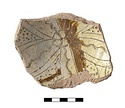
| Three fragments from body.
Zone of hounds; checkerboard pattern above hounds; rays below.
Red paint.
This rather unusual type is earlier than the smaller and more careless similar skyphoi from Italy ... 1932 ... This rather unusual type is earlier than the smaller and more careless similar skyphoi from Italy [cf. Johansen (1923), Les vases sicyoniens, p. 78, fig. 49]. |
| Upper part missing; bottom and two sides of lower part preserved.
Mold for draped figure, standing with left leg slightly bent at knee; only lower part of figure preserved.
Mold roughly smoothed on exterior ... 6 August 1973 ... Currently mis-assigned to southern Italy. |
| Mended from two pieces. Fragment preserving the profile of the wall, vertical, flaring slightly to the plain rounded lip, and the return to the foot. Surface heavily rouletted all over, giving a nicked ... May 1950 ... Giovanni di Ruoti finds (in Potenza, S. Italy). Probably regional. |
Parabolic Cup.
Bottom, much of lower wall, and part of upper wall restored.
Deep cup. Rim beveled to inside with shallow groove below. Hard, fine, somewhat micaceous, gray fabric (10YR 5/1); thick, shiny ... Context of 150-110 ... A gray-ware cup of the same shape but with plain rim, from Heraclea, is displayed in the Siris Museum, in South Italy. |
| A fragment from the side of a cylindrical cup.
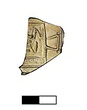
Around the neck panels, and in one of them a tabella ansata with lettering in relief: Ε Ν Ν Ι Ω Ν
Ε Π Ο Ι Ε Ι.
Yellow glass oxidized to blue.
Fragment of ... Card: early 1st c. A.D ... Fragment of cup by Ennion, celebrated glassmaker of Sidon, and possibly later active in italy. |
Cup Or Jug.
Fragment of shoulder and lower rim.
Low, rounded shoulder. Rim convex to outside, with groove at base.
Moldmade body: tops of small imbricate petals or leaves visible.
Rim pattern: jeweling ... Context of first half of 1st century ... Italian moldmade cups of the workshop of Sarius, from North Italy, dating in the first quarter of the 1st century after Christ (Dallemulle 1975, nos. 2--5, 7, pp. 279--282, figs. 6--8, pls. |
Pyxis?
Upper part missing; edge of foot chipped.
Projecting foot; slightly concave underside. Concave wall.
Pronounced nipple on floor. Hard, fine, very micaceous, gray/light gray fabric with uneven ... Context of 5th to 1st century ... Of somewhat similar shape, and also in gray ware, is a vessel from a grave of the 2nd to 1st century B.C. in Heraclea (South Italy; Giardino 1990, p. 121, pl. |
| Single fragment preserving almost all of base and lower part of one side of bowl.
Shallow conical form, thick sloping foot with slight spike below.
Rather poor finish. Light brown clay with scattered ... 1931 ... Probably from West Greece (or Italy?). 13th century?
|
Plate Or Bowl: Central Italian.
Foot and part of floor preserved.
Angular ring foot; rounded resting surface; pointed underside. Three circles on floor: four stamps within inner two circles; very fine ... Context of 150-86 ... This form of stamp is typical of central Italy and, according to Morel, is often found at Arezzo, Volterra, Cosa, Cerveteri, Rome, and Alba Fucens (Morel 1963, p. 50). |
Plastic Vase: Foot Askos.
Top and part of instep preserved.
Concave strainer pierced with six holes in top. Edge of top surrounded by fine groove. Trace of handle on right ankle, seemingly not a ring ... 225-175 ... According to Morrow, the lingula first appears in Italy in the 4th and 3rd centuries; no certain Greek sandal with this feature dates before the middle of the 2nd century, later than the context of this piece.
|
Unguentarium: Italian?
Nonjoining sections of neck and lower body preserved; one handle, much of body, and half of rim restored. Lower body missing.
Scraped groove below greatest diameter, at handle ... Context of 115-90 ... For plain or banded unguentaria with similar handles see Mercando 1976, p. 183, fig. 12, p. 186, fig. 20, from Ancona; CVA, Capua, Museo Campano 4 [Italy 44], pl. 9 [1982]:3, with reference to others on p. 16; Forti 1965, pl. |
Small Plate With Projecting Rim: Rome Or Etruria.
Fragments of rim missing.
Angular ring foot; beveled resting surface; flat underside. Broad, projecting rim, curving down at edge and undercut on inside ... Context of ca. 275-210 ... The general scheme of the decoration (circle/radiating palmettes/rouletting) may be found on a number of pieces from central and northern Italy: e.g.
Morel 1963, pp. 48--49, figs. 2, 3 (Arezzo); Taylor 1957, C 26b, p. 113, pl. |
Plastic Vase: Satyr Reclining On A Wineskin.
Broken all around; part of resting surface preserved.
Flat bottom; thin walls. Chubby figure reclines to viewer's right.
He lies on a mattress strewn with ... Context of before ca. 180 ... Bothmer 1961, no. 262, p. 66, pl. 98 (from North Italy); Belin de Ballu 1972, p. 114, pl. |
Vertical section of handle and over half of body, foot, and underside restored.
Low, flaring foot; flat resting surface; well-formed, slightly convex underside. Lower body very high and nearly straight ... Context of 150-110 ... XXXVIII (Olbia); Vilímková and Wimmer 1969, no. 96, p. 39, pl. 96 (Libya); Antiken aus rheinischem Privatbesitz, no. 86, pp. 63--64, pl. 41 (Italy). Square bows also appear on a hemispherical bowl from Chalkis (Δελτ 27, 1972, B1 2 [1977], pp. 340--341, pl. 292:στ). |
Small Plate.
Part of rim missing.
Very small, flaring ring foot; rounded resting surface; flat underside. Foot pierced for hanging in such a way that griffin is upright. Shallow plate with convex-concave ... Context of 115-50 ... Plates of similar shape occur in Italy, but most are larger (Morel 1981, Series 1281 and 1646). |
|
|