|
|
Undisturbed Late Hellenistic filling |
Cistern with two fills. Lower fill in cone on floor, with dumped upper fill above. Coins:
27 April 1940 #3-#5
14 May 1940 #5-#6
15 May 1940 #3-#7
17 May 1940 #11-#13
20 May 1940 # 8-#9
21 May 1940 #1 ... Late Hellenistic ... Late Hellenistic |
Pit at 36/ΙΖ ... Late Hellenistic to Early Roman ... Late Hellenistic to Early Roman Pit |
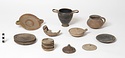
Alison Frantz ... Vases from "Child's Grave" disturbed by the Late Hellenistic cistern. No remains. JP
But see P 27110 ... Late Protogeometric/Early Geometric I ... Vases from "Child's Grave" disturbed by the Late Hellenistic cistern. |
Grave XXIII in notebook = RSY Grave 46.
Late Hellenistic filling in a disturbed grave, west of Areopagus ... 19 June 1939 ... Grave XXIII in notebook = RSY Grave 46.
Late Hellenistic filling in a disturbed grave, west of Areopagus. |
Pit 4 in Grave area (= Cistern). Not completely cleared. Filling probably late Hellenistic, though with some earlier material ... Hellenistic ... Filling probably late Hellenistic, though with some earlier material. |
Ancient fill in cistern tunnel leading to north; contained undisturbed fill which produced late Hellenistic sherds; it had been refilled in modern times ... 2nd c. B.C ... Ancient fill in cistern tunnel leading to north; contained undisturbed fill which produced late Hellenistic sherds; it had been refilled in modern times. |
Cistern System #1a: Shaft (Manhole) at 10/ΞΗ (10-11/ΞΖ-ΞΗ). Filling consistently late Hellenistic in hole and in passage; probably 1st c.
B.C. Coins:
26 May 1936 #1 ... 110-75 B.C ... Filling consistently late Hellenistic in hole and in passage; probably 1st c.
|
Martyr at Δ6. Top strosis (Byzantine-Turkish) discarded.
Strosis 2, late Hellenistic (Lot ΔΕ 21)
Strosis 3, early Hellenistic (Lot ΔΕ 22)
Strosis 4, to mid-4th c. B.C. (Lot ΔΕ 23)
Nothing catalogued from ... To mid-4th c. B.C ... Strosis 2, late Hellenistic (Lot ΔΕ 21)
Strosis 3, early Hellenistic (Lot ΔΕ 22)
Strosis 4, to mid-4th c. |
| Identified as pyre by SIR.
In room E. Burnt "pocket" found while digging red earth that contained late Hellenistic pottery, including a fragment of Pergamene (discarded). No pit was discerned, but concentration ... 3rd quarter 4th c. B.C ... Burnt "pocket" found while digging red earth that contained late Hellenistic pottery, including a fragment of Pergamene (discarded). No pit was discerned, but concentration in a "pocket" suggests that the pyre was in its original position and the layer in which it was buried contained late Hellenistic intrusions. |
Cistern shaft, part of cistern system in Η-Ι 16-17. Filling disturbed to bottom; general run of the pottery is to late Hellenistic, lamps as late as Knidos type. Finds from 60/ΙΘ-62/ΙΘ, 61/ΙΗ. "Some Arretine" ... 5 May 1932
18 June 1932 ... Filling disturbed to bottom; general run of the pottery is to late Hellenistic, lamps as late as Knidos type. |
Chamber of water system with one blind tunnel and two cisterns connected by tunnel. Pottery consistent throughout, late Hellenistic. Late 2nd c. B.C.
Ten stamped amphora handles. Most of bowls long-petal ... 100-75 B.C ... Pottery consistent throughout, late Hellenistic. Late 2nd c. |
Cistern C (pit) in West Room of late Roman House.
Mixed dump of material, with a little Classical, much Roman dating at least as late as 3rd century A.D., and large amount of late Hellenistic. Coins:
1 ... Late Hellenistic and Roman ... Cistern C (pit) in West Room of late Roman House.
Mixed dump of material, with a little Classical, much Roman dating at least as late as 3rd century A.D., and large amount of late Hellenistic. |
Top fill to 1.00m. = dump of late Hellenistic ware mixed with some Roman of 2nd c. to early 3rd. c. Intermediate fill 1.20-2.00m. = dump with tiles and stucco, almost no sherds. Coins:
6 February 1937 ... 2nd-3rd c. A.D ... = dump of late Hellenistic ware mixed with some Roman of 2nd c. to early 3rd. c. |
| Hellenistic Pyre below packed clay floors of Room 2; west of Late Roman wall extension, below tile platform terracotta drain installation, bordered on the north by bedding foundation stones of crosswall ... Ca. 300 B.C ... Hellenistic Pyre below packed clay floors of Room 2; west of Late Roman wall extension, below tile platform terracotta drain installation, bordered on the north by bedding foundation stones of crosswall between rooms 2 and 3. |
Klepsydra: Filling in overflow channel = Channel A, North of Paved Bldg. (was T 26-27:1) Three layers, all containing a mixture of early material (LHIIIC and Protogeometric) with late Hellenistic and early ... Mid 1st. c. A.D. with later intrusions ... Three layers, all containing a mixture of early material (LHIIIC and Protogeometric) with late Hellenistic and early Roman, though in differing proportions. |
Cistern on lower northeast slope of the Areopagus.
Two Hellenistic fills with late Hellenistic to Roman fill above.
Use fill characterized by broken water jars (lower fill); contemporary dump (middle fill); ... Early 1st c. B.C ... Two Hellenistic fills with late Hellenistic to Roman fill above.
... Middle fill contained fruit measure conforming to late 2nd c. decree. |
Nbp. 1740: From the gravel fill at the level of the lowest step, late Hellenistic pottery, higher up (middle to top steps) early Roman. Coins:
23 March 1948 #1-#4
24 April 1948 #1-#33
26 April 1948 #1-#26 ... Late Hellenistic-Early Roman ... Late Hellenistic-Early Roman |
Diameter 0.80m. Water level -2m. Tiled well; height of tiles 0.67m. well in court (Room 3) of House N.
Late Hellenistic destruction fill (Pergamene etc) to -7m;
Sand without a well deposit (lamp Type ... 1st c. B.C. to 1st c. A.D ... Tiled well; height of tiles 0.67m. well in court (Room 3) of House N.
Late Hellenistic destruction fill (Pergamene etc) to -7m;
Sand without a well deposit (lamp Type XII) at bottom. |
| In room A. Concentration of artifacts and burning in stratum, no pit discerned. The pyre lay below a Late Hellenistic fill with a smooth earth surface. It is described as a black patch of earth with sherds, ... 350-250 B.C ... The pyre lay below a Late Hellenistic fill with a smooth earth surface. It is described as a black patch of earth with sherds, resting on a rough and uneven surface topping a fill that dates largely in the 4th c., to at least 325, with seven Hellenistic sherds perhaps intrusive from the level above. ... Strosis II, on which the pyre rested, covered the walls of Room A, demonstrating that the pyre postdates a change of plan or abandonment of this part of the building, other parts of which survived to the Late Hellenistic period. |
Cumulative fillings of late 3rd-early 2nd and late 1st c. B.C. |
Cistern at the southeast foot of Kolonos Agoraios.
Nbp. 2369: Two chamber cisterns, 88/ΛΔ and 100/ΚΘ, united by a long straight passage running almost due N-S. A draw shaft at 95/ΚΘ is set just off the ... Late 2nd-early 1st c. B.C.-86 B.C ... Nbp. 1787: This cistern contained a hopeless mixture of sherds, from hellenistic to late roman ... One can say in a general way that the hellenistic fill lay over the bottom of this cistern and the roman above it, but every basket of Hellenistic contained also Roman sherds.
Nbp. 2441: ... the cistern was very mixed - Hellenistic, Late Roman, and coarse Byzantine. ... Subdivisions:
.1=Upper disturbed filling.
.2=Undisturbed late Hellenistic filling. |
Late Roman mixed destruction fill.
The fill in both the staircase and the cistern chamber was the same mixed destruction fill containing a large quantity of Hellenistic pottery mixed in with late 3rd-early ... 4th. c. A.D ... Late Roman mixed destruction fill.
The fill in both the staircase and the cistern chamber was the same mixed destruction fill containing a large quantity of Hellenistic pottery mixed in with late 3rd-early 4th c. |
Cistern at 6/ΛΓ.
Hellenistic lower fill, with mixed Hellenistic and late Roman fill above, and Byzantine fill in mouth. Coins
1 June 1938 #1-#8
2 June 1938 #1-#6
3 June 1938 #1-#3
4 June 1938 #1-#2
6 June ... 2nd century, with Byzantine disturbance ... Cistern at 6/ΛΓ.
Hellenistic lower fill, with mixed Hellenistic and late Roman fill above, and Byzantine fill in mouth. |
A great shaft 2.65m in diameter and over 10m deep cut out in the mid 1st c. to serve in some connection with the Brick Shaft system (U 22:1). Filled in to top (layer 2) in late 1st- early 2nd c. A.D. with ... 18 March 1937,
1-13 April 1937,
24 May-14 June 1937 ... Filled in to top (layer 2) in late 1st- early 2nd c. A.D. with a fill of mostly Hellenistic sherds (dump). ... (with Hellenistic pottery).
|
| Burned deposit: Middle Terrace, south of Archaic cemetery.
RSY: Pyre 10.
Pottery, burnt bone, charred logs, and heavy burning, recovered by tunneling under the cement floor of a Late Hellenistic workshop, ... Ca. 325-300 B.C ... Pottery, burnt bone, charred logs, and heavy burning, recovered by tunneling under the cement floor of a Late Hellenistic workshop, between two lekanai set into the ground and functioning with the cement floor. |
Late Roman, perhaps as late as 7th c., but excavator noted small amount of material made close dating impossible throughout. Nbpp. 2448-2449: The fill of this well throughout is mixed and there are numerous ... Early to Late Roman ... Late Roman, perhaps as late as 7th c., but excavator noted small amount of material made close dating impossible throughout. Nbpp. 2448-2449: The fill of this well throughout is mixed and there are numerous Late Hellenistic sherds even at the top ... Because of the very small quantity of sherds ... and the mixed character of the entire fill more accurate dating is impossible. |
Hellenistic-Early Roman fill over bedrock, along west side of Kolonos Agoraios. Consistent dumped filling; occasionally there is a late Roman fragment intruded from the filling above, but this seems not ... 26-29 February 1936
2-12 March 1936 ... Hellenistic-Early Roman fill over bedrock, along west side of Kolonos Agoraios. Consistent dumped filling; occasionally there is a late Roman fragment intruded from the filling above, but this seems not to affect the deposit which suggests some large scale operation, serving to level the area and to fill in the pits and grave cuttings of earlier periods. |
Pit (= collapsed cistern). Fill mixed, late Hellenistic to early Roman. The cistern floor has an E-W channel, no doubt running from the pit at 107/Ζ to the well at 107/ΙΓ (B 21:24). Coins:
10 June 1939 ... 150-100 B.C ... Fill mixed, late Hellenistic to early Roman. |
Hellenistic Fill at 70/ΛΣΤ.
Fill in irregular hollow. Pottery resembles Sullan debris, but lack of late duoviri handles suggests deposit slightly predates the sack. Coins
6 March 1937 #1-#4 ... Late 2nd c. B.C ... Hellenistic Fill at 70/ΛΣΤ.
... Pottery resembles Sullan debris, but lack of late duoviri handles suggests deposit slightly predates the sack. |
Brown earth with occasiional small stones, quite distinct from upper and lower fills. Pottery mostly Hellenistic with an occasional late Roman sherd scattered through it at all levels. [nbp. 3112] Coins: ... Mostly 1st c. with some Roman ... Pottery mostly Hellenistic with an occasional late Roman sherd scattered through it at all levels. |
Connected with G 14:3.
There was a layer of Late Roman fill. It rested over a layer of 2nd c. B.C Hellenistic and then another of 4th c. B.C Hellenistic; the passage between the two cisterns contained ... Late Hellenistic ... Late Hellenistic |
| Pyre in Room 1, area west of street (RSY=Pyre 11).
Early in the third quarter of the 4th. c. B.C.
In courtyard. Artifacts, bone, and cinders in irregular pit in floor sequence. The pit had been dug into ... 350-330 B.C ... The pit had been dug into a marble-and limestone-chip layer over bedrock, and was covered by a Late Hellenistic layer with tile fragments. |
Part of the cistern system 44/ΙΓ - 46/ΙΑ - 42/Θ. The filling of the 46/ΙΑ cistern shaft, with the exception of a little Roman at the top, was the same as the bottom fill of 44/ΙΓ - late Hellenistic, running ... Late 2nd-early 1st c. B.C ... The filling of the 46/ΙΑ cistern shaft, with the exception of a little Roman at the top, was the same as the bottom fill of 44/ΙΓ - late Hellenistic, running down to the end of the 1st c. |
Upper fill early Roman. Lower fill latest Hellenistic.
No house walls clearly associated with it, and apparently no attempt made to assign it to any particular house. Subdivisions:
.1=Upper fill
.2=Lower ... Late Hellenistic-Early Roman ... Late Hellenistic-Early Roman |
Cistern and drawshaft connected by tunnel; used in modern times as cesspool. No stratigraphy noted, but pottery from first five boxes excavated is later than that from boxes 6-18.
11 stamped amphora handles ... Hellenistic and Late Hellenistic ... Hellenistic and Late Hellenistic |
Cistern on the lower Acropolis slopes, west of Panathenaic Way; dumped filling of 1st century B.C.
Bottom diameter 3.90m. Cistern with connecting draw-shaft and a dead end tunnel dates from Late Hellenistic ... 1st century B.C ... Cistern with connecting draw-shaft and a dead end tunnel dates from Late Hellenistic times. |
Well with overflow into cistern system. Probably Hellenistic in origin. POU late 1st. c. to early 3rd. c. Dumped filling of 4th. (and 5th.?) c.
Abandoned at 22.50m. because of water. Coins:
21 May 1937 ... Late 1st. c.-4th. c. A.D. (and 5th c. A.D.?) ... Probably Hellenistic in origin. POU late 1st. c. to early 3rd. c. |
Digging abandoned at 17.10m.
Nbp. 2863: The fill in the mouth to -6.50 was a dump of mixed hellenistic and late roman sherds. From -6.50 to -11.00m. small stones with a few late roman sherds 4th-5th c ... 4th-5th c. A.D ... Nbp. 2863: The fill in the mouth to -6.50 was a dump of mixed hellenistic and late roman sherds. From -6.50 to -11.00m. small stones with a few late roman sherds 4th-5th c. |
| Rebecca Wood Robinson ... Damaged Protogeometric grave (E.L. Smithson: Grave XL).
Small corner only preserved, cut in part into the filling of the Submycenaean Grave J 9:2. In this corner, and spilling into the disturbed upper ... Late Protogeometric |
|
|