|
|
Containers 1-52. Top to 20.00m. = modern fill.
Note a strong presence of W. Asia Minor (non-export-type) closed vessels here - did owner perhaps come from there? [JWH] Coins:
25 May 1938 #1-#2 ... Late Roman 5th-7th c. A.D ... = modern fill.
Note a strong presence of W. |
| Dorothy Burr Thompson ... Grave 10 in notebook *(E.L. Smithson : Grave VI: PG). Bones discarded. Multiple inhumation of two children in an unlined trench in bedrock. No offerings. Nb. says two skeletons.
JP *Note in nb.: we continue ... LH III/EPG (date uncertain) ... *Note in nb.: we continue R.S. |
DBT note in Deposit Notebook: "Not a group in any strict sense, as numerous floors subject to confusion."
Simon's House = House B; more than layer 7a. The page numbers and finds listed are an effort to ... 11 April 1954 ... DBT note in Deposit Notebook: "Not a group in any strict sense, as numerous floors subject to confusion."
|
L 1079 and L 1080 are identified as from a pit at 29/ΝΓ. L 1082 and P 2130 are from a pit at 26-29/ΜΘ-ΝΑ. Probably the same pit as indicated on a note in deposit cardex. The finds are recorded together ... 5th c ... Probably the same pit as indicated on a note in deposit cardex. |
First trial east Stoa colonnade, N. of S. wall III, layer 12.
Note quantities of cattle bones, the knuckles sawn off and many worked bits. Evidently a bone implement factory near by. [nbp. 2139] Coins: ... Late 3rd c.-earliest 4th c. A.D ... First trial east Stoa colonnade, N. of S. wall III, layer 12.
Note quantities of cattle bones, the knuckles sawn off and many worked bits. |
Well at 20/ΙΔ.
No POU fill. Bottom packed with sherds, including roof-tile fragments. Above this, were six meters with a "fair quantity" of sherds; then the top meter and a half contained a great quantity ... Ca. 420-390 B.C ... Above this, were six meters with a "fair quantity" of sherds; then the top meter and a half contained a great quantity of sherds. (Note the palmette lekythos-from the middle part of the fill-Apart from this, characteristic end of 5th c., though mostly coarse.. |
Note of 20-III-52 (deposit nb): Have looked up notebook pp. 1101 ff. The fill of this well was certainly Roman, also some part of the fill behind the tiles - but is that only a part tunneled as a passage ... 2nd-3rd c. A.D ... Note of 20-III-52 (deposit nb): Have looked up notebook pp. 1101 ff. ... Anyway the handles all look Period Ib ... Note that there are pairs, and apparently there were large parts of the bodies of the jars saved which were thrown out or disappeared during the war. |
Lower filling mostly of second half of 4th c. B. C. and earlier, but perhaps dumped in 3rd c. B.C. Upper filling mixed to Roman (4th c. A.D.). Pottery in container (9-22-58) is mostly second half of 4th ... Ca. 375-325 B.C. with late-3rd-century disturbance ... Pottery in container (9-22-58) is mostly second half of 4th c., but note some earlier and little battered, as the red-figured chous and the lamp. |
Well behind Stoa Shop 18 (Well G: EB). Provides useful antecedents for many later shapes both black and plain.
Diameter at bottom 0.88m. Eight pairs of footholds preserved. The influx of water during excavation ... 650-625 B.C ... Mostly third quarter of 7th century B.C., with a little material of the last quarter.
NOTE: XVIII has been erased and replaced by XVII (p. 2906). |
Filling in the footing trench of the late Roman Fortification.
Includes Layer 1 and Layer 2 of Library Colonnade opposite Room 2. "Note: both these layers are fill thrown into V.W. footing trench." (nb.p ... End 3rd. c. A.D ... Includes Layer 1 and Layer 2 of Library Colonnade opposite Room 2. "Note: both these layers are fill thrown into V.W. footing trench." |
| In NE corner of Room D. In a Byzantine vessel=P 34464.
The position of the vessel in the corner of the room suggests that the burial was made after the construction of Byzantine Walls G and E. This type ... 10th-11th c. A.D ... Note that the grid is slightly different for P 34464. |
| Dorothy Burr Thompson ... Grave 4 in notebook. (E.L. Smithson: Grave XLIV). No remains (not really a grave, note on p. 331).
Roughly rectangular patch of unworked fieldstones, measuring about 1.20x0.80m neatly laid on bedrock, ... 19-21 March 1932 ... No remains (not really a grave, note on p. 331).
Roughly rectangular patch of unworked fieldstones, measuring about 1.20x0.80m neatly laid on bedrock, about 3m east of F 16:3 and F 16:4.
|
Herulian debris over the Library of Pantainos.
(Within this area the "Sculptor's Workshop", Iota, "Stoa" Room 1 has a group number of its own for the destruction fill R 14:2)
(Note also that the "Bone ... (Within this area the "Sculptor's Workshop", Iota, "Stoa" Room 1 has a group number of its own for the destruction fill R 14:2)
(Note also that the "Bone Factory" in the Library, Q-R 14:1 is a later, post-Herulian deposit)
(But in general the good Herulian fills included under Q-R 13-14:1)
MC reports that in any of these rooms where she has listed "Herulian debris" the filling is all one thing. |
A small concentration of pottery in lowest 1.80m., possibly a use fill. Three fills above, with little pottery, ranging from Hellenistic to late Roman in date. Coins:
26 February 1934 #4-#6
27 February ... 325-200 B.C ... We should check the grid reference of this well, a note (Section Γ, nb. |
Well at 62/ΙΑ, 63/ΙΑ, at the northwest foot of the Areopagus. Use filling in the lowest meter of the shaft.
The upper part of the shaft was filled with clay containing only occasional fragments of pottery; ... Ca. 600-540 B.C ... Note that pp. 70 and 76 are in NB. |
Road SE of altar, below 51.56m.
In 1981, p. 1883: "A single pass, ca. 0.03m. thick and we hit another surface, at 51.56m. which we take as Layer XV. Fairly loose gravelly fill under surface, sandy, greenish ... 1st c. B.C ... A note on p. 1961 of the field notebook: "Same as Layer XV, p. 1883" justifies including the finds from that layer in this deposit. |
Thra (ΘΡΑ) Well (East of Stoa Room 2). Heavy dumped filling, including figured, black and plain wares, and also a quantity of animal bones, mostly skulls of oxen. On many of these the horns had been sawn ... Ca. 520-480 B.C ... Estimated Grid
Note also unnumbered large tray of bones (p. 1251). |
May be of Hellenistic origin when cistern system went out of use.
For a general note on the cistern see Nb. ΟΕ III, pp. 246 ff.
Objects from B 586 various depths (no subdivision): S 2324-S 2330,
P 34894, ... Late 2nd-early 6th c. A.D ... For a general note on the cistern see Nb. |
| Use filling of middle of 1st to late 6th c. (Roman Group M); dumped filling of 9th and 10th c. Down to a depth of about 21.00m. the fill of the well contained very few objects, the latest of them being ... 1st-6th c. A.D ... See nbp. 786 for a note on the disposition of some uncatalogued material into a modern well. |
| Dorothy Burr Thompson ... Grave 2. Urn cremation (trench-and-hole). In some records as XXIII.
Variously labeled as grid 7/Δ, 7/Γ and 7/Γ-Δ.
Rectangular pyre trench cut through earth into bedrock, with only the lowest 0.04m surviving ... Transitional Late Protogeometric/Early Geometric I ... A note by J. Papadopoulos (nbp. 293) says small pieces of charred wood found with the burned material of this grave are stored with the human remains of AA 283.
|
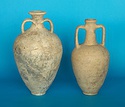
| Marcie Handler ... A deposit of six amphorae and one micaceous water jar was excavated between 20 June and 6 July 2005 in the area north of Wall K. The neck and one handle of one of the amphorae (BZ 1213) had been poking ... Ca. 1st c. A.D ... Along with the one whole amphora (BZ 1213), two mended amphorae (BZ 1262 & 1263) and the micaceous water jar (BZ 1264), there were also in-situ fragments of three other amphorae, but the necks, handles, and/or bases of these amphorae were missing and the vessels were therefore not mended (the fragments of these three amphorae can be found in the pottery tins).
NOTE: This deposit was first excavated 1-2 August 2001 as a "Late Roman layer with complete vessels" (elev. 53.040-53.370 masl, J/17,18-1/6,8). |
| Eugene Vanderpool ... Grave (adult female). (In some records as Grave XXXI).
The tomb was partly destroyed in antiquity; there are sherds of all periods down to Late Roman (and later) note din the fill immediately above it ... Middle Geometric I ... The tomb was partly destroyed in antiquity; there are sherds of all periods down to Late Roman (and later) note din the fill immediately above it. |
|
|