|
|
| North of House G (RSY=Pyre 13).
Concentration of artifacts, small pieces of bone, and burnt material in stratum, no pit discerned. The pyre is cut by the trench of a wall of a Roman house to north. It ... 290-250 B.C. |
| RSY Grave 51.
The grave lay on the slope of the Areopagus in Roman house O, just east of the line where the hillside is scarped for the foundation of the west wall of the house.
Cutting:the pit cut in ... Archaic period/6th or 7th c. |
Small pit north of Wall C (appr. 0.50 E-W x 0.35m N-S). Coins:
11 August 1994 #1125-#1127 ... 3rd c. B.C ... Small pit north of Wall C (appr. 0.50 E-W x 0.35m N-S). |
| Marcie Handler ... It was situated in the NW corner of Room 3 in the Classical Commercial Building, just S of Wall 11, the cross-wall that divides Room 3 from Room 4 to the north. The pyre pots were found surrounded by ... Late 4th c. B.C ... It was situated in the NW corner of Room 3 in the Classical Commercial Building, just S of Wall 11, the cross-wall that divides Room 3 from Room 4 to the north. ... The pyre deposit continued up to the north face of late Roman Wall C, suggesting that these lower courses of Wall C were packed into a narrow trench instead of built up within a wider foundation trench. |
Destruction debris in L.R. water basin, 6th-7th c. A.D, set against back wall of South Stoa II ... 6th c. or 7th c. A.D ... Destruction debris in L.R. water basin, 6th-7th c. A.D, set against back wall of South Stoa II. |
Well at 56/ΚΖ, just south of the south wall of the northern Late Roman Building ... Second half of 2nd c. - early 3rd c. A.D. |
| David Scahill ... Behind northeast corner of Classical Building; east wall C. Below Hellenistic levels and early Classical pit. Chamber cut through bedrock, depth ca. 0.90m., diameter ca. 2m., roughly square in shape, angling ... LH III A:1 ... Behind northeast corner of Classical Building; east wall C. Below Hellenistic levels and early Classical pit. ... Possible dromos cutting in northwest corner, running under wall C.
Loose fill of stones and earth filling tomb with large number of geometric sherds ranging early to late Geometric. ... At the floor of the tomb, bone fragments, broken pottery, two figurines and bronze implements along south wall. Pottery appears to be LH III A:1 with some possibly earlier. |
House C, Room 4 (Pottery dump of stamnos wall and fill below floor). Coins:
1 July 1947 #13
2 July 1947 #1
Coins from House IV:
14 May 1947 #1-#2
19 May 1947 #6-#7
20 May 1947 #32 ... First half 3rd c. B.C ... House C, Room 4 (Pottery dump of stamnos wall and fill below floor). |
Pit in House N, Room 2 (RSY, House C). Filling thrown in behind the west wall of the Great Drain South at the time of the building of the drain and the extension of House C.
Cf. Hesperia 20 (1951), pp ... Ca. 430-410 B.C ... Pit in House N, Room 2 (RSY, House C). Filling thrown in behind the west wall of the Great Drain South at the time of the building of the drain and the extension of House C.
|
Deposit at 42/ΙΕ beside rubble wall under modern cellar wall ... 5th c. B.C. |
| Pyre in House C, Room 12 (RSY=Pyre 9) in the industrial area west of the Areopagus.
Notebook refers to House N.
Beside west wall of room 12. Pottery, burnt bone, and cinders in a roughly round pit; disturbed ... Ca. 250 B.C ... Pyre in House C, Room 12 (RSY=Pyre 9) in the industrial area west of the Areopagus.
... Beside west wall of room 12. Pottery, burnt bone, and cinders in a roughly round pit; disturbed by Byzantine pit. |
Pocket behind heavy Roman retaining wall ... 4th c. B.C. |
N-S Cut on 20m. line (area of Road, area of Stoa, area N of Stoa)
various levels and dates over the three areas.
Investigations to the northwest of the market square in the area of the road that bordered ... Protogeometric to Late Roman ... B.C., with later (1st c. B.C.)
Layer VII: 4th c. ... Layer IV: 7th-3rd c. B.C.
Layer V: 8th-7th c. ... Plundered trench of early N-S wall: geometric to 4th c. |
Pocket in bedrock behind stepped retaining wall ... 7th c. B.C. |
| Kernos Pit #1 under Valerian Wall. P 30173-P 30174 added on May 7, 1973 ... 4th c. B.C. |
Geometric Well under Rubble Wall of Predecessor.
Classical pit above a Geometric well with a small amount of pottery from the late 6th to the middle of the 4th c. B.C. Estimated Grid ... Late 8th century B.C ... Geometric Well under Rubble Wall of Predecessor.
Classical pit above a Geometric well with a small amount of pottery from the late 6th to the middle of the 4th c. B.C. |
Dug as Tholos Trench V, Room E, burnt filling of plundered wall trench of S wall of court. See also lot Ζ 484 ... Late 6th c. B.C. |
| Anne McCabe ... Adjacent to the SW face of Byzantine Wall 14. The circular cutting, 0.90m in diameter, appeared at 53.504m under a layer of loose rubble (Lot 481). Wall of the well roughly built, consisting at the top ... 11-19 July 2006
24 June-21 July 2009 |
Wells at 24/ΙΓ at 26/ΙΑ near the SW corner of the market square, about 10m west of the Southwest Fountain House (the party wall between them broken through in antiquity).
Use filling middle to third quarter ... Ca. 550-525 B.C ... Wells at 24/ΙΓ at 26/ΙΑ near the SW corner of the market square, about 10m west of the Southwest Fountain House (the party wall between them broken through in antiquity).
Use filling middle to third quarter of 6th c. B.C., upper filling, 6th c. |
Ash and Carbon Dump in Corridor directly behind Room C of Brick Building.
This material comprises what appears to have been a household dump associated with the period of use of the Brick Building, but ... To mid-2nd century ... Ash and Carbon Dump in Corridor directly behind Room C of Brick Building.
... The dump is located in the corridor between the back wall of the Brick Building and the retaining wall behind the building , immediately east of the line of the dividing wall between Rooms B and C [City Grid: Q/18-11/2] |
Hephaisteion Garden; fill beside wall. Loose filling encountered in rescue excavation to examine wall found during construction of public toilet in Theseion Park, outside Agora area. SIR 1991
Originally ... Second half of 4th c. B.C. |
Clearing bedrock on line of early (Archaic) peribolos wall, east of entrance on the south side, west end. Uncatalogued material: 50 sherds, 83 fragments. of plemochoai.
Classical Ware : lekythos; plemochoai ... Early 2nd c. B.C. |
| Marcie Handler ... The Pyre was revealed in a layer of 4th c. fill in the north end of Room 6, just south of Wall 8. Room 6 is defined by the street wall (Wall A) on the west, Wall 7 on the east, Wall 9 on the south (preserved ... 4th c. B.C ... The Pyre was revealed in a layer of 4th c. fill in the north end of Room 6, just south of Wall 8. Room 6 is defined by the street wall (Wall A) on the west, Wall 7 on the east, Wall 9 on the south (preserved only as a stub on the east side of the area), and possibly Wall 8 or Wall 6 on the north.
2.5 meters SW of the pyre, a patch of floor surface at J/10-1/20 at 52.188 masl. was found. |
Material from trenches:
a) 1.00-7.00m. from East End of Stoa.
b) 18.40-21.40m. from East End of Stoa.
c) 46.60-48-60m. from East End of Stoa.
d) 51.00-53.00m. from East End of Stoa.
e) 79.00-81.00m. from ... 2nd c. B.C ... Material from trenches:
a) 1.00-7.00m. from East End of Stoa.
b) 18.40-21.40m. from East End of Stoa.
c) 46.60-48-60m. from East End of Stoa.
d) 51.00-53.00m. from East End of Stoa.
e) 79.00-81.00m. from East End of Stoa.
Includes drain trench in front of back wall of Stoa (some disturbed, some undisturbed fill), soft fill above stone drain, fill from within stone drain, channel behind stylobate. |
Investigations in the Hellenistic Metroon, various levels. Stoa Pits A, B, C, D, E, F, H and I (various layers).
Locations include:
SW corner of Primitive Bouleuterion; from contemporary filling alongside ... 8th-6th c. B.C ... Stoa Pits A, B, C, D, E, F, H and I (various layers).
... Levels include:
- 8th and 7th c. B.C.
- early 6th c. B.C. with much earlier material
- early to middle 6th c. B.C.
- first quarter of 6th c. |
Small pocket between the tumbled wall of large conglomerate blocks and Drain 2 ... 4th c. B.C. |
Investigations within the Stoa of Zeus, the north part, various levels.
Notebook references: Stoa Trench E Layers IV and V, Stoa Pits A, B and C, and Layers I and II of area between back wall and retaining ... 5th c. B.C ... Notebook references: Stoa Trench E Layers IV and V, Stoa Pits A, B and C, and Layers I and II of area between back wall and retaining wall of Stoa. ... Subdivisions: (from the deepest layers to the top):
.1=a) (Pre-)Persian
.2=b) Post-Persian Pre-Stoa
.3=c) Stoa and Stoa Annex filling |
Filling in the footing trench of the late Roman Fortification.
Includes Layer 1 and Layer 2 of Library Colonnade opposite Room 2. "Note: both these layers are fill thrown into V.W. footing trench." (nb.p ... End 3rd. c. A.D. |
Well at 19/ΛΓ.
The cistern S 19:3 and the well S 19:8, together with a Roman well, S 19:1, had collapsed to form a large pit S 19:5.
Top to -8.5m: Byzantine dump to 11-12th c. A.D.
-8.50m to -15.00m: 4th ... Mid 3rd century A.D ... Top to -8.5m: Byzantine dump to 11-12th c. A.D.
-8.50m to -15.00m: 4th c. B.C. fill from adjacent well, fallen in when tiles of this well removed and bedrock wall between two wells collapsed.
-15.00m to -17.00m: Fill of broken well tiles, bedrock and some pottery, none catalogued.
-17.00m to -17.30m: Original POU-Mid 3rd c., parallels to Group K. |
Well in front of Shop 15: Turkish (in line of Valerian Wall) Opened the well again in 1951, without realizing that it was finished. Found nothing in it. (p. 1468) ... 15th-16th c. A.D. |
Filling over and behind blocks of E. wall of Great Drain at 10-15/Α-Γ. Coins:
10 May 1954 #1-#2 ... 3rd c. B.C. |
| A well at the northeast corner of Classical Building, behind back wall. Dumped fill appears to have occurred as a single event as there are joining sherds throughout.
POU date ca. first half 5th c. B.C.; ... 5th c. B.C ... A well at the northeast corner of Classical Building, behind back wall. Dumped fill appears to have occurred as a single event as there are joining sherds throughout.
POU date ca. first half 5th c. B.C.; pottery in fill spans ca. last quarter 6th c.-430 B.C.; out of use ca. 430 B.C ... Pottery primarily of the mid 5th c. with the latest sherds dating to just before the last quarter of the century. |
| David Scahill ... Burial in Geometric well (J 3:8), in Classical Building II, Room I, next to south ashlar wall. "No grave goods!"
ADDENDA: J. Papadopoulos later associated P 34449 and P 34450 to that grave. (Cf. Agora ... Geometric ... Burial in Geometric well (J 3:8), in Classical Building II, Room I, next to south ashlar wall ... AA 362 a, b, c |
Firm fill over bedrock on east edge of section, north of the early (Archaic) peribolos wall. Uncatalogued material: 10 sherds, 30 fragments of plemochoai. Deposit created by Margie Miles, 4 inventoried ... 3rd quarter 4th c. B.C. |
Pit in Tholos Trench V (below Layer e).
In plan it would seem to have been oval, though its east end is c/../ by the south wall of the North Archaic Home. Its N-S width is 1.25m, its E-W length is 1.40m ... 7th-early 6th c. B.C ... In plan it would seem to have been oval, though its east end is c/../ by the south wall of the North Archaic Home. |
A shallow tiled well or reservoir set inside the South Stoa against its back wall. Its location in relation to the wall of the Stoa, and the fact that a lead pipe set through the latest floor of the Stoa ... 5th - 6th c. A.D. |
Red sandy earth at inner corner of heavy late wall at 12/ΛΖ.
A. Walker coin deposit. Coins:
27 March 1934 #1-#12
28 March 1934 #1-#2 ... 2nd-3rd c. A.D. |
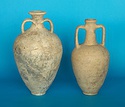
| Marcie Handler ... A deposit of six amphorae and one micaceous water jar was excavated between 20 June and 6 July 2005 in the area north of Wall K. The neck and one handle of one of the amphorae (BZ 1213) had been poking ... Ca. 1st c. A.D ... A deposit of six amphorae and one micaceous water jar was excavated between 20 June and 6 July 2005 in the area north of Wall K. The neck and one handle of one of the amphorae (BZ 1213) had been poking out of the surrounding fill since the end of the 2001 season. ... The second layer of fill (lot 1541) excavated around the amphora dated to the early Roman period (c. 1st century A.D.), and after we removed this layer of fill we revealed the outlines of five more amphorae and one micaceous water jar. |
The data in the Deposit Notebook is presented by trench; an attempt is made here to accumulate data from similar layers across the trenches. Subdivisions:
.1=Post Hadrianic cleanup
.2=Marble working waste ... 2nd c. B.C.-3rd c. A.D. |
Fill against back wall foundations of Royal Stoa I/6,9-4/8,14. Dug separately, these many fills contain material which joined horizontally and vertically all along back wall of Royal Stoa. Fill seems to ... 2nd/3rd quarters of 5th c.-420s |
|
|