|
|
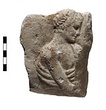
| Preserved is but a small bit of the wall, with the head and upper body of a beardless man to right. He wears an himation leaving his right arm and shoulder bare.
Pentelic marble. Marbles from fifth cut ... 1 April 1936 |
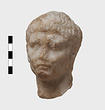
| Broken off at the root of the neck, nose and chin damaged.
A Julio-Claudian portrait of a man, summary but effective.
Pentelic marble.
Drilled for setting on base June 1950. Finished From pit in floor ... Julio-Claudian period. |
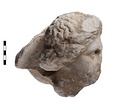
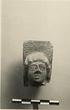
| Broken from a relief, probably from a grave stele; the head and part of the background surface only preserved. Nose and chin broken.
The woman faces to her left. Her hair, worn in a low knot, is sketchily ... 1 April 1936 |
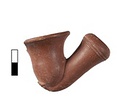
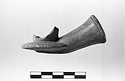
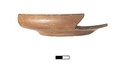
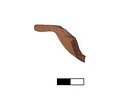
| Two pieces broken from rim.
It is of lily type (bowl blends imperceptibly into rim; acute angle between stem socket and bowl axis), with reinforced toe, long flaring stem socket.
On front of bowl, an ... 31 March 1936 |
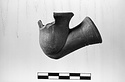
| Rim broken away, base chipped.
It has a bowl condensed to a disk; flat square foot; flaring cup-like rim now mostly missing, flaring stem socket wiht large hole.
Orange clay, uneven red slip. Catalogued ... 17, 31 March 1936 |
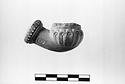
| Three-fourths of rim broken away.
It is of lily type with heavy, angular keel; smooth bowl merging into flaring heavy lip; flaring stem socket with two bands of rouletting partially encircling it.
Orange ... 17, 31 March 1936 |
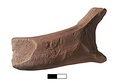
| Rim broken away.
Round with keel bottom, petalled base, smooth stem and socket with moulded and stamped ornament at stem end and with a seal on right side. Suggested reading of seal (by N. Stavroulakis) ... 1 April 1936 |
| A circular stamp; bust of a Byzantine emperor, with round disk (sun?) at his right, and triple-branched sceptre at left; traces of letters at his left.
Cf. SS 9085, SS 9434, SS 9235. Par: SS 09085, SS ... 2 April 1936 |
| early hdl
Burning torch; star.
Early Thasian.
Cf. Pridik (1917), p. 53, no. 384, pl. VI, 24. Par: Pridik 1917, Pl 6, 24, text p53, nr 384* Finished Below surface. Θάσιον
burning torch
Πυλά(δης) star Leica ... 31 March 1936 |
| Head and forepaw of lion. Late fill. Ἀριστοκλεῦς
head and forepaw of lion
(in O framed) Leica ... 2 April 1936 |
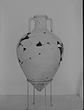
| Plain amphora; tip and many wall fragments missing; plump body, short neck, massive down-turned lip.
Buff clay, yellow on surface; slightly micaceous.
Stamp on one handle.
Naxian(?). Dim: WxTh of stp ... 31 March-2 April 1936 |
| A woman 's face.
Early gouged technique. Traces of white paint and of red at the mouth. In modern filling. Leica ... 1 April 1936 |
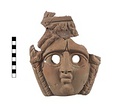
| Tragic mask.
Many edge fragments missing. Two fragments from the hair do not join.
Eyes and nostrils pierced. Small hole to left of chin: string hole (?).
Traces of red paint in the hair.
Pink clay.
Cf ... 1 April 1936 |
| Head, fragments from the body, the left arm from the elbow, the right hand, the left upper leg and foot, and the right lower leg missing.
The lower left leg does not join.
The weight on the left leg, the ... 1 April 1936 |
| One edge preserved; elsewhere broken all around.
Perhaps part of a seated female figure in a plain chiton (?)
Coarse light red clay. 3.05m. to 3.30m.below surface 3.05m. to 3.30m.below surface. Found with ... 31 March 1936 |
| Broken behind and at neck; the top of the cap missing.
A fringe of hair across the forehead; then a pointed cap.
Traces of red and white paint. Disturbed late Roman fill. Leica ... 31 March 1936 |
| Broken away at neck. Otherwise intact.
Head with high headdress, decorated with herringbone pattern.
ADDENDA: Same mold as T 819 and T 1532. Late Roman fill under cesspool. Leica ... 1 April 1936 |
| Broken at neck behind and above eyes.
A fat-faced person.
Abundant traces of white and a few of the red laid over it. Late Roman fill. Leica ... 2 April 1936 |
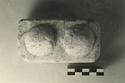
| Mastoid weight.
Two bosses joined by a bar which has been broken away.
Pentelic marble. Leica ... 31 March 1936 |
| Single base fragment with added foot (half broken off).
Body form as P 33057; foot flaring, with thick tilted base, faintly grooved on outer edge. Interior neatly wet-smoothed.
Yellow, with light brown ... 1-25 April 1936 |
| Base fragment of a small closed vessel (jug?).
Terra Sigillata Africana A/C: thin-walled, clean-breaking, with glossy red slip on outside.
Early to mid 3rd century. Added 15 February 2006. Finished Well, ... April 1936 |
| Three joining pieces (two of rim and one of base), giving part of one side.
Shallow tilted floor, low upcurved rim above a slight external angle, tapered foot with sloping outer face. Interior smooth, ... April 1936 |
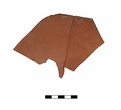
| SIngle rim fragment.
Ware as 4th c. dishes (Form 59), with semi-polished slip on interior and rim.
Date of context: late 4th-early 5th c. A.D. Added 6 February 2006. Finished Dumped fill in front of Stoa ... 31 March 1936 |
| Base fragment. Mended from two fragments.
Groove on bottom, set well in from edge. Smooth slip, as that on Form 62.3.
Date of context: late 4th c. A.D. Added 6 February 2006. Finished Dumped fill in ... 31 March 1936 |
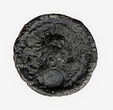
| A: head of Helios, right.
In field, lower right, a star; lower left indeterminate object. Border of dots. Small countermark at bottom, illegible.
B: plain. Entered as coin no. 7, for the day. Modern fill ... 31 March 1936 |
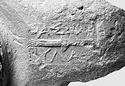
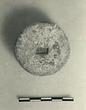
| Cylindrical.
Impressed in top, a small rectangular stamp, with the letters: Δ.Α.Σ. (δημου Αθηναιων σταθμος).
Cf. IL 349 and IL 4. Modern filling. Leica ... 2 April 1936 |
| Flat, nearly square.
In relief on the upper side, the top part of an amphora. Letters below : T and H. Hellenistic fill. Leica ... 1 April 1936 |
| From a figurine lamp.
foot with phallus nozzle.
Poor red glaze. Roman Cellar. Layer 4. Leica, LXIX-23 ... 31 March 1936 |
| Foot, handles and part of wall missing. Deep bowl with horizontal keel at mid-height and flaring rim. Horizontal handle on either side with a hole pierced through keel on each side of handle.
Pale yellow ... 31 March-2 April 1936 |
| Mended from many fragments. Restored in plaster. Flat nicked base. Squat body, cylindrical neck, flat flaring lip. Two strap handles set close together.
Pale yellow clay with three matte brown stripes ... 31 March-2 April 1936 |
| Massive sharply-profiled foot.
Scratched in the underside while clay still soft:
Cf. Stamped similar toes: SS 9463, SS 9637. Surface to 3.80m.
Previously North Basement-Jar Fragments, Block IV (4th ... 31 March-2 April 1936 |
| From a heavy-walled Western Sigillata bowl with lightly profiled base ring.
On the floor, in a foot-shaped stamp:
Graffito on underside: Φ Κ At 1.30-2.00m. below top of railroad wall. Below top of railroad ... 31 March 1936 |
| Wall fragment broken all around. From a heavy-walled Western Sigillata bowl with flaring lip (broken off). Beneath the lip, a band of large ovules, and on the wall below, a dolphin and an amphora. At 1.30-2.00m ... 31 March 1936 |
| Fragment of floor and base ring. Very low base ring; side wall broken away close down.
On floor, in foot-shaped stamp:
Graffito on underside:
Arretine Ware. At 1.30-2.00m. below top of railroad wall ... 31 March 1936 |
| Neck, handles, and base missing. From base: long round-ended petals; then, on upper body, eight rows of stamped maeander sections. On shoulder, round-ended petals, reversed, below a small cable.
Good ... 1 April 1936 |
| Part of a cover tile; one edge preserved. Streaky brownish-red glaze outside.
Incised through the glaze (number 75): Pit in bedrock, 5th. c. Leica ... 2 April 1936 |
| Small oinochoe, shape 8. Double handle split at the rim attachment, missing. Squat body with low ring foot and concave flaring lip. On body, vertical grooves; around base of lip, moulded cable. Under handle, ... 2 April 1936 |
| Flat circular lid with knob handle. Edge chipped. Black glaze on upper surface and stem of knob. Knob reserved, with band around its upper edge. Pit in bedrock, 5th. c. Leica, 83-251 ... 2 April 1936 |
| One handle, part of the other, and a fragment from the rim missing. Projecting ring foot, neatly profiled. Convex body with offset handle zone; above handle zone, an inset straight rim, to take a lid ... 2 April 1936 |
| Fragments of base, wall and rim missing. Restored in plaster. Low ring foot and horizontal handles applied to rim, which is flat on top. Outside, bands. Inside the foot, beneath, a ring and an eight-armed ... 1 April 1936 |
|
|