|
|
One handle and part of foot and rim restored.
Scraped groove in resting surface; concave underside with nipple.
Ivy-leaf thumb rests. Squat proportions, with lower body higher than upper body. Ivy garland ... Ca. 325 |
Both handles and much of wall and rim missing.
Spreading ring foot, lipped. Reserved: underside with band, circle and dot. Decoration inside: zone of enclosed circles, zone of linked palmettes, pattern ... Ca. 425 B.C. |
Mended with missing pieces restored in plaster and painted, notably sections of the lower part of the body. Glaze abraded around handle B/A. H. 0.563; rest. diam. 0.415. T. L. Shear, Hesperia 7, 1938, ... Ca. 440-430 B.C. |
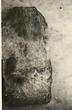
| Inscribed fragment of stele (?).
Broken at top and sides; back rough picked.
On the face, along the lower edge an unfinished band, projects about 0.02m. from the finished surface.
Pentelic marble. Catalogued ... 1931 |
Foot and handles restored.
Scraped groove below handle attachments. Delicate molded rim.
Three dolphins (antithetical pair at right, one leaping right at left) over pattern of alternating hoops and ... 290-280 |
Most of foot and floor with part of wall.
Moulded ring foot; raised rings on underside. Reserved: the space within the innermost ring, with two circles and dot. Groove above junction of wall and foot ... Ca. 430 B.C. |
Kylix base with black glaze. Broken at edge and most of name is broken off. Oscar Broneer, Nb. No. 4. 178 88-399 ... 31 May 1937 |
Half of one handle missing.
Plain resting surface with outer edge scraped or worn; concave underside; no groove between moldings of foot. Top of handle nearly horizontal. Rouletting on floor. Shiny black ... 350-335 ... Plain resting surface with outer edge scraped or worn; concave underside; no groove between moldings of foot. ... P 12690 (Agora XII, no. 661, p. 283, fig. 7, pl. 28), with taller upper body, comes from same deposit.
Cf. BCH 102, 1978, p. 646, fig. 20; slightly advanced over Olynthus V, no. 513, p. 186, pl. 149 and Olynthus XIII, no. 504, p. 286, pls. 183, 187. |
|
|