|
|
| Section Ν 1937 ... R.H. Howland ... Report on the excavation in the northern end of Section Ν, which started at Byzantine level and went down to the first classical level. A strip of the Byzantine and Vandal road was the largest area exposed ... 25 Jan-30 Mar 1937 ... Report on the excavation in the northern end of Section Ν, which started at Byzantine level and went down to the first classical level. A strip of the Byzantine and Vandal road was the largest area exposed. A late room with a trough was excavated, and a wall complex related to the Odeion, examined. Classical strosis in various places were cleared. |
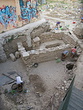
| Agora Excavations 1995 Preliminary Report ... John McK. Camp II ... Excavations continued in the areas of the Panathenaic Way, west of the Stoa Poikile, and in and around the Classical commercial building north of the Stoa Poikile.
In the Panathenaic way the exploration ... 12 Jun-4 Aug 1995 ... Excavations continued in the areas of the Panathenaic Way, west of the Stoa Poikile, and in and around the Classical commercial building north of the Stoa Poikile.
In the Panathenaic way the exploration of the Classical levels continued. ... The exploration of the levels overlying the Classical commercial building continued and more of the walls of the third room from the south were found along with a cement lined basin. |
| Agora Excavation Summary 1966 ... Gerald Lalonde ... Excavation was carried out beneath the modern road south of the Theseion and the Southwest Fountain House. The purpose was to investigate the coarse of the roadway and its adjacent monuments at successive ... 4 Jul-2 Sep 1966 ... The purpose was to investigate the coarse of the roadway and its adjacent monuments at successive levels of use from Turkish time back to the Classical Greek period. |
| Section Ω 1969 ... John McK. Camp II ... Excavations were carried out in the Late Roman complex known as Philosophical School C, and in House D, a private house of the 5th c. B.C. which underlies the north half of the school. A second house of ... 8 Jul-23 Aug 1969 ... A second house of the Classical period was discovered, but only a slight digging was carried out. |
| Agora Excavations
Season Summary 2015 ... John McK. Camp II ... Excavations were carried out in three areas: in Byzantine levels over the Painted Stoa in Section ΒΘ; at the north end and beneath the Classical Commercial Building in Section ΒΖ; and in Section ΟΟ in ... 8 Jun-31 Jul 2015 ... Excavations were carried out in three areas: in Byzantine levels over the Painted Stoa in Section ΒΘ; at the north end and beneath the Classical Commercial Building in Section ΒΖ; and in Section ΟΟ in the old excavations. |
| Agora 2016 - Summary Report ... John McK. Camp II ... Excavations were carried out in the northwest corner of the agora square in Sections ΒΘ and ΒΖ in and around the classical building identified as the Painted (Poikile) Stoa, and in the southwest corner ... 13 Jun-5 Aug 2016 ... Excavations were carried out in the northwest corner of the agora square in Sections ΒΘ and ΒΖ in and around the classical building identified as the Painted (Poikile) Stoa, and in the southwest corner in Section ΟΟ just north of the area known as the industrial district, with recovered material dating from the 8th century B.C. to the 12th c. |
| Excavation Report 1958 ... Dorothy Burr Thompson ... This report covers the excavations in the southwestern side of Section Φ and in the area under Aischanes Street. The section had been excavated down to the Classical level in the previous season. Part ... 12 Mar-15 May 1958 ... The section had been excavated down to the Classical level in the previous season. |
| 1996 Excavation Summary ... John McK. Camp II ... Excavations were carried out in two areas: in early levels underneath the west end of the Middle Stoa, and in and around the Classical commercial building north of the Stoa Poikile. The result of the 1996 ... 10 Jun-2 Aug 1996 ... Excavations were carried out in two areas: in early levels underneath the west end of the Middle Stoa, and in and around the Classical commercial building north of the Stoa Poikile. |
|
|