|
|
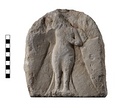
| The back, irregular, worn as if with later use, may preserve the approximate original thickness. The bottom is dressed with the toothed chisel; the sides and rounded top coarsely rough-picked.
The surface ... 11 March 1933 |
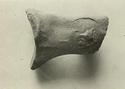
| Shape like that of the stocky Knidian handles.
Coarse red clay grey at core; the top surface of the handle darkened with a matt substance, except for the stamp.
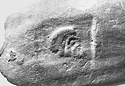
The surface of the impression (where preserved) ... 10 March 1933 |
| Typical handle; part of rim preserved.
Circular impression of which one-third of the circumference is broken away, another lost in the incompleteness of setting, the rtest neat and fresh; retrograde; ... 1st century B.C. |
| Angular handle; part of rather thin rolled rim preserved.
Light reddish-buff clay.
Impression shallow below; original,ly sharp (though doubled) but worn down middle.
Cf. Nilsson (1909), no. 229; fourteen ... 10 March 1933 |
| Broad handle with small upper part preserved and nearly all of lower part.
Micaceous red clay, buff at core and surface. Down the side a straggling line of brown glaze with curious brush strokes.
Shallow ... 10 March 1933 |
| Arched, rather thick handle.
Micaceous fairly fine clay, pinkish-buff, yellowish at surface; smutted.
Impression on down curve; partly incomplete, and outer end broken away.
Cf. Pridik (1917), p. 37, ... 11 March 1933 |
| Knidian type; large fragment, preserving almost all of lower part of handle but not upper attachment.
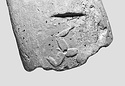
Narrow rectangular impression, slightly chipped to the left, incomplete to the right.
Early Knidian ... 11 March 1933 |
| Handle broken off, otherwise complete and typical, with a large "A" in relief on the reverse.
Purplish wash.
Pinkish-buff clay.
Type XX of Corinth collection. In mixed classical fill. Leica ... 10 March 1933 |
|
|