|
|
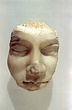
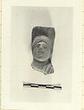
| The face, about life-size, is preserved, the chin missing and the cheeks broken away.
The top of the head has its original surface, a smooth-finished one across its front, with rough-picked surface behind ... 18 June 1935 |
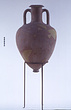
| High hollow with concave sides.
Unglazed. Cistern.
Mid 4 th c. B.C. Leica, 90-10-16 (14,17), 90-10-19 (18,20) ... 21 June 1935 |
| Handle almost complete; fairly long curve.
The fabric somewhat resembling Knidian.
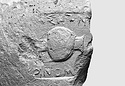
Stamped on the curve. The herm well stamped, bearded, on its side with head to right; the thyrsos with ribbon tied around ... 18 June 1935 |
| Whole jar, missing wall fragments;broad flat outwards projecting rim; no groove, ring foot.
Capacity (wheat, revised by VG 1939) 45.250
Pinkish-buff clay, slipped; light gray core.
Finger depression ... 2nd quarter-3rd quarter of 4th century B.C. |
| Rectangular stamp; hydria. Finished Late fill. Θασίων
vaseVI
Κ̣ρινομ[ένης] Leica ... 19 June 1935 |
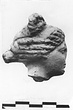
| Woman 's head broken off at neck.
Hair brushed back in large locks to a small sharply projecting knot. An elaborate construction (wreath, or curls ?) on the top of the head.
Traces of red paint on hair ... 18 June 1935 |
| Broken at the top.
In low relief a nude male youth left climbing up a rocky scrap holding him in his left hand a hydria. A corner of a cloak over his shoulder hangs down.
Head and shoulders missing ... 21 June 1935 |
| End of nose broken.
The figure wears high rectangular headdress, with vertical bands of herring-bone pattern.
Faint traces of red paint in eyes and around edge of hair.
Yellow red clay.
Late Roman.
ADDENDA: ... 19 June 1935 |
|
|