|
|
Cistern in valley west of the Areopagus. Dumped filling of late 1st. to early 2nd. c. and of 5th to 6th century. Coins:
7 June 1939 #12
8 June 1939 #18-#19
9 June 1936 #26 ... 1st.-2nd. c. A.D. |
Early cutting beside Great Drain: 103-111/Λ-ΛΓ (= "Deep cutting" Pit at 107/ΛΑ).
Abandonment filling in channel for early drain; the fragment of a red figured bell krater, P 17000, probably to be dated ... Ca. 425-395 B.C. |
| (RSY=Pyre 2). Pyre in the industrial area west of the Areopagus, in House B. In northern corner of room. No pit discerned. A deposit of small stones (a marker/) lay 0.30m above the level of the pyre, ... Third quarter of the 4th. century. |
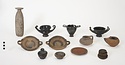
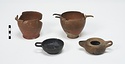
| A compact group of four complete vases and a lamp, found on a house floor; possibly the remains of a sacrificial pyre but without evidence of burning or the characteristic votive vases.
Layer II, "nest ... 425-400 B.C. |
E.L. Smithson: Group H: Collapsed well west of the Great Drain.
First described as 105-107/Protogeometric Pit ... Protogeometric |
Fills from construction and reconstruction of a house. "Brown House" = House A (RSY Hesp. 20) (and pit under Layer 4) in the industrial area west of the Areopagus.
Under the original floor of this house ... Second half of the 5th. c. B.C. |
Scanty debris filling in a pit. The wishbone-handled bowl (P 16753) is of the middle of the third quarter of the 5th. c. century, as are also two red figured fragments, P 25820 and P 25821; the deposit ... Ca. 450-400 B.C. |
Grave (?) under wall 4. Infant burial(?); a kados, P 16747, lying sideways with a tall cylindrical stand, P 16748, set over it as a cover; the upper parts of the pots cut away ... Late 6th. c. B.C. |
|
|