|
|
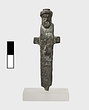
Ostrakon deposit, sand fill in a shallow channel in bedrock at the bottom of the Great Drain in the valley between the Areopagus and the Hill of Nymphs.
This group of ostraka may well come from a single ... Ca. 490-480 B.C. |
| Complete.
Bearded head with low polos-like cap.
Herm ends below in a spike.
Cf. Hesperia 90 (2021), p. 399, n. 112. Μικροσκοπική χάλκινη Ερμαϊκή στήλη. Σχεδόν ακέραια. Great Drain, sand fill; dump. Stoa ... 12 August 1947 |
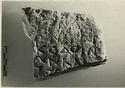
| Broken into five pieces and very fragmentary.
Inscribed. From the "dump". Store in ziplock polyethylene bag and in area with 40% r.h. or lower.
Wear cotton or latex gloves when handling. Do not bang around ... 25 October 1947 |
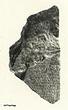
| Inscribed fragment.
Inscribed face only preserved, a thin sliver.
Five lines of the inscription preserved.
The marble heavily veined with quartzy grayish-green.
Pentelic marble. Found in Hellenistic context ... 8 June 1939 |
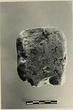
| Inscribed boundary stone.
Rectangular slab, broken off at top and bottom; roughly finished.
The inscription on the upper part of the front face; the beginning broken off.
Limestone. Found in water channel ... 13 October 1947 |
| Inscribed fragment.
Part of back preserved; roughly tooled.
Five lines of the inscription preserved, trace of sixth above.
Hymettian marble. Found in mixed Byzantine and late context north of the Roman ... 26 May 1939 |
| Inscribed fragment.
Broken above, below and at left.
Back surface very rough picked; right side worked smooth with tooth chisel. Only relatively small triangular area of inscribed surface reserved.
Non-stoichedon ... 29 November 1970 |
| Inscribed fragment.
Part of the top preserved, and perhaps part of the right side.
Four lines of the inscription preserved; stoichedon.
Space between lines, two including: 0.027m.
Space between letters, ... 6-11 February 1939 |
|
|