|
|
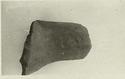
| Bit of rim preserved. Broad; level; broken before curve.
Coarse red clay, greyish at core. Traces of light slip(?).
Right end of the impression broken away; obliquely but neatly set; sharp. Original ... 12 March 1932 |
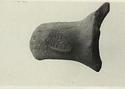
| Small, rises slightly; curves near body.
Coarse red clay; light slip.
Impression set obliquely; curving edges due to shallow setting. Ἐπὶ Ε[ὐ]
βούλ[ο(υ) Κ]
νίδιο(
(Β retr, Ε lunate) Leica ... Byzantine |
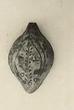
| Rather small, broad; broken before curve.
Coarse red clay, brownish at core; light slip.
Impression very shallow; possibly incomplete right end; large letters.
Late Knidian. Rdg: the pretty distinct ... 23 April 1932 |
| Broad in section; short upper arm rising slightly from attachment.
Hard red clay coarse grained; light slip.
Impression a leaf, without frame; no letters.
Late Knidian.
Cf. Dumont (1872), p. 380, no ... 29 February 1932 |
| On rim, herringbone, with two stamped circles at nozzle.
Discus, plain, with circular groove surrounding it; one central and four auxiliary oil holes. Air hole in the circular groove, between nozzle and ... 23 February 1932 |
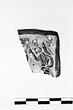
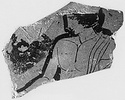
| Top and right edge preserved, bordered with band of dull purplish-brown glaze. Suspension hole just inside this band at upper right hand corner. Within, at right, Hermes, facing left, broken at the hips ... 10 March 1932 |
| Beneath a plain black glazed area is a reserved space in which are painted two draped figures, facing left. The figures are at the edges of the small fragment so that only the right side of one, and the ... 10 March 1932 |
| The fragment is from near the edge of the lid; the vertical flange which fitted into the box, and the projecting horizontal flange, have broken away but can be traced. The surface of the fragment is very ... 10 March 1932 |
|
|