|
|
Rectangular version, to take portable oven, as 2027.
A rim fragment from a rectangular eschara in Aegina, Aegina Museum, preserves part of a low narrow spit-rest and, on the rim, written in the wet clay, ... Context ca. 420-390 B.C ... A rim fragment from a rectangular eschara in Aegina, Aegina Museum, preserves part of a low narrow spit-rest and, on the rim, written in the wet clay, the letters ΕΨΡΠ. |
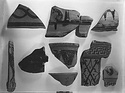
| Fragment from an openwork stand.
Step pattern above and bird's head and neck right.
Cf. fragment in the Aegina museum.
Subgeometric style. Geometric area outside house; from surface filling. Leica, 3-57, ... 1 April 1932 ... Cf. fragment in the Aegina museum.
Subgeometric style. |
Apparently complete.
Some kind of symbol or perhaps a ligature involving the letters alpha and delta: cf. two 6th c. B.C. ligatures of these letters from the precinct of Aphaia on Aigina, A. Furtwangler, ... Furtwangler, Aegina, Das Heilihtum der Aphaia, Munich, 1906, p. 466, nos. 367, 368. |
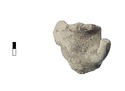
| Single fragment preserving small portion of shoulder, neck and lower handle of closed vessel.
Handmade. Shoulder curving in; vertical neck; vertical handle, circular in section, attached to upper shoulder ... 16 July 1973 ... Light-colored clay characteristic of Aegina, fired close to very pale brown 10 YR 8/4-7/4.
|
|
|