[Agora Deposit] F 15:4: Well

Well just outside the southwest corner of the market square ... Late 7th-early 6th c. B.C.

[Agora Deposit] F 5:3: Pit

Pit on north slope of Kolonos Agoraios. Traces of burning in the dirt fill; mixed in with this many fragments of fine pottery ... Ca. 450-420 B.C ... Hesperia 4 (1935), p. 238 ... Agora IV, p. 238 ... Agora XII, p. 389.

icon

[Agora Deposit] F 19:4: Well

This filling is the largest deposit of its time found in the Agora. It may be compared with H 6:5 and with N 7:3. Dug in soft bedrock to a depth of 11.40m; footholds cut on opposite sides of the shaft ... Ca. 490-450 B.C.

[Agora Deposit] H 4:5: Pit

Pit in shop I of Roman Stoa, 2.50m. behind the Royal Stoa. Most of the pottery dates to the third quarter of the 5th c. B.C. Many of the vessels were marked with a ligature, indicating that this was the ... 3rd quarter 5th c. B.C.
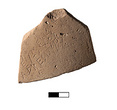

[Agora Deposit] F 13:2: Well 7

Dump, 4th c. Cut through a cistern which was probably constructed in the 4th c. B.C, near the southwest corner of the market square. Coins: 25 May 1935 #1 (with L 1809) (disintegrated) Subdivisions: .1=Upper ... Second half 1st c.-end 2nd c.

[Agora Deposit] F 13:3: Well 9

Well near southwest corner of market square; successive use fillings, and dumped filling. Lower use filling, second half of 4th century B.C. Main use filling, second quarter of 2nd century B.C. to shortly ... 10 April-31 May 1935

[Agora Deposit] F 5:1: Cistern

Evidence of stratification into five layers, although joins between the layers. Layer VI added when the construction of the Roman building above required it. No subdivisions assigned. Flask-shaped cistern ... Early 3rd-late 2nd c. B.C.

[Agora Deposit] E 15:6: Well F

A well (diameter 1.10m) at the east edge of the valley road leading from the SW corner of the Agora, about 90m SW of the Tholos. The mouth of the well was subsequently covered by the east wall of the Great ... Ca. 500-480 B.C.