|
|
| Sacrificial Pyre II, Classical Building II.
Found right beneath the stuccoed channel built for sluicing in the 1st c. A.D., and must have been partly disturbed when the channel was constructed. It may ... Ca. 250 B.C. |
Nbp. 3104: When dug, the fill of the well divided itself into 3 deposits.
Objects catalogued from the "earth" are: L 4838, P 21602, P 21603, P 21604. Dumped filling of Turkish times. Coins:
17 May 1937 ... Late 6th-7th c. A.D. |
Backfill of demolition of Great Monument beneath Middle Stoa.
[Soft pit below Layer II of south aisle (=fill of early "Great Drain")] ... Early 4th c. B.C. |
| David Scahill ... Below packed clay floors in Room 2 of Classical Building II; bordered on east and south sides by polygonal cross wall and back wall extension for Classical Building. Late Roman wall and drain installation ... LHIII A:1 |
N-S Cut on 50m. line (area of Road, area of Stoa, area N of Stoa) various levels and dates over the three areas.
Investigations to the northwest of the market square in the area of the road running out ... Prehistoric to Roman |
May be of Hellenistic origin when cistern system went out of use.
For a general note on the cistern see Nb. ΟΕ III, pp. 246 ff.
Objects from B 586 various depths (no subdivision): S 2324-S 2330,
P 34894, ... Late 2nd-early 6th c. A.D. |
Roman well, stratified.
Finds from the earth (not recorded in a subdivision):
P 7995, P 8036, P 21834, SS 6338, IL 483, IL 486, BI 309, BI 310,
BI 314.
According to the excavator the shaft had been cleaned ... 2nd-4th c. A.D. |
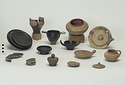
East of Classical Building II backwall, above Mycenaean chamber tomb K 2:5. Rough circular pit of reddish brown fill cut into geometric fill that extends down inside tomb. Some evidence of burning on pottery ... Ca. 460 B.C. |
| Pyre against north face of polygonal wall, Room 2, Classical Building II. No floor preserved above, but the pyre is below floor level 51.820masl, preserved just to the east and above patchy floor with ... Ca. 275-260 B.C. |
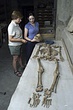
| Rodney S. Young ... Grave 20 (E.L. Smithson: Grave X: PG). Bones discarded. Pit tomb, inhumation (on bier or in coffin?), perhaps of a child. Little ash and carbon in the filling, but the grave offerings were unburned.
JP ... Developed Protogeometric |
| Sacrificial Pyre I, Classical Building II.
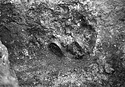
The pyre was set through the original floor level of the northern room of the Classical Building and apparently is the remainder of a ritual conducted when the ... Ca. 375-350 B.C. |
| David Scahill ... Burial in Geometric well (J 3:8), in Classical Building II, Room I, next to south ashlar wall. "No grave goods!"
ADDENDA: J. Papadopoulos later associated P 34449 and P 34450 to that grave. (Cf. Agora ... Geometric |
| David Scahill ... At northeast corner of Classical Building II; on south side of dromos of Tomb K 2:5, and separated from it by ca. 0.6m of bedrock. Chamber cut through bedrock. The northeast corner of chamber defined ... LHIII A:1 |
Crosscut between Middle stoa Piers 1 and 2 from west (south aisle), layer II.
Chiefly late 5th to mid-4th c. B.C. Coins:
2 July 1965 #1 ... Late 5th to mid-4th c. B.C. |
The data in the Deposit Notebook is presented by trench; an attempt is made here to accumulate data from similar layers across the trenches. Subdivisions:
.1=Post Hadrianic cleanup
.2=Marble working waste ... 2nd c. B.C.-3rd c. A.D. |
Accumulated fillings in the Bouleutrion Plateia beginning in late 5th c. B.C. and continuing into the 3rd c. A.D., reaching a depth of 0.20-0.30m. (Hesp. 6 (1937), p. 168. Subdivisions:
.1=Layer I
.2=Layer ... 5th c. B.C.-3rd c. A.D. |
| Rodney S. Young ... Grave 10 in notebook. No remains. Probably grave of a woman.
Only a small portion of the inhumation pit was preserved at the northeast edge of pit A, a large oval cutting of modern date dug for the construction ... Middle Geometric II |
Rodney S. Young ... Grave 1 in notebook. Slightly disturbed by the digging of Pit A.
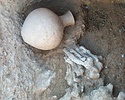
A large oil jar/amphora lay on its side with a flat stone stopping its mouth. The three small vases offered at the burial were found, together ... Ca. 600 B.C ... Agora VIII, p. 127 ... Agora XII, p. 391 ... Agora XXIII, p. 332. |
Well C - Passage, belongs with II - Brick Shaft. All dumped fills. No objects catalogued from Well C of section ΟΑ. One object (I 5422) catalogued from modern fill in shaft, one from dump (I 5545). Coins: ... 2nd c. A.D.- Byzantine |
Well at 67/ΛΓ on the northeast slope of the Areopagus. Connected with the same cistern system as O 20:2.
Dug as several fills but probably a continuous accumulation Coin
28 May 1938 #1 (?) Illegible N ... 300-250 B.C. |
|
|