|
|
Cistern in Room 12, House C=House N.
Simple flask-shaped chamber with draw shaft, in House M, Room 1; no tunnels. Excavated as single fill, but later analysis of material suggested two fills. Coins:
24 ... 4th. c. B.C. |
| Rodney S. Young ... Grave 4 in notebook. Amphora, no other pots but carbonized remains of food offerings. Over urn two stone slabs, on top, mass of small stones containing Late Geometric sherd ... Late Geometric |
Eugene Vanderpool ... Disturbed burial: Pocket in bedrock (Grave 11: PG). In some records as Grave XI. No remains. No cutting or traces of burning nearby
The coin listed here was found "cleaning bedrock", presumably at the ... Developed to Late Protogeometric |
| Geometric Burial. Burial B in notebook.
Overlay E 14:13. Skeleton lay on smoothed bedrock, head southward, arms folded on chest, hands below chin. Legs, cut off by later disturbance, probably bent, with ... Late Geometric |
Various layers and dates, primarily from Tholos Tr. L (area of early road drain), Q (area of road) and V (area of road).
Also Room G of Trench V listed with G-H 11-12 probably has road layers (no finds, ... 8th c.-ca. 480 B.C. |
| Hole in bedrock; dumped filling used in leveling.
Probably a natural water line, tending to wash out, has been cut back for various purposes, and finally all filled in to make level bedding for 4th c., ... Ca. 350-270 B.C. |
Lined with small stones.
Difference noted between the pottery from the top and that from the bottom. Coins:
11 April 1933 #13 (disintegrated)
12 April 1933 #1-#6 (disintegrated) (Coin no. 1. N 18194 found ... Turkish |
| Rodney S. Young ... Grave 13 in notebook.
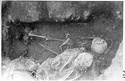
Two skeletons of small children lay in a pithos which had been put on its side; its mouth was stopped by a stone slab.
Most offerings were inside the pithos, but two kantharoi and ... Late Geometric |
| Sacrificial Pyre = Pit in floor (identified as pyre by SIR); with the characteristic small plates and saucers. "Saucer Grave" at 12/ΚΑ.
Dimensions: 2m (length)x 0.70 (width).
North of north wall of building ... First half 4th c. B.C. |
| Eugene Vanderpool ... Mycenaean Grave under Stoa Terrace, at original north end of Stoa; and PG vases on patches of stones over this burial, and to NE (formerly P 8:7). Cf. Q 8:13. No remains. In some records as Grave XLV ... 1 December 1953 |
| Rubbish Dump in mouth of abandoned well in Tholos Trench F, Kitchen. Filled with ash, charcoal, broken pottery, roof tiles.
Also from Trench L.
13 March 2014 by Ann Steiner
The deposit has four components ... Ca. 425-400 B.C. |
| Well in Room 6 of Street Stoa U/2,U/3-13/15.
Associated with the building lying under the Roman Street Stoa. Its fills divided into 5 separate layers, with the bulk of finds belonging to Layer 1, the ... 14 June-21 August 1973 |
| Pyre in House C, Room 12 (RSY=Pyre 9) in the industrial area west of the Areopagus.
Notebook refers to House N.
Beside west wall of room 12. Pottery, burnt bone, and cinders in a roughly round pit; disturbed ... Ca. 250 B.C. |
Grave in south peristyle of Hephaisteion. Grave LXI in notebook.
No mention of bones. Coins:
11 March 1939 #12-#14
13 March 1939 #4
14 March 1939 #2-#4 Neg. KK 393 ... 11-13 March 1939
18 March 1939 |
| Grave in west peristyle of Hephaisteion. Grave XXXIX in notebook.
No mention of bones. Coins:
7 March 1939 #12-#13
8 March 1939 #4-#5
10 March 1939 #3-#9 Neg. KK 367 ... 7-10 March 1939 |
Irregular depression in bedrock (ca. 7x5m), ca. 2m deep; area south of E-W Late Roman wall. Dumped filling apparently intended to level off the area. Coins:
11 March 1952 #10
12 March 1952 #1-#5
13 March ... Ca. 400-325 B.C. |
Dumped filling of 6th c. A.D. Coins:
3 May 1939 #1-2 (red earth above well)
9 June 1939 #1
10 June 1939 #1
12 June 1939 #1-#5
13 June 1939 #1
19 June 1939 #1-#2, #3 (Dump)
7 May 1940 #1
9 May 1940 #1
27 ... Early 1st-5th c. A.D. POU |
Accumulated debris on the west side of the market square.
Related layers added 1999/2000 (JWH), e.g. "Gravelly layer above burning", "Clearing Classical floor", "Lowest level above bedrock", "Below burning", ... First half of 5th c. A.D. |
| Margaret Crosby ... Grave 1 (Grave XXVI: EG) Urn cremation (trench-and-hole), adult male?
[JP]
Boots or Booties Grave. Near the west branch of the Great Drain, about 100m to the southwest of the Agora horos inscription ... Early Geometric I |
Great Drain: fillings in south part of section; Martyrs I, II and III, all layers (essentially no difference in the layers).
Pottery sorted and recorded by H.A. Thompson 12 may 1950: "Having gone through ... Second half of 2nd c. B.C.-Early 1st c. B.C. |
|
|