|
|
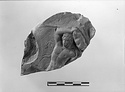
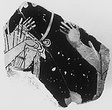
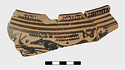
Wall fragment. Glaze slightly pitted on outside. Max. dim. 0.087.
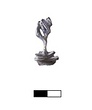
Barbiton-player (most of instrument except for tips of arms and crosspiece; hands, right forearm of player) to right. Also preserved is ... Probably late third quarter of the 5th century B.C. |
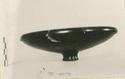
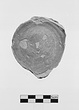
| Rather less than one-quarter preserved. Flat bottom, slightly concave, low wall; rim offset and in-sloping. At least two groups of concentric rings around center.
Fine brown micaceous clay, flaky; good ... 1-2 April 1938 ... Agora XXXII, no. 359, fig. 12. |
Part of wall restored.
Angular ring foot; beveled resting surface; slightly convex underside.
Mouth concave to inside, molded to outside; rim rounded on top. Shiny black glaze inside and on top of rim, ... 275-250? |
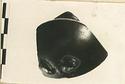
Floor fragment. Glaze pitted on outside. Max. dim. 0.039; est. diam. of tondo 0.10.
I, jumper(?). The fragment preserves the slightly raised head, a little of the back, and the start of both outstretched ... Ca. 510 B.C. |
Nodules.
Part of medallion and the lower wall preserved.
Medallion: Athena Parthenos facing (?) surrounded by small pointed leaves. Around a rather large scraped groove. About it are successive bands of ... 1934 |
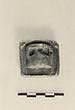
| Flat, nearly square.
In relief on the upper side, the top part of an amphora. Letters below : T and H. Hellenistic fill. Leica ... 1 April 1936 |
| Double convex body, upper part deeper than lower. Traces of pierced knob on left side. On top, two shallow, concentric grooves; edges of filling hole, broken away, probably rose a little.
Nozzle, pointed, ... 12 February 1932 ... Agora IV, no. 359, p. 81, pls. 12, 39. |
| Giant hurling rock.
First interpretation: youth figurine hurling rock.
Fragmentary relief. Broken on bottom and right side. The left arm and legs of the giant missing.
The top and back smooth but uneven; ... 1 March 1933 |
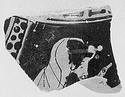
| Piece from upper left corner of panel; part of maeander above, dotted border at right. From a pelike. Panel depicts head of bearded man in profile to right; cloak drawn up over back of head. He wears a ... 16 May 1939 |
| From the body of a column krater?
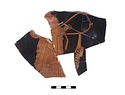
a) A bearded man wearing a chiton with overfold and an himation over his shoulders, moving right playing a lyre from which hang a leopard-skin flute case, a plektron ... 19-23 March 1936 |
| Inscribed fragments.
Fragment Ο 59 a), broken on all sides.
This inscription was probably stoichedon.
Fragment Ο 359 b), mended from two pieces; the fresh looking breaks along the left side appear to ... 5th. century B.C. |
| Wall fragment from krater. Concert scene: at the left, a lyre, and the player's hands and arms. At the right, part of the drapery and the outstretched hand of a listener. Relief contour for the lyre and ... 8 July 1947 |
| Fragment preserves two of three shell feet, part of floor and wall. Bit of West Slope decoration above (diminishing rectangles) set off by groove through glaze.
Black glaze; pink to buff clay.
For ... 17 April 1936 ... Hesperia 12 (1943), p. 359, fig. 60a ... Agora XXIX, no. 316, pl. 32. |
| Foot broken off; chips and a little of floor missing. Shallow bowl; heavily rolled rim undercut on the outside. Two scraped lines set off ring above foot. Small circle and dot at reserved top of foot cone ... May-June 1954 |
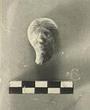
| Broken behind and at neck.
Hair parted at center and carried back in long strands.
White color for eyes, red for flesh. Late Roman fill between tongue walls. 272 Leica ... 27 February 1935 |
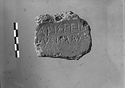
| Obverse: inscription.
Reverse: a man, probably animal-headed, seated right, holding up a branch.
In the field an inscription.
Black stone well polished and worn, chipped.
Deposit: cf. E 5:4 (?). Strosis ... 8 March 1937 |
| Typical shape.
Clay a bright tawny red with small grey core.
Fresh impression incomplete above and below.
Cf. Dumont (1872), no. 16, pl. VI. Par: Dumont 1871, Pl. VI, no. 16 (for attribute); and the ... 28 March 1933 |
| Fragments from upper part of inscribed stele with relief above.
Fragment Δ 75 a), broken all around save front and back.
The better preserved surface shows legs and feet apart of frontal figure standing ... 100-150 A.D. |
| Rim fragment of shallow dinos with portion of shoulder; broken at sides, glaze chipped and slightly pitted on exterior. Mended from three fragments.
Short vertical rim with flat top, slight ridge at lip ... Late 8th or early 7th c. B.C. |
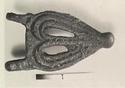
| Only plate preserved.
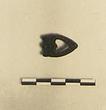
Heart-shaped buckle, ornamented with grooves. Three pierced projections on the under side for attachment.
Late Roman or Avar (?) Late Roman road fill, with coins for the day, nos ... 25 January 1938 |
| Two joining fragments of bowl, each with part of wall and cut design.
Floral design with stem and leaf ornaments. Two posts at right angles.
Wall of clear glass, now decayed with thick silvery weathering ... 14 May 1956 |
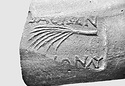
| An extremely coarse sherd, probably from a roof tile.
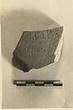
The letters scratched on the top:
Pinkish buff clay; slip on the top surface. No. 502. Rectangular rockcut shaft. Leica, 2-428, 3-167 PD 461, DA ... August-September 1932 ... Hesperia 15 (1946), no. 15 ... ILN (3 September 1932), p. 359 ... Agora XXV, no. 66, pp. 12, 39. |
| Several fragments of lower part of square bottle mended; 15 other fragments not mended.
Sides slightly indented. Out-turned wide rim. On bottom, molded pattern of a swastika enclosed within a triangle, ... 14 May 1956 |
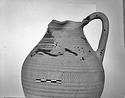
| Fragments of mouth missing, otherwise intact. Flat bottom; deep ovoid body; trefoil mouth; rising double-rolled handle.
On shoulder, three running dogs, right, pursuing a hare. Zigzag and double axe as ... 8 December 1953 ... Hesperia 30 (1961), pp. 129-130, no. N 12, pl. 15 ... Agora VIII, no. 84=359. |
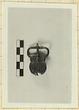
| Only plate preserved; broken projection.
Flat, shield-shaped buckle with center cut out. At flat end three pierced projections for attachment to belt. Road fill. Waterwashed fill over the Panathenaic way ... 13 April 1937 |
| Five fragments make up to three and give some of upper wall. Battle scene?
a) Falling figure with shield(?) at left, a tree, and rider at right, facing left.
b) Two riders, birds in field.
c) Tree, drapery(?) ... 9 May 1956 |
| A buckle with a loop and tongue attached by a hinge to another loop with two projections of attachment behind. Earth of trench 7, graves 11 and 12; presumably from grave 11. Leica, XLIII-100, 83-321, 83-641 ... 4 May 1934 |
| Wall fragment from a plain amphora.
Inscribed on the outside: Tholos Trench E, east end, between middle and late drain, layer IV. 1815 Leica, 7-342 ... 3 June 1937 ... Hesperia 21 (1952), p. 3, no. 6, pl. 1 ... Hesperia 7 (1938), p. 359, fig. 50 ... Agora XXV, no. 6, pp. 12-13, 32, fig. 1. |
| Outward flaring keeled lip. On upper face of lip, procession of geese, right. On outer face of lip, between purple bands, "running dog". On front neck panel, gorgon running right, pick-like object in right ... 23 February 1935 ... Agora:Object:AA (1933), p. 12, no. 3 ... ABV, p. 12, no. 26. (Manner of Gorgon P.) ... Agora XXIII, no. 141, pl. 18. |
| Badly corroded.
Shaped like a right angle triangle with the hypoteneuse slightly curved. Geometric grave. nestled in Ethafoam pad, 20% RH
08/88: stored in a plastic bag in a box in LAB
with gloves Leica, ... 13 March 1947 ... Hesperia 43 (1974), p. 359, pl. 76 d, no. ... ILN (12 November 1949), p. 748, fig. 6 ... Agora XXXVI, no. T18-19, p. 198, fig. 2.109. |
| Four fragments; a fifth may belong, but is broader and much flatter. Geometric grave. nestled in Ethafoam pad, 20% RH
with gloves Leica, XXVII-49, 82-396 ... 13 March 1947 ... Hesperia 43 (1974), p. 359, pl. 76 d, no. ... ILN (12 November 1949), p. 748, fig. 6 ... Agora XXXVI, no. T18-20, p. 198, fig. 2.109. |
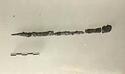
| Four fragments of a pin, apparently pointed at both ends.
(Only three found May 2002-tip missing) Geometric grave.
Found across left ankle of skeleton when it was cleaned. nestled in Ethafoam pad, 20% ... 13 March 1947 ... Hesperia 43 (1974), p. 359, pl. 76 d, no. ... ILN (12 November 1949), p. 748, fig. 6 ... Agora XXXVI, no. T18-21, p. 198, fig. 2.109. |
| Intact.
a) Flat-bottomed bowl-shaped pyxis; convex side wall, flanged inside to receive lid. Lid and flange pierced for fastening. On pyxis body, at bottom: three bands, zigzag, three bands. A wide band ... 2 March 1935 |
| A small buckle with a loop and a solid surface with two loops for attachment behind, and a tongue. Grave 10, by the heart. 80 Leica, XLIII-100, LVII-93, 83-321, 83-641 ... 2 May 1934 |
| Slightly chipped; otherwise intact.
A rectangular plaque with a neat round hole pierced through it at the center of one end. Undecorated. Stained with iron rust at the center of one side.
Yellow sandstone ... 13 March 1947 ... Hesperia 43 (1974), p. 359, Nr. I 18:1-22, pl. 76 d ... ILN (12 November 1949), p. 748, fig. 6 ... Agora XXXVI, no. T18-22, pp. 198-199, figs. 2.109, 2.114. |
| Intact save fragments of mouth missing. Round mouth; narrow neck; spherical body; flattened bottom; band handle. Undecorated.
Light buff clay, unglazed; handmade.
Cf. Hesperia 17 (1948), pl. 71:B6 ... 13 March 1947 ... Hesperia 43 (1974), p. 359, no. I 18:1-18 ... Hesperia 37 (1968), p. 87, noted under no. 5 ... Agora XXXVI, no. T18-18, p. 198, figs. 2.109, 2.113. |
| Whole jar put together of large fragments, part of side restored.
Cap. (Lang 1954) 21.710.
Red clay.
Stamped on neck; sphinx. Grf: =PIIC= (according to M.L.)*
Prof: PD 1454--64* Well; uniform Greek fill ... 4 April 1933 |
|
|