|
|
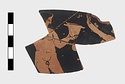
Five non-joining fragments c and d of lip and bowl, b and e of bowl, b of one handle, a of floor. Reserved line at rim. Glaze abraded on handle. Max. dim. a) 0.077, b) 0.092, c) 0.092, d) 0.08, e) 0.038; ... Ca. 450-440 B.C. |
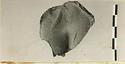
Wall fragment from the receptacle of a rhyton(?). Max. dim. 0.063.
Maenad (most of draped legs, hanging leg of her nebris), probably dancing to right. Above her right thigh at the break is a bit of reserve ... Probably early 5th century B.C ... During his visit to the Agora in the summer of 1953, Beazley suggested that 1673 is a fragment of a plastic vase, presumably a rhyton. The shape of the horn is that of a cow, but cow-head rhyta known to me are quite different and considerably later than 1673: Paris, Petit Palais 371 (ARV2 777, ---, 1) and New York, M.M.A. 06.1021.203 (ARV2 777, ---, 2; Paralip. 417, 2; H. Hoffmann, Attic Red-Figured Rhyta, Mainz 1962, pl. 13), both from the Cow-Head Group; Naples Stg. 62 by the Eretria Painter (ARV2 1251, 37; Lezzi-Hafter, Eretria-Maler, p. 348, cat. no. 258, pl. 170); Boston, M.F.A. 01.8105 (ARV2 1551, 11; Hoffmannn, pl. 19:1, 2); and Ruvo, Jatta 1116 (ARV2 1551, 12) from the Group of Class W to which Hoffmann assigns a third, Bayonne 118 (p. 42, cat. no. 112, pl. 22:1) but which Beazley (ARV2 1704) places near the Group. |
| Preserves part of back of nude (?) figure.
Broken all around.
Fine pink-buff clay.
ADDENDA 17/12/64: mold missing.
Cf. Hesperia 64 (1995), p. 460, n. 254. Area South of East-West late Roman Wall; dumped ... 11 March 1952 |
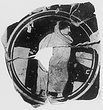
| Stemless cup with ring foot.
In the medallion, draped youth, right, facing basin. No contours.
Near the painter of London E 777. Well 2. 5th. c., 3rd. quarter? Leica ... Mid-5th. c. B.C. |
| a)Fragment from floor only. In the medallion, a long-sleeved figure to right, preserved from shoulder to thigh, its right side only. Relief contours. Around the medallion, a maeander broken by dotted checkerboard ... 7 June 1937 |
|
|