|
|
Half of wall and rim missing.
Flaring foot; flat, narrow resting surface; pointed underside.
Strongly flaring rim. Rouletting on floor. Very micaceous, reddish yellow fabric (5YR 6/6); shiny red glaze ... 150-125 ... Agora V, p. 14, under F 34 ... Thompson 1934, D 12, p. 371 |
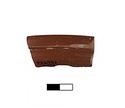
| Single rectangular rim sherd.
Low sloping wall, with rounded transition to bottom. Vertical jutting rim-band. Two mouldings (convex, above concave) on innerface, with small bead at lip; small offset at ... 1931 |
Most of handles missing.
Moulded foot, concave beneath, with reserved groove in resting surface. Scraped line at junction of two mouldings on lower part of foot. Shallow body. Decoration inside: seven ... 375-350 B.C. |
Others, contemporary P 8862 and P 8863 E 14:5; P 8862 Pots and Pans, fig. 36; J.H.S., LXXXII, 1962, pl. IV, 2, right ... Context ca. 520-490 B.C. |
| About half of the bottom of a small plain pot (jug?) on ring foot. Inside is a powdery purplish-brown substance; traces of the same on the floor of P 8938 (Χ 122).
Identified by E. Caley as hematite (26 ... 11 February 1937 |
Tiny chips of rim missing.
Flat resting surface; pointed underside. Convex wall with angle at top. Downturned rim. Thin, dull black-to-orange glaze on floor only.
Similar: P 20906 (Agora XXVII, no. 208, ... 200-175 ... Similar: P 20906 (Agora XXVII, no. 208, p. 194, ill. 41, pl. 49 [Q 8--9]), P 22860 (H--K 12--14). |
Intact.
Slightly concave underside with string marks. Steep, convex wall.
Pink fabric (7.5YR 7/4); thin, dull black glaze.
Other fairly well glazed saucers of Hellenistic date: P 19872--P 19875 (Young ... 350-300 |
Small chip missing from rim.
Flattened base, irregular underneath. Plump body. Shiny red glaze inside and out.
Cf. P 1453 (H--K 12--14), nearly a twin ... 250-175 |
|
|