|
|
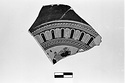
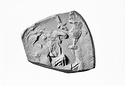
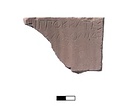
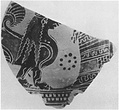
| Fragment from the interior medallion. The border consists of alternating tongues of black and red bound on both sides by concentric circles and alternating dot bands. Within is the head and left shoulder ... 16 June 1931 |
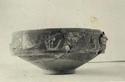
Intact.
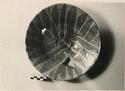
Slightly concave underside with string marks. Steep, convex wall.
Pink fabric (7.5YR 7/4); thin, dull black glaze.
Other fairly well glazed saucers of Hellenistic date: P 19872--P 19875 (Young ... 350-300 |
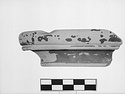
Flat bottom; low strap handle.
Two published pieces which belong to the middle years of the century are P 10819 G 12:22 Hesperia, Suppl. IV, 1940, p. 126, fig. 94 c and P 21872 N 7:3 Hesperia, XXII, 1953, ... Ca. 480 B.C. |
Scraped groove on top of foot. Graffito on floor and under foot: ΔΕ, ligatured.
There are many cups of this shape from the same deposit; of the following, several carry graffiti: P 5116 Hesperia, V, 1936, ... 470-460 B.C ... There are many cups of this shape from the same deposit; of the following, several carry graffiti: P 5116 Hesperia, V, 1936, p. 337, fig. 4; Bloesch, FAS, p. 139, 8; P 5118-9; P 5120 Hesperia, ibid., p. 353, fig. 22; P 5121, P 5123-5; P 5128 ibid., p. 347, fig. 16, 1; ARV 1611, 7; P 5129-30. From a con- temporary deposit, G 12:22, others also have the ΔΕ liga- tured: P 10813-6 Hesperia, Suppl. IV, 1940, p. 126, noted under a); P 10812 ibid., p. 127, fig. 94 a, is smaller and has no graffito.
|
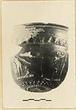
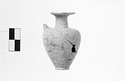
Globular body with well-rounded shoulder; high flaring ring foot; handle set on shoulder.
On some examples of the last quarter of the 6th century the shape is more ovoid; cf. the large inscribed hydria ... Context ca. 520-490 B.C. |
Flat projecting bottom rising to central tube. Spout nearly vertical. Groove under mouth. Reserved bottom. Glaze fired brown and black.
Contemporary, P 10818 G 12:22 Hesperia, Suppl. IV, 1940, p. 127, ... 475-450 B.C. |
Torus ring foot. Rim flat on top, sloping inwards, in- curving. Reserved: resting surface, underside with two glazed circles and central dot, and handle-panel.
Contemporary with this are P 21885-6 N 7:3 ... 475-450 B.C. |
Mended from four fragments.
Slightly convex underside with string marks. Straight wall, concave near bottom. Very micaceous, pink fabric (7.5YR 7/4); unglazed.
Similar: P 28572 and P 28573 (from same ... 325-275 |
Flat-topped rim; walls nearly vertical above, rounded below; spreading ring foot. A broad stripe of glaze crosses the rim at the points of the handle-attachments.
Type common in late archaic contexts; ... Context ca. 520-490 B.C. |
Flaring ring foot; high double handle. Glazed: the neck, a band below the handle-attachment, and on the top surface of the foot.
There are three published examples from deposits of the second quarter ... 480-450 B.C. |
| Low foot; inside, three deeply cut rings. Two horizontal handles, grooved. On rim, in white paint, pattern of alternating palmette and spirals.
Coarse buff-pink clay; matte paint, almost orange inside ... 9-17 June 1933 ... Agora V, no. K 22, p. 62, pl. 12 ... Agora XXXI, p. 153. |
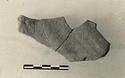
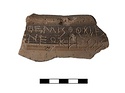
| From a coarse unglazed pot; mended from three pieces.
Incised outside:
Red (Attic) clay. Green sand fill in bottom of drain. 1776 Leica ... 9-10 June 1939 |
| Mended from two pieces; from an unglazed pot.
Incised inside, diagonally to the pot:
Soft brownish-pink clay with gray core. Green sand fill at bottom of drain. Leica DA 15268 ... 12 June 1939 |
Floor fragment with ring base. Band and two concentric circles with central dot on underside of floor. Scratches on surface. Diam. of base 0.087; max. dim. 0.095. H. A. Thompson, Hesperia 17, 1948, pp ... Probably last quarter of the 5th century B.C ... Raubitschek, Archaeology 1, 1948, p. 81, fig. 57; ILN, Nov. 12, 1949, p. 749, fig. 12; R. ... Rotroff, Birds of the Athenian Agora (Agora Picture Book 22), Princeton 1985, fig. 4; Agora XXV, p. 64, cat. no. 309, fig. 11.
... For the ostracism of Hyperbolos in either 417 or 416 B.C., see Agora XXV, p. 64 with bibliography. |
Hole in center of floor.
Ring foot. Flaring rim; two horizontal handles, curling upwards. Glazed as 74. The bowl has warped a little and is slightly oval.
Similar and contemporary are P 24176 Q 15:2; ... 425-400 B.C. |
Ring foot. A grooved spiral in the center of the underside. Glazed all over, except for resting surface, center of underside with glazed circle and dot, edge of rim on top and the junction of rim and floor ... Ca. 400 B.C. |
Ring foot, concave moulding beneath, incurving rim. De- coration inside: a circle of enclosed ovules, within palmettes. Glazed inside and out.
A similar pattern is found on the small bowl P 10979 B 15:1 ... Ca. 400 B.C. |
Tritoness And Eros.
Bottom, with part of lower wall.
Cup rests on broad ridge with slightly concave surface; pointed underside. Six grooves preserved on exterior. Emblem surrounded by two scraped grooves ... Ca. 200 ... Hausmann 1959, pl. 4 and, from the Agora, P 18932, P 21040, P 22127 (Agora XXII, nos. 181--183, pp. 65--66, pl. 33 [C 20:2, H--K 12--14]). For similar compositions in other wares, see Pagenstecher 1909, no. 39, p. 43, fig. 19; Jentel 1976, pp. 325--327, 338--340, 369, figs. 170, 174--178, 195, pls. LIII, LV, LX; Richter 1959, p. 244, figs. 26, 28, pls. 54, 55; Courby 1922, no. 22, p. 239, fig. 40 on p. 239 = Carapanos 1878, no. 5, p. 111, pl. |
| Several joining fragments give full profile.
On medallion, large head of Athena Parthenos facing; rope border; scraped groove across it.
Around medallion, double row of small leaves.
On wall, large standing ... 20 February 1953 |
| From the rim of a semi-glazed bowl. A glazed band below the rim inside; outside, a wide and a narrow band; cross stripes on the rim.
Incised below the rim outside: House L, room 5; early fill over bedrock ... 31 July-3 August 1947 |
| Mended from seven fragments; complete except for small piece missing from the side. Small ring foot; the bent-over rim forms a drip on the outside. Unglazed outside, with splotches of cream slip. Inside, ... 24 April 1935 |
| Mended from many fragments. Pieces missing from the rim. Ring foot; flaring wall with narrow vertical rim outside; broad concave rim inside.
Interior covered with yellowish glaze. Pit A. 1258 Leica, ... 24 April 1935 |
| Mended from six small fragments. Small pieces missing from side and from base. Low open bowl on ring foot. Interior and exterior of rim, covered with green glaze over white slip. Pit A. 1258 Leica, XXV-21 ... 24 April 1935 |
| About one-third remains. Low base ring; deeply profiled side.
Deep red glaze inside and out.
Cf. Agora XII, no. 819.
Cf. Agora XXXII, p. 1, n. 2. Square Building fill, area of Piers 21, 22. 3806 Leica, ... 3 June 1954 ... Deep red glaze inside and out.
Cf. Agora XII, no. 819.
Cf. Agora XXXII, p. 1, n. 2 ... Leica, 87-12-32(31) |
Rim and wall fragment. P.H. 0.052; est. diam. at rim 0.10.
Owl (feet missing). To left and right, part of an olive sprig. Dilute glaze: dots on face.
Johnson (AJA 59, 1955 [ pp. 119--124], p. 121) suggests ... Third quarter of the 5th century B.C. |
| Parts of both handles and considerable parts of floor and rim missing. Like P 24601 (ΣΑ 2811).
Circle and dot beneath.
Cf. Agora XII, no. 420. Well beneath Stoa gutter. 3780 Leica PD 2630-22 ... May-June 1954 |
Ring foot with two torus mouldings at the edge. Straight stem. Mouth flanged to receive a lid, the vertical projecting edge bevelled. The handles are double tubes, vertically pierced for string. Reserved: ... Ca. 500 B.C. |
| Broken through middle.
Sides and bottom smooth.
On top a roughly carved figure of sleeping Eros.
Pentelic marble. Circled marbles. Leica ... January 1954 ... Agora X, no. SW 22, p. 37, pl. 12. |
Platter With Upturned Rim.
About one-fourth of rim and part of floor preserved.
Low ring foot; flat resting surface. Ridge outside foot, possibly originally part of foot. Horizontal floor. Thick, upturned ... 1st-century context |
| From the lower side wall, with variegated ornament: kantharos, mask, tendril, and tip of pointed leaves below. Roman fill on bedrock; 6th.-7th. c. A.D. Leica, 99-22-10(11), 99-22-12 ... 18 April 1947 |
| From a coarse unglazed pot.
Incised inside, lengthwise to the pot:
Dull purplish-red clay with buff surface. Green sand fill in bottom of drain. 1776 Leica ... 9-10 June 1939 |
| Part of base and lower side wall preserved. Low base ring; flaring wall. Line of break indicates inset rim. Traces of stamp in center of floor: possibly rosette.
Glaze red to black.
Samian A. Well, 2nd ... March-April 1937 |
| Two joining fragments. Broken above, below and at one side, where skirt was held up by left hand.
Legs and skirt below knees.
Parian marble. Late fill area of house 650 B/9 ... Last quarter of 6th c. B.C. |
Torus ring foot; bell handle, glazed outside. Rim flat on top, projecting outwards, reserved. Inside, reserved central disc with three glazed circles and dot; outside, glazed band, outer and inner faces ... 520-500 B.C. |
Torus rim, high flaring ring foot, arched rolled handles from neck. Streaky brownish glaze on rim, body and upper part of foot; neck and handles unglazed. Graffito on shoulder, a symbol "like an elongated ... Context ca. 600 B.C. |
| Eight joining fragments, preserving most of vessel except for handle and part of rim. Paint very worn. Ovoid early Protocorinthian aryballos. Lower part decorated with three broad bands in black glaze; ... 19 June 1997 |
Mended and complete. Glaze abraded on one handle. H. 0.065; diam. at rim 0.19; diam. of tondo 0.106; diam. of foot 0.08. Themelis, Agora: Guide, fig. opp. p. 62; M. Lang, Socrates in the Agora (Agora Picture ... Ca. 500 B.C. |
Most of flaring wall on one side, part of cul, all of one handle, and start of the other. Glaze misfired brownish on outside; considerable abrasion. P.H. 0.075; diam. at rim 0.109. C. Boulter, Hesperia ... Ca. 450 B.C. |
| Fragment of a closed pot.
Forequarters and lower part of head of Sphinx to right, facing toward a human figure of which only the lower part, draped to the ground in an elaborately embroidered garment, ... 6 March 1936 ... ABV, p. 22, no. 12 ... Agora XXIII, no. 1859, pl. 119. |
Spreading ring foot with torus edge and a fillet between wall and foot; low strap handle, upper attachment at rim. Lip inset and slightly concave. Reserved: torus edge of foot, resting surface and underside ... 500-480 B.C. |
|
|