|
|
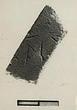
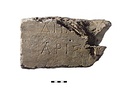
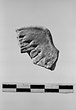
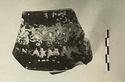
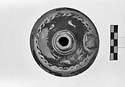
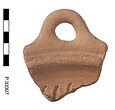
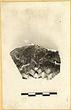
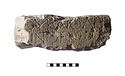
Left to right. Γάες
If this is a genitive of Gaia, as Blegen suggested, it is surprising. Ge and its forms are normal in Attic epigraphy, while Gaia is poetic. Votive dump. Γάες |
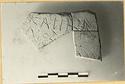
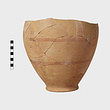
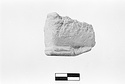
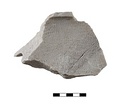
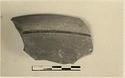
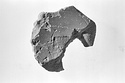
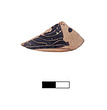
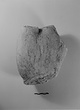
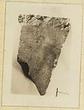
| Joins P 17950. Small wall fragment of plain pot.
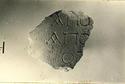
Inscribed outside. Red gravelly fill under wall B, ostrakon fill. 8330 Leica ... 20 October 1949 ... Agora XXV, no. 370, pp. 15, 71. |
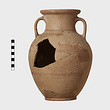
| From the wall of a large plain amphora?
Incised outside:
Pale greenish buff clay.
Joins P 20412. Red gravelly fill with kalikia. 4976 Leica ... 10 June 1947 ... Agora XXV, no. 370, pp. 15, 71. |
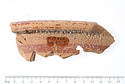
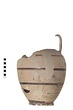
| Mended from many small fragments. Rim piece of a semi-glazed krater, badly broken.
Incised inside:
Red glaze inside, on rim, and for band outside. Finished Red gravelly ostrakon fill under ΝΘ-Ξ wall ... 13 June 1947 ... Agora XXV, no. 372, pp. 15, 71. |
Base preserved.
Graffito on bottom. Complete after purchase.
Clay: fine buff; black glaze. Assembly Place - filling of Period III. Σατύρο(υ) ... 1932 |
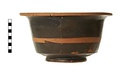
Ring foot. A sharp angle at junction of floor and wall. Broad projecting rim, flat on top and with a vertical outer face. Reserved: the resting surface, a zone around the wall. the top and the vertical ... Ca. 450 B.C. |
| The writing end broken away; the eraser end slightly curved. Rectangular rockcut shaft (no. 435). Leica, XXIV-47 ... August-September 1932 |
Handles, foot, stem, and three-quarters of upper bodymissing.
Thin stem. Pointed lower body with scraped groove below handle attachment. Two antithetical dolphins preserved (probably originally four), ... 290-275 |
One-fourth of upper wall missing.
Scraped groove in resting surface; concave underside. Tapering stem. Scraped groove at junction of body and stem and below handle attachment. Lip very thin, as in cup-kantharos ... 290-275 |
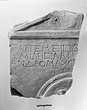
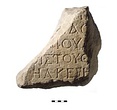
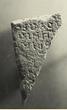
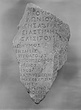
| Inscribed fragment.
Upper left portion of a grave stele.
Part of pedimental top, circular medallion at center, and round picked back preserved.
Remains of iron dowel in left side.
Four lines of the inscription ... 28 January 1938 |
| Inscribed fragment.
Inscribed face only preserved.
Five lines of the inscription preserved.
Pentelic marble. Found in the wall of the modern house 638/21, over the east end of the South Stoa II. Leica ... 20 December 1935 |
Vertical section of handle and over half of body, foot, and underside restored.
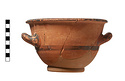
Low, flaring foot; flat resting surface; well-formed, slightly convex underside. Lower body very high and nearly straight ... Context of 150-110 |
Flat underside, reserved. Graffito on underside: Δ.
In the latest stages of the shape, the bowls are dipped, e.g. P 10572 B 15:1 Hesperia, XVIII, 1949, pl. 93, 71; P 786 I-J 18:1 and P 17889 N 21:9 ... 430-410 B.C. |
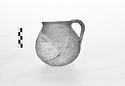
| Mouth and handles broken off and a hole in the shoulder. Flaring ring foot.
Painted on the shoulder in black:
Red clay with grits, unglazed. Smeared inside with a black coating (resin?). Well. Leica, ... 27 April 1936 ... Agora XXI, no. Hc 15, p. 71, pl. 39. |
| Obverse : standing Hermes, with money bags and caduceus.
Reverse : standing Serapis, partly draped, right arm outstretched.
Cf. IL 211 for type. Cistern A. in zip lock bag in conservation
with gloves ... 23 May 1935 |
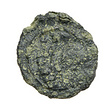
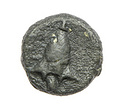
| Obverse: helmet.
Reverse: plain. House A, room 2: upper brownish fill. Leica ... 28 March 1939 |
| Inscribed fragment.
The left side preserved; otherwise broken.
The start of two lines of the inscription preserved.
Hymettian marble. Found in the wall of the modern house 638/12, over the central part ... 6 December 1935 |
One handle and part of the other, half of rim and body, and all of foot restored.
Molded rim. Vestigial masks at base of handles. Neck: ivy garland running right. Main stem white and undulating; large ... 120-110 |
Half of upper body and parts of handles and lower body restored.
Scraped groove in resting surface; concave underside. Small, delicate foot with high, thin stem. Pointed lower body with scraped groove ... 285-275 |
| Mended from many pieces and preserved to level of greatest diameter. Ring foot. Wide glazed bands on foot and around body at intervals.
Pinkish-buff clay. Finished Well, early Geometric. 6987 Leica, ... 25 October-3 November 1947 |
| Fragments of body missing, retored in plaster. Ring foot, short neck, convex lip; handles from below lip to upper part of shoulder. Decorated with plain glazed bands, one around foot, two around body, ... 22 June 1935 |
| Fragmentary: the neck, one handle, part of the other and large parts of the body missing. Decorated with plain glazed bands: one around the foot and three around the body; a large loop on the preserved ... 22 June 1935 |
| Tip broken away.
Solid; thin bone accented; modelled feathers.
Blond clay. Under hypocaust of Roman Bath; container B 821. Herakles Deposit. 7982 Leica, 77-10-12, 93-7-20 ... 1961 |
| A spiral band bracelet.
Badly broken and almost entirely corroded.
One end preserved, finished with a knob and a small projection.
Inner face of band plain, outer ornamented with a broad ridge along the ... October 1954 |
Foot and part of lower body preserved.
Flaring, molded foot with raised edge; broad, beveled resting surface.
Short, thick stem. Medallion visible underneath: very worn gorgoneion surrounded by calyx ... 200-175 |
| Inscribed fragment of columnar monument.
Broken all around.
Part of columnar surface and of three lines of the inscription preserved.
Pentelic marble. Found in late wall, north of the church of the Holy ... 11 March 1952 |
| Small fragment missing from one side.
Cut from hard breccia. From deep stony fill in middle of peristyle of Heliaia. 3471 Leica, 83-91 ... 3 August 1960 |
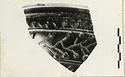
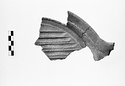
| Rim and wall fragment.
Three zones: above, alternating dolphins(?) and shellfish(?); middle, large vine pattern; below, leaf(?).
Pinkish-buff clay; black glaze. A similar piece in lot T 158. "From various ... 1933 |
| Broad flat bottom and convex inward tilted side wall.
Good black glaze, except on bottom.
Cf. Agora XII, no. 898. Well. Leica ... 29 May 1937 |
| Intact except for cracks and some nicks on rim. Tall, flat-bottomed mug with angular lower body and vertical upper wall. Plain lip slightly out-turned. Band handle rising from rim. Lower wall glazed solid; ... October 1954 |
| Intact. Small flat-bottomed one-handled cup; rim flares slightly. Band handle from rim.
Poor brownish-black glaze on lower wall outside, on inside, and for bands on inner and outer edge of rim, also for ... October 1954 |
| Chip from rim broken off and repaired and lower part of handle missing; otherwise intact. Restored in plaster. Flat-bottomed one-handled cup with plain vertical lip.
Glaze and decoration as P 24299 (ΚΤΛ ... October 1954 |
| Fragment of lower right corner of a bracket like A 678 ( Ι 907), from the same mold. Clay is the same, but fired pinker. Great Drain. Leica ... May-June 1936 |
| Fragment from a columnar grave monument.
Broken all round.
Parts of two lines of the inscription preserved.
Pentelic marble.
ADDENDA This object was later entered and numbered again, as I 3899 (ΚΤΛ 32), ... 1st. century A.D ... Hesperia 15 (1946), p. 231, no. 62 ... Agora XVII, no. 256, p. 71. |
| Part of the body preserved; four small non-joining pieces (the lower left corner of the panel; part of its left edge; a bit of the lower border; and a wall fragment). Panel bordered above by tongues, around ... June 1937 |
| Small fragment missing from one side.
Cut from hard breccia.
Cf. ST 702. From deep stony fill in middle of peristyle of Heliaia. 3471 Leica, 83-91 ... 3 August 1960 |
| Broken off at the waist.
Woman wearing chiton and short himation tighly wrapped around upper body and held at left side.
Traces of white color. Agora sample no. 412. NEUT. ACT. ANAL. , Brookhaven , May ... April 1938 |
| Much missing; restored in plaster on the analogy of P 2870. Round-bottomed squat bowl with short upstanding rim.
Very thin fabric of pinkish buff clay with dull black glaze inside; two brown glaze bands ... 22 May-6 June 1935 |
| Mended from three pieces. Part of wall and bottom. Tongues, nicely rounded, on wall. Groove around medallion.
Dull glaze, worn.
Cf. P 22858. Middle Stoa, building fill, disturbed. Container 71. (In ... 15 March 1933 |
| Two animals in moderately high relief, on a heavy plaque.
Above, left, a spotted dog (?); below, a bird, eagle (?).
Late Roman.
ADDENDA: Part of scene: person with snakes, animals in field, Mithraic ... 7 February 1936 |
Foot and handles restored.
Scraped groove below handle attachments. Delicate molded rim.
Three dolphins (antithetical pair at right, one leaping right at left) over pattern of alternating hoops and ... 290-280 |
| Fragment from the rim and wall of a straight-walled kantharos ornamented with an elaborate wreath in thinned clay paint and white.
Incised inscription beneath (some letters much worn by action of sand ... 22 July 1947 |
| Neck and handle missing. Ring-handled lagynos on heavy base. Angular body; ridge at base of neck. On upper wall, white and yellow wave pattern with leaping dolphins above.
Glaze considerably worn. Back ... 10 May 1954 |
| High block base with careful mouldings top and bottom. Much rubbed.
Blond-tan clay. Under hypocaust of Roman Bath; container B 821. 7984 Leica, 79-15-23, 79-17-7 ... 1961 |
| Rim, save at handle attachment, and much of wall missing; restored in plaster. Small, round-bodied, with narrow very slightly flaring rim; band handle, rim to shoulder.
Gritty light red clay, remains ... June 1937
June 1938 |
| Three joining fragments preserve some of rim and floor and one handle-stub, rising from rim. An open dish; rim fitted for lid; rough parallel grooves in floor.
Gritty brownish to gray clay. Cistern, upper ... 9 May 1939 |
| Preserved in three joining fragments is the upper right hand corner, except the top, the face entire and the whole lower part.
The head, with hair parted and waved, crowned with a diadem and bunches of ... May-June 1936 |
| Small roughly rectangular weight.
Incuse depression on either side. Kalikia under modern wall. Leica ... 12 April 1939 |
| Roughly circular clay chipped disk "counter" fashioned from a large thick-walled open vessel. Painted black on interior, black to reddish-brown on exterior. Interior painted solid; three thin bands above ... 10-24 July 1996 |
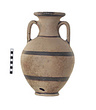
| The rim missing; restored in plaster. Low vertical ring foot and fat ovoid body; vertical handles decorated with St. Andrew's crosses. Unglazed, except for band on foot, half way to shoulder, below shoulder, ... July 1946 |
| One handle and small part of rim, wall, and floor of pan. Flat underside. Straight spreading wall. Deeply grooved rim. Horizontal handle attached to rim. Deeply grooved floor (ends of four grooves preserved) ... July-August 1961 |
| Fragment from volute only. Characteristic off-white marble and tooth-chisel surface texture.
Temple of Athena at Sounion series. From disturbed area, east end of Middle Stoa. Leica ... 26 August 1965 |
| Flaring foot. Elongated petals with jewels between.
Attic clay; good black glaze. Well 9. Leica, 90-34-29 PD 901-71 ... April-May 1935 |
| A piece missing from rim. Flat base; body high and narrow, with high shoulder; horizontal ridges; high nearly vertical rim with plain lip.
Gritty pinkish-buff clay, somewhat micaceous; unglazed and blackened ... May-June 1936 |
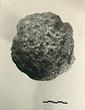
| Flake broken from side of ball.
Cut from hard breccia.
ADDENDA Balls found in Pompeion measure 0.14-0.35m.
Cf. AM 56 (1931), p. 4. From deep stony fill in middle of peristyle of Heliaia. 3471 Leica, 83-91 ... 3 August 1960 |
Bolster Krater: Pergamene.
Rim fragment.
Projecting rim, strongly convex on top. Top surface has pair of scraped grooves at either edge. At left, dolphin leaping right, with incised outline filled in ... Context of 250-175 |
Dionysos.
Half of foot of cup, with face and part of hair of emblem.
Very shallow cup rests on ridge surrounded by scraped groove.
Four grooves preserved on exterior. Head of Dionysos turned to viewer's ... Ca. 240? |
| About half preserved, but fragmentary and with many non-joining pieces.
Large open mouth with plain lip. Flat vertical handle. Rounded bottom; no base.
Dark red clay, mostly fired dark gray; gritty and ... 4 May 1934 |
| Apparently shaped by hand from thin sheet of clay with flat center, followed by dimples (two preserved) and then by broad undulating flutings (three preserved) as it rises into wall of vase. Possibly from ... February 1989 |
| Part of bottom with a high, nearly straight sided foot-ring, and a nearly flat floor.
Pale greenish glass. Agora sample: no. 284. Great Drain.
From the dumped filling in a collecting basin and drain, near ... May-June 1936 |
| Half of base and adjoining floor preserved. Ring foot. Grooved circle on interior. Bit of stamp at edge of break; nothing legible.
Buff clay. Red glaze. Cistern, middle fill. 1940-1944 Leica, 96-71-14(15) ... 9-15 May 1935 |
| Fragment of rim and upper wall. Wall, from left to right: wing and tail of bird flying left; Eros flying right; signature: retrograde, running from bottom to top; right arm and wing of frontal Nike, with ... 15 April 1953 |
| Broken to left and right. Part of via and mutule with hawk's beak molding preserved. No mason's marks. No traces of color.
From Square Peristyle.
Poros. From wall, S.W. corner of Byzantine Room E 1. Leica ... 24 April 1950 |
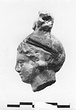
| Head with elaborate crescent-shaped top-knot in front of which part if a fillet is preserved.
Traces of white paint and of red on hair.
Grayish clay. Cistern, finial filling.
25-1 B.C. Leica, V-15, 7-137 ... 10 February 1937 |
| Part of plain rounded rim preserved; otherwise broken.
Interior, good dull red glaze. On top of rim, black line. On outside of rim, broad band (of white?), then a narrow black line, then dull red glaze ... 3 April 1937 |
| Three joining and one non-joining fragment from rim and discus.
Wreath of buds and flowers on shoulder; underneath, "alpha".
Grayish wash, worn.
Type XIX of Corinth collection, type 54D of Agora collection ... 15 April 1937 ... Type XIX of Corinth collection, type 54D of Agora collection ... Leica, LIX-71, LXIX-44, 96-67-15, 96-67-16 |
| One handle missing; much of rim chipped away. Vertical rim with flange for lid. Horizontal handles, vertically turned.
Coarse brown ware, gritty and micaceous. Cistern, lower mixed earth, strosis 3 ... 11 June 1963 |
| Fragments are missing from the side wall and bottom. Restored in plaster. Bulging bottom; almost vertical side wall; broad flaring rim with a slight ridge around its inner edge to hold the lid. No trace ... 3-12 March 1934 |
Body fragment with start of neck, all of ring base. P.H. 0.085; P. diam. 0.075.
A woman dressed in a chiton and himation sits to right on a klismos, juggling two balls(?). In front of her, the right hand ... Ca. 420-400 B.C. |
| Wall fragment from closed pot; broken all around.
At left, set of dotted diamonds. In center, swastika. Top and right, underside of animal(?).
Clay pinkish-buff, micaceous. Scraping bedrock. Box 15 ... July 1956 |
| From the bottom of a small Samian B bowl with part of the foot preserved.
The stamp:
Red glaze inside and out. Leica, 93-30-15 PD 1171-181, PD 1172-6 ... 26 April 1934 |
| Inscribed fragment.
Right side preserved; otherwise broken.
Three lines of the inscription preserved, and a trace of a fourth below.
Pentelic marble.
ADDENDA This fragment joins on to I 3871b, above ... 18 April 1936 ... Hesperia Suppl. 15 (1975), p. 71, pl. 31 ... Agora XVI, no. 326, p. 326. |
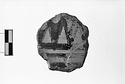
| Single wall fragment, broken all around.
Preserves draped male reclining on elbow on mattress with pillow. Branch with blob-fruit in field. Trace of groundline below mattress. Added red: stripes on garment, ... 3-8 August 1994 |
| Intact except for three small holes in lower body. Glaze worn. Flaring ring foot, ovoid body, thickened projecting rim slightly concave on interior. Tall narrow neck. Five broad painted bands: one at top ... 18 July 1997 |
| Head and feet missing.
Long pointed feathers folded over tail.
Pinkish clay. Under hypocaust of Roman Bath; container B 821. 7982 Leica, 80-78-11 ... 1961 |
| Back missing and legs. Head chipped.
Yellowish paint. Blond clay. Under hypocaust of Roman Bath; container B 821. Leica, 80-78-6 ... 1961 |
| Intact. Flat bottom, slightly out-turned lip; band handle from lip. Streaky thin black glaze inside and out; bottom unglazed; rim reserved inside and at edge outside, banded inside. Bands also on handle ... 1 July 1952 |
| Three non-joining fragments of rim and wall. Surface very worn, white ground nearly gone on fragments b) and c).
Concave, black glazed rim. On body, white ground with black glazed verticals, probably lotus-buds ... 3-8 August 1994 |
| The lower part and the whole handle preserved, also a very small segment of the rim (not above the handle). Accessory red for alternate tongues of pattern around top, for two narrow bands below this and ... June 1932 |
| Handle missing; filling hole and nozzle chipped.
Imbricated leaves on shoulder; ridge around flat top.
Signed in relief.
Remains of red to black glaze wash.
Crumbly gray clay.
Type XVIII of Corinth collection, ... 15 April 1937 ... Type XVIII of Corinth collection, type 49B of Agora collection.
... Leica, LIX-71, LXIX-36, 96-67-15, 96-67-16 |
| Half of the side wall and a little of the bottom remains. Restored in plaster. Slightly bulging bottom; high side wall sloping outward; the rim is plain outside - on the inside it has a narrow ledge to ... 3-12 March 1934 |
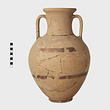
| Parts are missing from the side wall and handle. The body is high, the shoulder almost right-angled. Neck short, mouth flaring; strap handle with double grooves. A band of black paint around root of neck; ... 3-12 March 1934 |
| Lip offset; vertical ring handle broken off. Lion spout. Well, in north cistern arm. Group E. Leica, 90-35-4, 4-335 ... 5 March 1934 |
| Part of right hand of colossal figure holding staff or stick.
Perhaps slightly greater in scale than other hands of giants, but very similar in material and workmanship.
Pentelic marble.
Cf. S 596 (Ν' ... August 1946 |
| Fragment of inscribed column drum.
Broken all round.
Parts of eighteen and possibly nineteen lines of the inscription preserved, the first five or six larger than the rest.
Pentelic marble. Found in late ... Late 2nd. century A.D ... Hesperia 15 (1946), p. 238, no. 71 ... Agora XV, no. 419, p. 299. |
| Fragment from left side of inscription.
Front and left surfaces preserved.
Pentelic marble. Found in the wall of a modern house, in the southeast corner of the Market Square. Leica ... 180-190 A.D ... Hesperia 15 (1946), p. 238, no. 71 ... Agora XV, no. 409, p. 293. |
| Profile preserved from lip to lower wall.
Double upper zone: above, row of horizontal spirals and upright leaves; below egg and dart; line of beading between the two zones. Wall: to left, a nude bearded ... (1935) |
| Mended from many fragments. Small pieces yet missing from bottom and sides. Ring base. Reserved: edge of bottom and resting surface of foot, ring around exterior, edges of lip (outer and upper). Good black ... 4 April 1933 |
| Mended from many fragments. Most of foot and lower part of sides missing. Flaring lip, rounded on top and projecting, handles curving upward and set lower than in P 2353 and P 2354. Ring foot, vertical ... 4 April 1933 |
| Wall fragment, broken all around. Calyx of leaves below. On wall, a sphinx to left; behind it another creature to right with someone standing on its back.
Firm black glaze. Stoa annex, N.E. corner, removal ... 15 June 1936 |
| Rim fragment. Rosettes and leaves and egg pattern. No disturbance noted in pottery notebook but above disturbed layer 72 and with long petal bowl frag. (P 21048). Middle Stoa, building fill, disturbed ... 15 March 1933 |
| Preserved: a bit of the base of the neck, gently curving.
Graffito.
Light red clay, with mica. Catalogued December 1958. Well to north of Nymphaion. Container 83. Leica ... April 1954 |
| Mended. Neck, most of shoulder and side missing.
Delicate fabric, small flaring ring toe. Decoration in narrow horizontal bands.
Grayish-buff micaceous clay.
Fragments of one similar in tray. Previously ... May-June 1954 |
| Much of wall and rim missing. Restored in plaster. On bottom, rosette; then imbricated leaves; above, Nikes and Erotes flying over kraters; then guilloche.
Glaze worn. Cistern, north passage, found with ... 12 April 1937 |
| Inscribed fragments of columnar monument.
Dedication. Honoring Marcus Terentius Varro Lucullus as Proconsul (ανθυπατος), presumably refering to his command in Macedonia.
Fragments Τ 70, Τ 75, Τ 86, Τ ... 72-71 B.C. |
| Fragment from an inscribed base (?).
Broken all round; the rough picked top appears not to be original.
Dedication.
Parts of two lines of the inscription preserved.
Hymettian marble. Found in the wall ... 10 February 1933 ... Hesperia 15 (1946), p. 234, no. 65 ... Hesperia 3 (1934), p. 71, no. 67 ... Agora XVIII, no. H434 a, pl. 42. |
| Small fragment preserving part of face of cornice and three guttae; broken at sides; top and back.
Hard white poros; bright blue paint on underside of mutule.
From Square Peristyle.
Same as A 1926, A 1946, ... 20 February 1953 |
| Inscribed fragment.
Broken below and at right side; top moulding mostly chipped away.
Upper left corner of large stele; smooth dressed left side and back, rough picked on top.
First decree complete; Archonship ... 285/4 B.C ... Hesperia 9 (1940), p. 84, no. 15 ... Agora III, no. 428, p. 136 ... Agora XV, no. 71, p. 81. |
| Apparently from a life size satyr mask.
The fragment preserves a bit of the upper right side of the brow, with a small horn, behind which is a leaf, and short curling locks of hair. A bit of the finished ... 24 June 1933 |
| Fragment of inscribed stele.
Pedimental stele, part of right side preserved with part of right gable and its top and back. Surface badly chipped, and rubbed.
Four lines of the inscription preserved.
Hymettian ... 13 December 1935 |
|
|